Explore our curated collection of science & nature book reviews and recommendations.
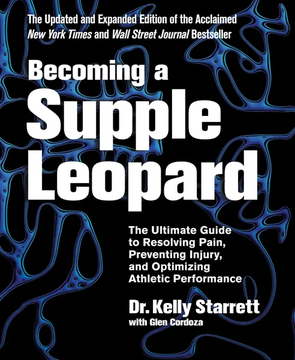
Becoming a Supple Leopard is a densely practical reference guide by Kelly Starrett, Doctor of Physical Therapy and CrossFit coach, co-written with Glen Cordoza, presenting a systematic movement and mobility system designed to resolve pain, prevent injury, and optimize athletic performance across a wide range of athletes and practitioners.
Feb 10, 2026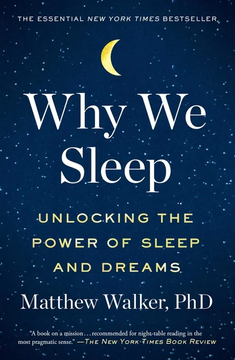
Why We Sleep is a New York Times and Sunday Times bestselling popular science book by Matthew Walker, a professor of neuroscience and psychology and director of the Center for Human Sleep Science at the University of California, Berkeley. Originally published in 2017 and reissued by Scribner in 2018, the book makes a sweeping case for sleep as one of the most consequential forces governing human health, cognition, and longevity — drawing on roughly two decades of research by Walker and his team. It earned broadly positive reviews from mainstream critics and a wide general readership, while also attracting pointed pushback from academic peers for overreach and alarmism.
Feb 16, 2026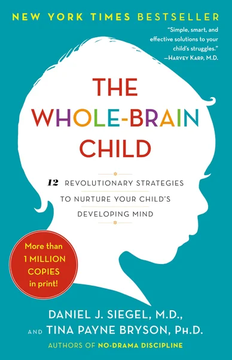
A New York Times bestseller with more than one million copies in print, The Whole-Brain Child translates neuroscience into twelve concrete strategies designed to help parents navigate meltdowns, fears, and frustrations while supporting healthy emotional and intellectual development in their children.
Feb 11, 2026
Jonathan Haidt's The Righteous Mind: Why Good People Are Divided by Politics and Religion is a social psychology book, originally published in 2012 and reissued by Vintage in 2013, that argues human morality is driven primarily by intuition rather than reason — and that this fundamental fact explains the chasm between liberals, conservatives, and libertarians in modern political life. Structured across three distinct arguments, the book introduces Haidt's moral foundations theory, mapping six dimensions of moral judgment — care/harm, fairness/cheating, loyalty/betrayal, authority/subversion, sanctity/degradation, and liberty/oppression — to show why different political tribes speak what amount to different moral languages. It is a challenging, research-grounded work that draws both strong admiration and pointed critique, and remains one of the most discussed social psychology books of the past decade.
Feb 17, 2026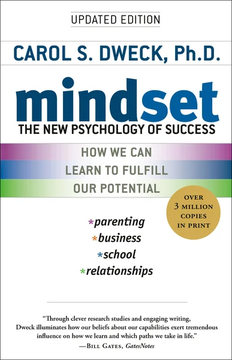
Carol S. Dweck's Mindset: The New Psychology of Success is a landmark work of popular psychology from a Stanford University researcher that has sold over a million copies, introducing a generation of readers to the distinction between fixed and growth mindsets and arguing that how people think about their abilities shapes nearly every domain of their lives — from school and work to sports, leadership, and relationships.
Feb 12, 2026
Eric Ries's business book The Lean Startup introduced a framework — built on rapid prototyping, validated learning, and iterative product releases — that has since sold over one million copies, been translated into more than thirty languages, and become required reading in entrepreneurship programs worldwide. This review covers the book's content and published reception; as a functional methodology guide, its real-world effectiveness is best evaluated through direct application.
Feb 12, 2026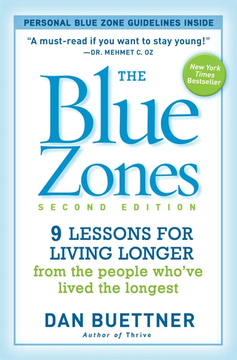
Dan Buettner's The Blue Zones distills field research from the world's longest-lived communities into nine actionable lessons, making a compelling case that a longer, healthier life is built less from genetics than from the right daily habits and community structures — a premise that has fueled both a publishing phenomenon and a real-world public health movement.
Feb 11, 2026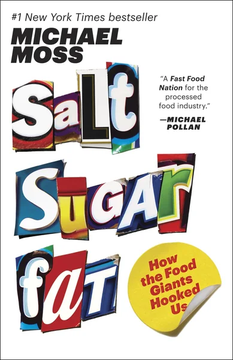
Michael Moss's Salt Sugar Fat: How the Food Giants Hooked Us is a rigorously reported investigative nonfiction book — a #1 New York Times bestseller and James Beard Foundation Award winner for Writing and Literature — that dismantles the processed food industry's deliberate engineering of hyper-palatable products, tracing how Kraft, Frito-Lay, Nestlé, Coca-Cola, and others have spent decades manipulating salt, sugar, and fat to override human appetite at a calculated "bliss point."
Feb 11, 2026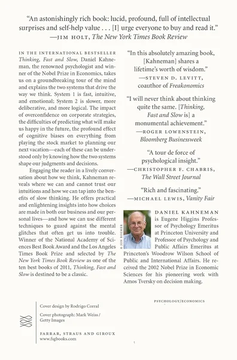
Thinking, Fast and Slow is Daniel Kahneman's landmark popular science book presenting his decades of research on human judgment and decision-making through the lens of two cognitive systems — with more than 2.6 million copies sold and recognition as a New York Times bestseller, it is one of the most influential works of behavioral science written for a general audience, though some of the priming studies it cites have since come under scrutiny during the psychological replication crisis.
Feb 11, 2026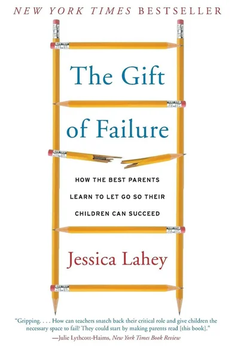
Jessica Lahey's The Gift of Failure makes a research-backed, practically structured case that over-protective parenting undermines children's capacity for self-reliance — and offers targeted, concrete guidance for parents and educators who want to change course.
Feb 10, 2026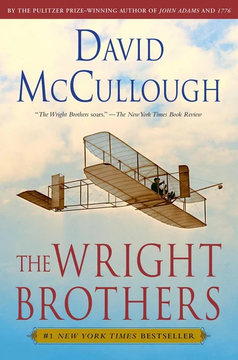
David McCullough's The Wright Brothers is a narrative non-fiction account of Orville and Wilbur Wright — the bicycle mechanics from Dayton, Ohio, who changed history on a winter day in 1903 at the Outer Banks of North Carolina — written by a two-time Pulitzer Prize winner and praised by major literary critics, though some reviewers note that the book's admiring portrait of its subjects leaves certain dimensions of their inner lives unexplored.
Feb 11, 2026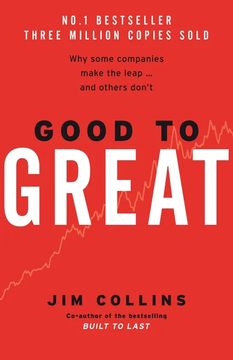
Published on October 16, 2001, Jim Collins' Good to Great: Why Some Companies Make the Leap... And Others Don't is a research-driven management book that sold four million copies and crossed well beyond the traditional business-book audience — a genuine phenomenon that also accumulated a substantial body of serious criticism over the two decades since its release.
Feb 11, 2026Search
Rating
Active Filters
Search
Rating
Active Filters
Showing 109 - 120 of 122 reviews
