

8 min read
4.6
· 11,973 Amazon ratingsShare This Review

The Righteous Mind by Jonathan Haidt Review: A Provocative Map of Moral Division
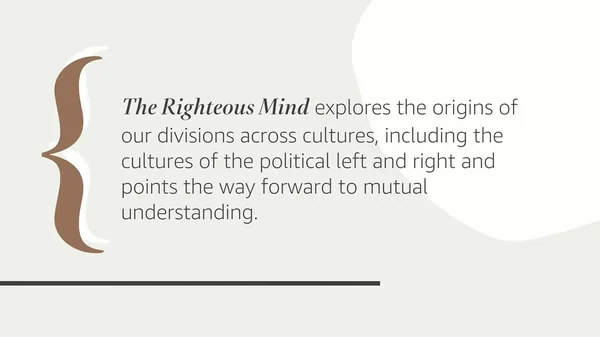
Jonathan Haidt's The Righteous Mind: Why Good People Are Divided by Politics and Religion is a social psychology book, originally published in 2012 and reissued by Vintage in 2013, that argues human morality is driven primarily by intuition rather than reason — and that this fundamental fact explains the chasm between liberals, conservatives, and libertarians in modern political life. Structured across three distinct arguments, the book introduces Haidt's moral foundations theory, mapping six dimensions of moral judgment — care/harm, fairness/cheating, loyalty/betrayal, authority/subversion, sanctity/degradation, and liberty/oppression — to show why different political tribes speak what amount to different moral languages. It is a challenging, research-grounded work that draws both strong admiration and pointed critique, and remains one of the most discussed social psychology books of the past decade.
 Tap to enlarge
LuvemBooks Verdict
Best for
Readers genuinely curious about why political and religious opponents believe what they do — particularly those with an interest in social psychology, moral philosophy, or political science who want a rigorously argued, research-backed explanation rather than a polemic.
Worth it if
Worth engaging with if you're prepared to have your own moral intuitions examined as critically as everyone else's, and if you want a systematic framework — the six-foundation model — for understanding why liberals, conservatives, and libertarians talk past each other.
Skip if
Skip it if you're primarily looking for validation of your existing political tribe, if you need a framework that travels easily beyond the U.S. political context, or if the book's more speculative third section on evolutionary "groupishness" is likely to frustrate you after the tighter empirical grounding of the first two.
What readers & critics say
The Guardian acknowledged that Haidt "has a point" on the core insight that people shape evidence to fit pre-existing convictions, but raised a substantive objection that his claims about conservative electoral success are undermined by counter-examples (notably Obama's victories), weakening his prescriptive conclusions for liberal politics. The LSE Review of Books found a key strength in the way Haidt takes readers through his own journey of moralistic discovery, showing how his assumptions could be challenged and knocked down.
“His conclusions may make unsettling reading for those of a liberal persuasion — republicans and conservatives win by appealing to a greater range of moral impulses.”
— The GuardianAge & Reading Level
Recommended age
Adult
Reading level
Adult
who it suits
Skip if you're looking for a politically validating read that affirms your existing beliefs rather than scrutinising them.
In This Review
- What Works & What Doesn't
- What the Book Actually Argues
- Significance and Place in the Field
- Where the Book Is Strongest
- Genuine Limitations and Points of Contention
- Who This Book Is For
What Works & What Doesn't
What Works
- Introduces a six-foundation model of morality (care/harm, fairness/cheating, loyalty/betrayal, authority/subversion, sanctity/degradation, liberty/oppression) grounded in cross-sectional psychological research
- Applies moral foundations theory concretely to U.S. Liberals, conservatives, and libertarians, making abstract psychology politically legible
- Social intuitionism argument — that reason largely justifies intuition rather than generating it — is backed by engagement with major thinkers from Hume and E. O. Wilson to Kohlberg
- Generated scholarly responses across multiple peer-reviewed journals, reflecting reach beyond the popular-science market
- Designed to foster cross-partisan understanding rather than score points for either side, giving it unusual intellectual evenhandedness
What Doesn't
- The Guardian raised the pointed objection that Haidt's claims about conservative electoral advantage don't account for prominent counter-examples, weakening the prescriptive conclusions he draws for liberal politics
- The book's focus is primarily on the U.S. Political context, which limits how directly its framework maps onto other political systems
- The third section's evolutionary account of human 'groupishness' is a more speculative extension of the earlier, more tightly sourced research
- Haidt's own political evolution during the writing process, noted by The Guardian, invites scrutiny of whether the framework fully escapes the intuition-driven reasoning it critiques in others
What the Book Actually Argues
Significance and Place in the Field
Where the Book Is Strongest
Genuine Limitations and Points of Contention
Who This Book Is For
Frequently Asked Questions
Sources & Further Reading
The key facts and claims in this review are grounded in the retrieved, verified sources listed below.
- Cited in this review
- 1
- 2
en.wikipedia.org
- Further reading
- 3
Jonathan Haidt, Wikipedia
- 4
- 5
- 6
richardblackaby.com
- 7
- 8
- 9
braverangels.org
Related Reviews
Reviews of books we picked for readers who enjoyed The Righteous Mind.


Reader Comments
No comments yet
Be the first to share your thoughts!