
7 min read
4.5
· 21,368 Amazon ratingsShare This Review
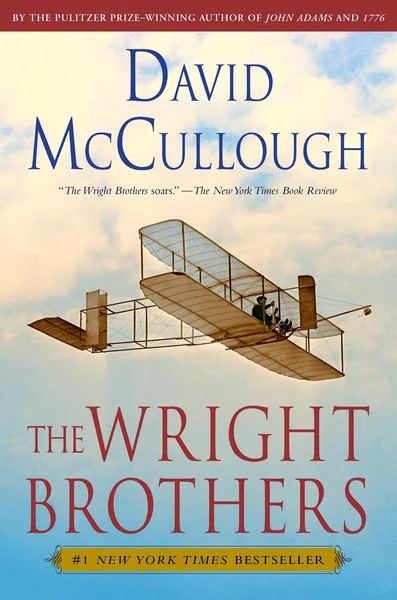
The Wright Brothers by David McCullough Review: A Propulsive, Meticulously Researched History
David McCullough's The Wright Brothers is a narrative non-fiction account of Orville and Wilbur Wright — the bicycle mechanics from Dayton, Ohio, who changed history on a winter day in 1903 at the Outer Banks of North Carolina — written by a two-time Pulitzer Prize winner and praised by major literary critics, though some reviewers note that the book's admiring portrait of its subjects leaves certain dimensions of their inner lives unexplored.
LuvemBooks Verdict
Best for
General readers drawn to American history and innovation who want a rigorously researched but accessible narrative — particularly those coming to the Wright brothers' story for the first time and who appreciate McCullough's humanising, family-centred approach to popular history.
Worth it if
You want authoritative, propulsive narrative history that situates the Wright brothers within their family and culture — including Wilbur's overlooked engagement with French art and architecture — without the density of academic scholarship.
Skip if
You already know the Wright brothers' story well and are looking for a psychologically probing or revisionary account that interrogates the brothers' inner contradictions rather than celebrating their achievement.
What readers & critics say
Kirkus Reviews, retrieved directly, called it "an educational and inspiring biography of seminal American innovators" and praised its "fluently rendered, skillfully focused" quality. The New York Times review, retrieved directly, offered a more measured note — observing that McCullough "makes his subjects extra-estimable" and that the book leaves little room to explore Wilbur's inner life beyond aviation and family, a reservation echoed by historynet.com, which concluded that "despite his efforts, the two brothers to a large extent remain" at a certain distance from the reader.
“A charmingly pared-down life of the 'boys' that grounds their dream of flight in decent character and work ethic.”
— Kirkus Reviews“McCullough makes his subjects extra-estimable — if Wilbur ever had an impassioned relationship with anyone outside blood relatives or aviation, this isn't the book to exhume it.”
— nytimes.comAge & Reading Level
Recommended age
Adult
Reading level
Adult
who it suits
Skip if you're looking for a psychologically probing biography that interrogates its subjects' inner conflicts and contradictions rather than celebrating their achievements.
In This Review
- What Works & What Doesn't
- What the Book Is and What It Covers
- Significance and Place in Popular History
- Strengths: Narrative Drive and Granular Research
- A Genuine Limitation: Emotional Depth and Character Complexity
- Who This Book Is For
What Works & What Doesn't
What Works
- A #1 New York Times bestseller, praised by Janet Maslin of The New York Times as 'concise, exciting and fact-packed' with research so granular readers may wonder how it was all collected
- Draws on French-language archival sources long overlooked in English-language accounts, adding a dimension to the story that McCullough identified as a key reason for writing the book
- Written by a two-time Pulitzer Prize and two-time National Book Award winner, bringing rigorous narrative craft to a general-audience non-fiction subject
- Situates the Wright brothers within their family and community — including Wilbur's surprising cultural life in France — rather than reducing them to their invention alone
What Doesn't
- Some critics, including Bob Hoover of the Star Tribune, found the characterization thin — the book's admiring tone leaves limited room for psychological complexity or contradiction
- Readers already well-versed in Wright brothers history may find the narrative more celebratory than revisionary, offering accessible storytelling over new scholarly argument
What the Book Is and What It Covers
Significance and Place in Popular History
Strengths: Narrative Drive and Granular Research
A Genuine Limitation: Emotional Depth and Character Complexity
Who This Book Is For
Frequently Asked Questions
Sources & Further Reading
The key facts and claims in this review are grounded in the retrieved, verified sources listed below.
- Cited in this review
- 1
barnesandnoble.com
- Further reading
- 2
David McCullough, Wikipedia
- 3
- 4
en.wikipedia.org
- 5
- 6
- 7
onmywalk.com
- 8
- 9
- 10
eclecticreaderbooks.com
- 11
historynet.com
- 12
Related Reviews
Reviews of books we picked for readers who enjoyed The Wright Brothers.

Reader Comments
No comments yet
Be the first to share your thoughts!