At a glance

LuvemBooks Verdict
Best for: Readers genuinely curious about why political and religious opponents believe what they do — particularly those with an interest in social psychology, moral philosophy, or political science who want a rigorously argued, research-backed explanation rather than a polemic.
Worth it? Skip it? Read the full verdict →Ask LuvemBooks
Was this helpful?
- Is it worth reading?
- For readers genuinely curious about why political opponents believe what they do, The Righteous Mind is among the more rigorously argued attempts to answer that question available in popular social psychology. It generated scholarly responses across journals including Science, Philosophical Psychology, and the Journal of Moral Education — a reach well beyond the typical popular-science book — and its moral foundations framework gives it an empirical scaffolding that distinguishes it from purely polemical treatments of partisan division. The main caveat is that its prescriptive conclusions for liberal politics rest on shakier ground than its descriptive moral psychology, and the third section on evolutionary 'groupishness' is a more speculative turn than the first two.
- Similar books
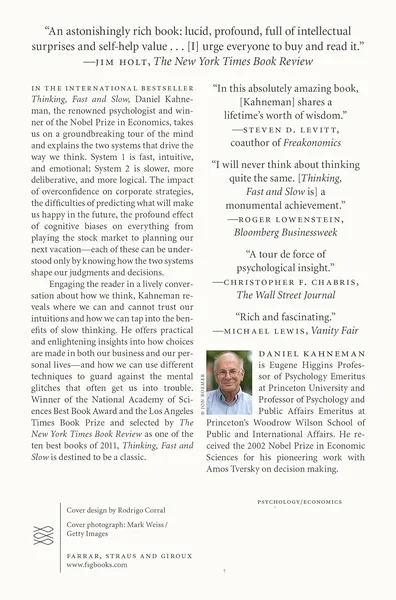
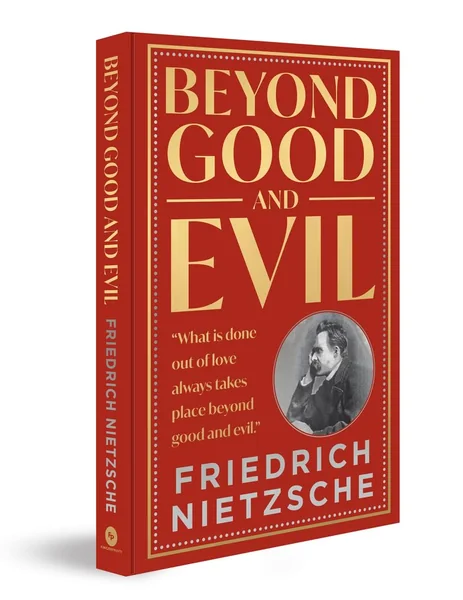
- Readers who find The Righteous Mind compelling have natural next reads in several directions. Daniel Kahneman's Thinking, Fast and Slow covers adjacent intellectual ground on the limits of conscious reasoning and the power of intuitive, System 1 thinking — a framework that runs parallel to Haidt's social intuitionism. For those drawn to the book's moral philosophy dimension, Friedrich Nietzsche's Beyond Good and Evil and Plato's The Republic are foundational works that interrogate the nature of morality and justice at a deeper philosophical level. Haidt's own earlier book, The Happiness Hypothesis: Finding Modern Truth in Ancient Wisdom, is also frequently cited alongside The Righteous Mind as a companion exploration of moral psychology, though it is not currently in the LuvemBooks catalogue.
- Who should read this?
- The Righteous Mind rewards readers with an interest in social psychology, political science, or moral philosophy who are willing to have their own political self-image examined alongside everyone else's. It is specifically valuable for anyone genuinely curious about why political opponents think and vote the way they do — Haidt's stated aim is to make each side legible to the other from the inside. Readers looking for validation of their existing political tribe, or for a self-help guide to navigating political conflict, will find this an unreliable source of comfort.
- About Jonathan Haidt
- Jonathan David Haidt is an American social psychologist and author.
- What are the main themes?
- The central theme is that human morality is driven primarily by intuition rather than reason — and that this explains the intractable nature of political and religious conflict. Closely related is the argument that moral disagreement between liberals, conservatives, and libertarians is not simply a matter of one side being wrong, but of each drawing on a different subset of six evolved moral foundations. A third major theme is human 'groupishness': the innate tribal orientation that Haidt links to the binding power of religion and political identity, which can both unite communities and drive them into destructive conflict with outsiders.
- What are the book's weaknesses?
- The most substantive critique, raised by The Guardian, is that Haidt's claim about conservative electoral advantage runs into counter-examples the framework struggles to account for, weakening the prescriptive conclusions he draws for liberal politics. A related vulnerability is that Haidt's own political evolution during the writing process — also noted by The Guardian — invites scrutiny of whether the framework can truly stand outside the intuition-driven reasoning it diagnoses in others. Additionally, the book's third section on evolutionary 'groupishness' is a more speculative extension than the tightly sourced first two sections, and the book's focus on the U.S. political context limits how directly its conclusions transfer to other democracies.
Summarize this book
Follow up
Synthesized from verified book data & published reviews · How we review
Press Enter to ask. Answers come from our editorial Q&A — start typing to see related questions.
Age & Reading Level
Recommended age
Adult
Reading level
Adult
who it suits
Skip if you're looking for a politically validating read that affirms your existing beliefs rather than scrutinising them.
Editorial Review
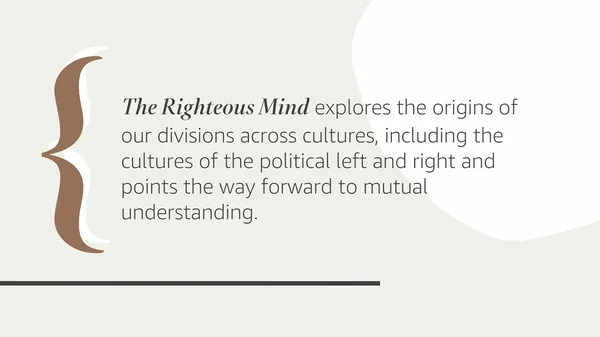
Jonathan Haidt's The Righteous Mind: Why Good People Are Divided by Politics and Religion is a social psychology book, originally published in 2012 and reissued by Vintage in 2013, that argues human morality is driven primarily by intuition rather than reason — and that this fundamental fact explains the chasm between liberals, conservatives, and libertarians in modern political life. Structured across three distinct arguments, the book introduces Haidt's moral foundations theory, mapping six dimensions of moral judgment — care/harm, fairness/cheating, loyalty/betrayal, authority/subversion, sanctity/degradation, and liberty/oppression — to show why different political tribes speak what amount to different moral languages.…
Read the Full ReviewBooks like The Righteous Mind
Curated picks for readers who enjoyed The Righteous Mind, with our reasoning for each match.
If you liked The Righteous Mind