
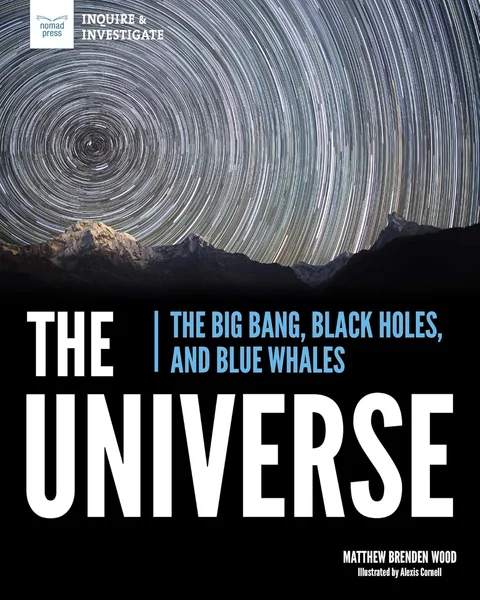
The Universe: The Big Bang, Black Holes, and Blue Whales (Inquire
At a glance
LuvemBooks Verdict
Best for: Middle school students aged 12–15 with a budding curiosity about cosmology who thrive with hands-on, inquiry-based learning — and the teachers or homeschool educators looking for a standards-aligned STEM supplement for grades 7–9.
Worth it? Skip it? Read the full verdict →Preview the book


Ask LuvemBooks
Was this helpful?
- Is it worth reading?
- For its target audience — middle schoolers in grades 7–9 with a developing curiosity about physics and cosmology — the book delivers genuine value, particularly because of its hands-on STEM activities and Wood's credible background holding a bachelor's degree in astronomy from the University of Massachusetts at Amherst. The Inquire & Investigate framework transforms what could be a passive survey of cosmology into an active investigation, giving it real utility in classroom and homeschool settings. Readers or educators seeking deep dives into specific topics like black hole mechanics will find it a strong starting point rather than a comprehensive reference, but for a young person who has looked up at the night sky and wondered where it all began, LuvemBooks considers it well-matched to that question.
- Similar books
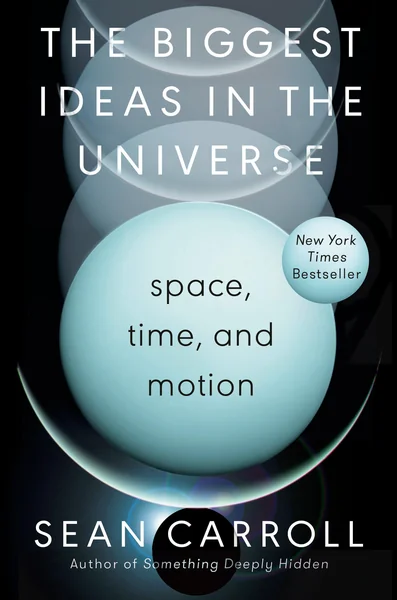
- Readers drawn to The Universe will find natural companions among accessible science titles at varying levels. Sean Carroll's The Biggest Ideas in the Universe: Space, Time, and Motion covers overlapping cosmological territory for a more general adult audience, offering greater depth. Stephen Hawking's A Brief History of Time remains a touchstone for accessible cosmology writing, though it too skews toward older readers. For a broader scientific curiosity that echoes the book's inquiry spirit, Carl Sagan's The Demon-Haunted World: Science as a Candle in the Dark is a compelling companion, and David Macaulay's The Way Things Work appeals to a similar young-reader appetite for understanding how the physical world operates.
- Who should read this?
- The Universe is most squarely aimed at middle school students in grades 7–9 — particularly those with a developing curiosity about physics and cosmology who benefit from hands-on reinforcement alongside reading. Teachers and homeschool educators working within STEM curricula will find the standards alignment with Common Core and Next Generation Science Standards and the built-in activities especially useful. Readers who have already worked through other Inquire & Investigate titles, or Wood's earlier Planetary Science or The Space Race, will recognize the format immediately and know what to expect.
- What age is it for?
- Best for readers ages 12 and up — the book is explicitly designed for the 12–15 age range and leveled for grades 7–9. The content is structured around cosmology and STEM inquiry at a middle-school comprehension level, with Guided Reading and Lexile leveling built into the Inquire & Investigate series format to match that developmental stage.
- About Matthew Brenden Wood
- Matthew Brenden Wood is an instructional designer and author of several science books for young readers. A former math and science educator, he is a passionate advocate of STEAM education and outreach. His works include The Universe: The Big Bang, Black Holes, and Blue Whales, aimed at readers ages 12 to 15, and he is available for speaking engagements and classroom visits.
- What's the reading level?
- The book is leveled for Guided Reading and Lexile standards as part of the Inquire & Investigate series, targeting grades 7–9 and readers ages 12–15. It aligns with both Common Core State Standards and Next Generation Science Standards for that grade band, making the reading-level calibration explicit and verifiable for educators and parents selecting it for curriculum use.
- How does this compare to Wood's other books?
- LuvemBooks has reviewed Wood's Projectile Science: The Physics Behind Kicking a Field Goal, which shares the same hands-on STEM orientation but applies it to applied physics rather than cosmology. Within his Nomad Press catalogue, The Universe is the most ambitious in scope — spanning from the Big Bang to the end of the universe — compared to earlier titles like Planetary Science: Explore New Frontiers or The Space Race: How the Cold War Put Humans on the Moon, which are more focused in subject matter. Readers who enjoyed those titles will find the format of The Universe immediately familiar, as it draws on the same Inquire & Investigate series structure.
Summarize this book
Follow up
Synthesized from verified book data & published reviews · How we review
Press Enter to ask. Answers come from our editorial Q&A — start typing to see related questions.
Age & Reading Level
Recommended age
Ages 12–15
Reading level
Young adult
who it suits
Best for: Ages 12+ — content is leveled for grades 7–9 with Guided Reading and Lexile standards calibrated for middle school comprehension and scientific vocabulary.
Skip if you want a flowing narrative read of cosmic history rather than an activity-integrated, inquiry-based format.
Editorial Review
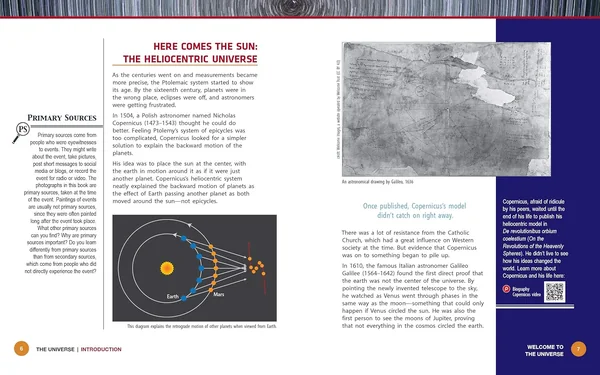
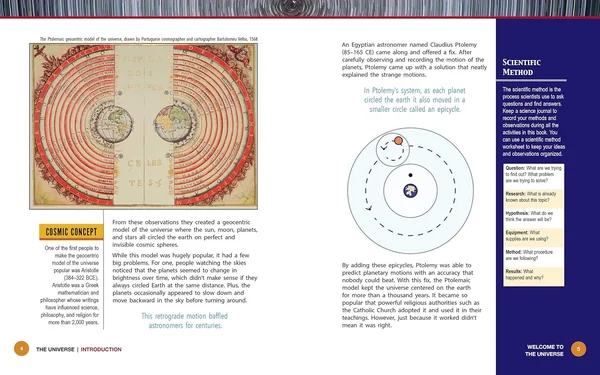
Published by Nomad Press in April 2021 as part of the Inquire & Investigate series, this illustrated nonfiction title for readers ages 12–15 guides young learners from the moment of the Big Bang through the large-scale structure and eventual fate of the universe, pairing content with hands-on STEM activities and research projects throughout.
Read the Full ReviewBooks like The Universe
Curated picks for readers who enjoyed The Universe, with our reasoning for each match.
If you liked The Universe
Why It’s Trending
Big Bang Theory Back on Netflix Sparks Fresh Interest in Universe Science Books
The Big Bang Theory is streaming again on Netflix, and it's putting physics and cosmology back on readers' radars. If you've got a curious 12–15 year old who's suddenly asking big questions about the universe, this hands-on STEM title is a great next step.