At a glance

LuvemBooks Verdict
Best for: Curious readers aged 10 and up — and intellectually engaged adults — who want to understand not just what machines do but why the underlying physics makes them work, delivered through visual diagrams rather than dense prose.
Worth it? Skip it? Read the full verdict →Ask LuvemBooks
Was this helpful?
- Is it worth reading?
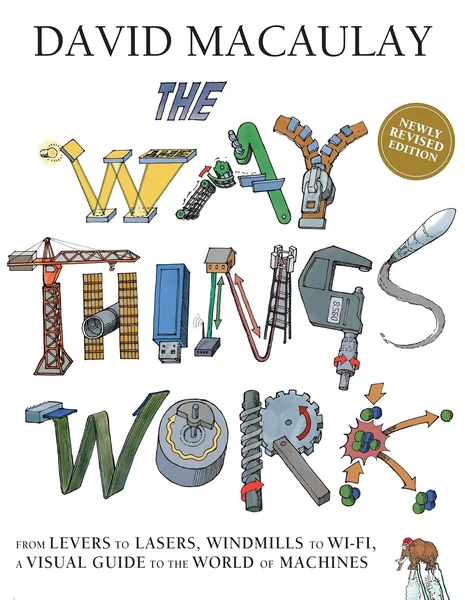
- For anyone curious about how machines and technology actually work at a mechanical and physical level, The Way Things Work: Newly Revised Edition is an outstanding and enduring resource. Kirkus Reviews called the original 'an astonishing tour-de-force,' and subsequent revisions have maintained that reputation — the diagrams are described as bringing 'within the grasp of even casual viewers a greater understanding of the technological wonders of both past and present.' The main caveat is that the technical prose, credited to Neil Ardley, is functional rather than elegant — Kirkus characterized it as 'careful, pedantic, and occasionally awkward' — and the book rewards patient browsing more than quick lookup. Those willing to engage with it on its own terms will find it genuinely illuminating.
- Similar books
- Readers who enjoy The Way Things Work: Newly Revised Edition often gravitate toward other books that make big, complex ideas visually and conceptually accessible. Sean Carroll's The Biggest Ideas in the Universe: Space, Time, and Motion applies a similar rigor-meets-accessibility ethos to physics and cosmology for curious adults. For those drawn to the playful, error-illuminating side of science and mathematics, Matt Parker's Humble Pi: When Math Goes Wrong in the Real World offers engaging popular-science storytelling. Carl Sagan's The Demon-Haunted World: Science as a Candle in the Dark is a natural companion for readers who want a deeper philosophical grounding in scientific thinking. Matthew Brenden Wood's The Universe: The Big Bang, Black Holes, and Blue Whales is a visually rich option for younger readers ready to explore science beyond mechanics.
- Who should read this?
- The Way Things Work: Newly Revised Edition is ideal for curious readers aged 10 and up who want to understand the mechanical and scientific principles behind everyday machines — not just what they do, but why the underlying physics makes them work. It's a strong fit for STEM-curious young people, parents and teachers looking for an accessible illustrated science reference, and adults who retain a genuine curiosity about how the physical world operates. Those drawn to narrative-driven popular science or readers who need a fast alphabetical-lookup encyclopedia will find it less suited to their needs.
- What age is it for?
- Best for ages 10 and up. The publisher targets readers from age 10 through grade 9, and the book's visual approach — page-dominating diagrams, cutaways, and the comic woolly mammoth device — keeps abstract mechanical principles accessible to readers at that level. The depth of explanation is sufficient to engage adults as well, making this a genuinely cross-generational reference rather than a book that ages out quickly.
- About David Macaulay
- David Macaulay is a British-born American illustrator and writer.
- What's the cultural legacy of this book?
- Few nonfiction books for young readers have had as long or culturally productive a life as The Way Things Work. The original 1988 edition spawned two animated television series, a Dorling Kindersley interactive CD-ROM, a board game, and an animatronic attraction at the San Francisco Metreon. It has been a New York Times bestseller across multiple editions and remains one of the most widely recognized science and technology books for young people and curious adults alike — a record that reflects both its educational value and its genuine popular appeal.
- What's the reading level?
- The publisher targets grades 5 through 9, placing the primary reading level at roughly ages 10 to 14, though the book's demonstrated audience spans considerably wider. The technical text, contributed by Neil Ardley, is detailed and precise — Kirkus noted that some explanations are 'specific enough to tax the experts' — meaning advanced younger readers and adults alike will find sufficient depth. Casual or reluctant readers may find the functional, occasionally pedantic prose less immediately inviting than the diagrams.
Summarize this book
Follow up
Synthesized from verified book data & published reviews · How we review
Press Enter to ask. Answers come from our editorial Q&A — start typing to see related questions.
Age & Reading Level
Recommended age
Ages 10–15
Reading level
Middle grade
who it suits
Best for: Ages 10+ — thematic organization, detailed technical text, and abstract mechanical principles suit confident readers at middle-grade level and above.
Skip if you want a narrative-driven popular science read or a fast alphabetical-lookup reference rather than a thematic browse.
Editorial Review
David Macaulay's The Way Things Work: Newly Revised Edition is a New York Times bestseller and a decades-spanning nonfiction reference that explains the mechanical and scientific principles behind hundreds of everyday machines — from levers and zippers to Wi-Fi and 3D printers — using Macaulay's signature diagram-driven approach and the recurring comic presence of woolly mammoths. Originally published in 1988 with technical text by Neil Ardley, the book has been substantially revised and updated, with this edition published by Houghton Mifflin Harcourt bringing coverage of the latest developments in digital technology and modern machines.…
Read the Full ReviewBooks like The Way Things Work
Curated picks for readers who enjoyed The Way Things Work, with our reasoning for each match.
If you liked The Way Things Work