At a glance

LuvemBooks Verdict
Best for: Curious readers — whether students of introductory physics or mathematically willing adults — who want to understand how physics actually works through its real equations, not just polished metaphors.
Worth it? Skip it? Read the full verdict →Ask LuvemBooks
Was this helpful?
- Is it worth reading?
- For readers frustrated by popular physics books that strip away the mathematics, The Biggest Ideas in the Universe is a genuinely distinctive offering. Physicist Chanda Prescod-Weinstein praises Carroll for taking readers on 'a much deeper exploration of foundational notions like force, motion, and momentum than other books manage,' crediting the mathematical approach as the mechanism that makes that depth possible, while science writer John Gribbin lauds how Carroll shows physics' biggest ideas 'become manifest in mathematical form.' The honest caveat, raised by Kirkus Reviews, is that some of the math will challenge readers despite Carroll's reassurances — the gap between willingness and preparedness is real, and those without any calculus background may find themselves working harder than anticipated.
- Similar books
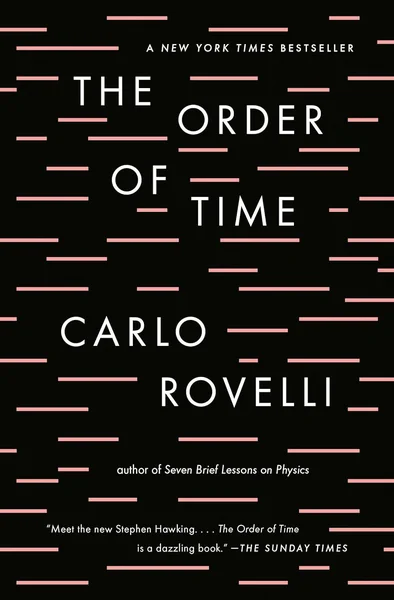
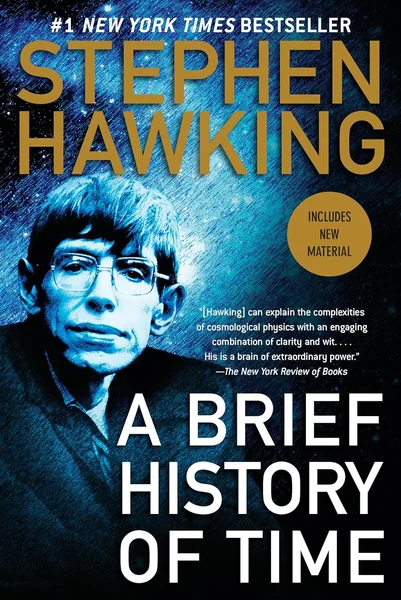
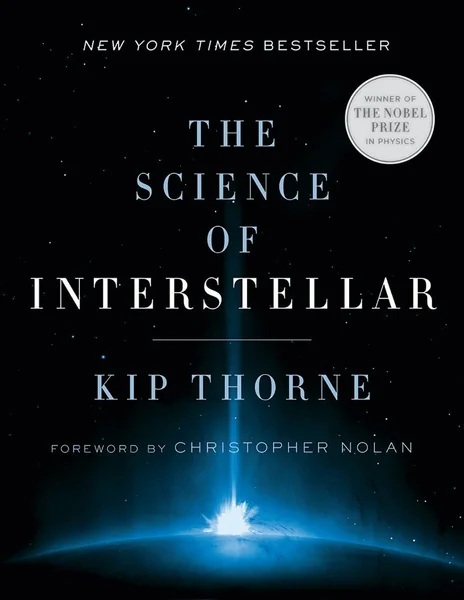
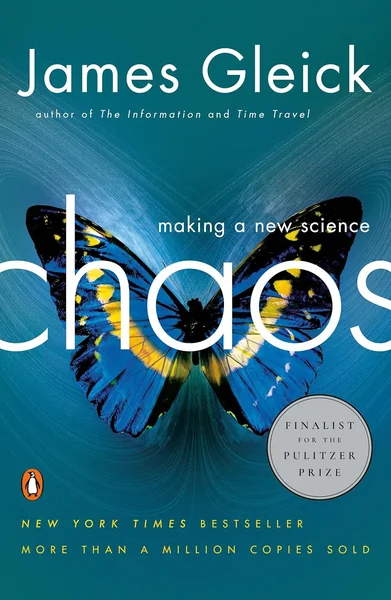
- Readers drawn to The Biggest Ideas in the Universe will find natural companions in other works that bridge rigorous science and general audiences. Stephen Hawking's A Brief History of Time is the classic touchstone for accessible cosmology, while Kip Thorne's The Science of Interstellar similarly dives into relativity and spacetime with a physicist's precision. For those who want to see mathematics surface in unexpected cultural contexts, Simon Singh's The Simpsons and Their Mathematical Secrets offers a lighter but genuinely substantive exploration. James Gleick's Chaos: Making a New Science shares Carroll's commitment to explaining a paradigm-shifting scientific framework in depth, and Carl Sagan's The Demon-Haunted World echoes Carroll's conviction that the public deserves real scientific thinking rather than a watered-down substitute.
- Who should read this?
- The Biggest Ideas in the Universe is best suited to two overlapping audiences: curious adults who have been frustrated by popular physics books that substitute metaphors for real science, and students of introductory physics in high school or college who want an elegant, rigorous companion to formal coursework. Physicist Chanda Prescod-Weinstein and science writer John Gribbin both endorse Carroll's approach as delivering genuine depth — but readers with no mathematical confidence and no prior exposure to calculus should arrive prepared to work, as Kirkus Reviews is candid that some of the math will be challenging despite Carroll's reassurances.
- About Sean Carroll
- Sean Michael Carroll is an American theoretical physicist who specializes in quantum mechanics, cosmology, and the philosophy of science.
- What are the main themes?
- At its core, The Biggest Ideas in the Universe argues that physics is a precise, logical, and deeply beautiful way of seeing the universe — and that general readers deserve access to that precision rather than a softened metaphor-based substitute. The book treats space not as an inert backdrop but as, in Carroll's framing quoted by Kirkus, a turbulent phenomenon with 'a life of its own,' and time as something that functions like space in helping locate events yet differs fundamentally in its apparent one-directional flow — a directionality that, as Carroll notes, no physical law actually forbids reversing. Conservation laws, Newtonian dynamics, Einstein's relativity, four-dimensional spacetime, and the warped geometry that produces black holes are the conceptual pillars, all grounded in their underlying mathematics.
- Where should I start with Sean Carroll?
- For readers who want Carroll's most mathematically engaged work and are prepared to sit with equations, The Biggest Ideas in the Universe is his most ambitious pedagogical entry point and the opening volume of a planned trilogy — making it the natural choice for anyone who wants to follow his full argument about how the universe works. Readers seeking a less equation-intensive introduction to his thinking might find From Eternity to Here or Something Deeply Hidden — both of which Kirkus Reviews notes covered gravity, energy, and relativity with characteristic enthusiasm — a gentler starting point.
Summarize this book
Follow up
Synthesized from verified book data & published reviews · How we review
Press Enter to ask. Answers come from our editorial Q&A — start typing to see related questions.
Age & Reading Level
Recommended age
Adult
Reading level
Adult
who it suits
Skip if you want a metaphor-driven popular science read with no mathematical demands.
Editorial Review
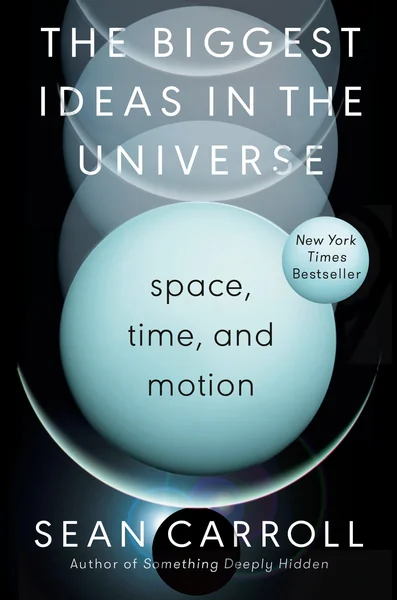
Sean Carroll's The Biggest Ideas in the Universe: Space, Time, and Motion, published by Dutton on September 20, 2022, is a nonfiction popular-physics book that deliberately breaks with convention — it includes the actual mathematics. As the first volume in a planned trilogy, it covers classical mechanics, Einstein's theory of relativity, and the geometry of spacetime, building toward black holes and the warped structure of gravity.…
Read the Full ReviewBooks like The Biggest Ideas in the Universe
Curated picks for readers who enjoyed The Biggest Ideas in the Universe, with our reasoning for each match.
If you liked The Biggest Ideas in the Universe