At a glance
LuvemBooks Verdict
Best for: General readers — especially those without a scientific background — who want a clear, story-driven explanation of how science works and why skeptical thinking matters for everyday civic life.
Worth it? Skip it? Read the full verdict →Ask LuvemBooks
Was this helpful?
- Is it worth reading?
- LuvemBooks regards The Demon-Haunted World as a genuinely important and durable work of science communication — one that major critics described as a "spirited defense of science" rich in "surprising information and beautiful writing," and that the contemporary skeptical movement considers a foundational text. Its core argument — that pseudoscience has continued to burgeon in the information age and that scientific thinking is critical to democratic institutions — has grown more pointed, not less, across the nearly three decades since publication. The key caveat is that the book is openly polemical: Smithsonian magazine and The New York Times have both noted that Sagan does not always incorporate all relevant information on the specific subjects he discusses, reflecting advocacy momentum over comprehensive scholarly coverage. Readers who accept that trade-off will find it a compelling and urgently written guide to critical thinking.
- Who should read this?
- The Demon-Haunted World is addressed explicitly to general readers — those without a scientific background who want to understand how science works and why it matters to civic life. It is structured around accessible storytelling, concrete examples, and memorable thought experiments rather than technical exposition, making it a natural entry point for anyone encountering the philosophy of science or the skeptical movement for the first time. It is particularly well suited to readers alarmed by the spread of misinformation and the erosion of evidence-based reasoning in public discourse. Those who prefer a neutral or comprehensive scholarly treatment of topics like UFO research or parapsychology may find its unapologetically advocacy-driven tone a poor fit.
- Similar books
- Readers drawn to The Demon-Haunted World's blend of accessible science writing and big-picture thinking will find strong companions in the curated titles below. Stephen Hawking's A Brief History of Time shares Sagan's gift for making profound scientific ideas legible to a general audience without sacrificing intellectual seriousness. Daniel Kahneman's Thinking, Fast and Slow complements Sagan's skeptical toolkit with a rigorous psychological account of the cognitive biases and heuristics that make humans susceptible to pseudoscience in the first place. James Gleick's Chaos: Making a New Science offers another landmark of popular science writing from roughly the same era, tracing the emergence of chaos theory with narrative drive and historical depth. For those who want to go deeper into Sagan's own universe, his landmark television series companion Cosmos is a natural next step, though it is not currently in the LuvemBooks catalogue.
- About Carl Sagan
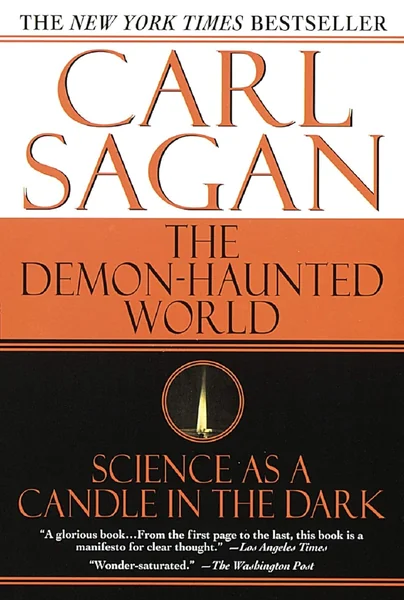
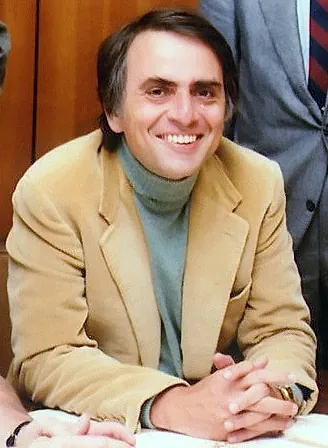
- Carl Edward Sagan (November 9, 1934 – December 20, 1996) was an American astronomer, planetary scientist, and science communicator born in Brooklyn, New York. He began his academic career as an assistant professor at Harvard before moving to Cornell, where he held the David Duncan Professor of Astronomy position. He authored works including The Demon-Haunted World (1995), aiming to explain the scientific method to a general audience.
- What are the main themes?
- The Demon-Haunted World is organized around several interlocking themes: the nature and value of the scientific method as a self-correcting, error-detecting way of thinking; the dangers of uncritical credulity and the spread of pseudoscience and superstition; and the relationship between scientific literacy and democratic health. Sagan also explores how misinformation propagates through credulous media — illustrated by the real-world "Carlos" hoax — and why unfalsifiable claims, however emotionally compelling, fall outside the domain of science. Underlying all of these threads is a civic argument: that the erosion of evidence-based reasoning is not merely an intellectual problem but a threat to democratic institutions.
- Does it actually explain the scientific method?
- Yes — explaining the scientific method to a general audience is one of the book's explicit central purposes. Sagan frames science not as a fixed body of facts but as a disciplined, imaginative way of thinking with a "built-in error-correcting machine," a quality he contrasts with the rigidity of superstition and pseudoscience. Rather than relying on abstract exposition, he teaches these principles through concrete storytelling and thought experiments — most memorably the dragon in the garage parable, which illustrates the concept of falsifiability — and through the practical "baloney detection kit" of skeptical tools. The approach is designed for readers without a scientific background, prioritizing accessibility over technical depth.
Summarize this book
Follow up
Synthesized from verified book data & published reviews · How we review
Press Enter to ask. Answers come from our editorial Q&A — start typing to see related questions.
Age & Reading Level
Recommended age
Adult
Reading level
Adult
who it suits
Skip if you want a neutral, multi-perspective survey of fringe phenomena such as UFO research or parapsychology rather than an openly advocacy-driven argument for scientific skepticism.
Editorial Review
Carl Sagan's The Demon-Haunted World: Science as a Candle in the Dark is a landmark work of science communication, originally published in 1995, in which the Pulitzer Prize–winning astronomer makes the case that critical thinking and the scientific method are indispensable not just to knowledge, but to democracy itself. A New York Times bestseller and winner of the Los Angeles Times Book Prize, the book remains a touchstone for the contemporary skeptical movement and a forceful rebuttal to pseudoscience, superstition, and credulity.
Read the Full ReviewBooks like The Demon-Haunted World
Curated picks for readers who enjoyed The Demon-Haunted World, with our reasoning for each match.
If you liked The Demon-Haunted World