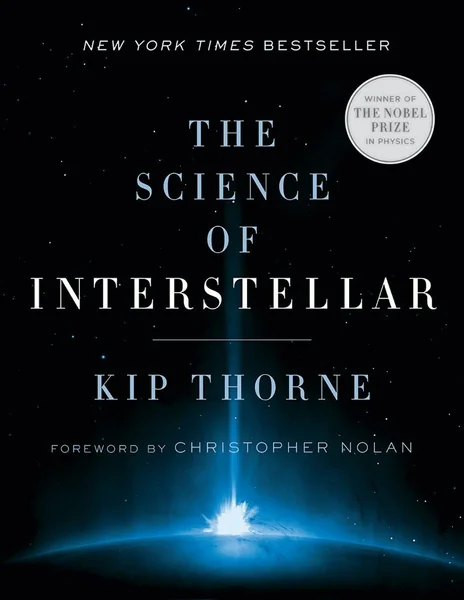
The Science of Interstellar
by Kip Thorne
Nobel Prize-winning physicist Kip Thorne examines the real science behind Christopher Nolan's film Interstellar, covering black holes, wormholes, time dilation, and gravitational physics.
Read our full reviewAt a glance
Be one of the first readers to answer.
Read it? Was it right for you?

The Science of Interstellar
by Kip Thorne
LuvemBooks Verdict
Best for: Fans of the film Interstellar who left the cinema curious about the real physics behind Gargantua, wormholes, and time dilation, and who want authoritative answers from the physicist who shaped those sequences from the inside.
Worth it? Skip it? Read the full verdict →Ask LuvemBooks
Was this helpful?
- Is it worth reading?
- For anyone who engaged with Interstellar and found themselves curious about the physics behind its imagery, The Science of Interstellar offers direct, authoritative answers from the person best positioned to give them. Thorne's dual role as physicist and executive producer means the book delivers both rigorous science and genuine behind-the-scenes insight no outside commentator could replicate. Readers with a deeper scientific background will find additional value in the sections on singularity types and extra dimensions, where Thorne ventures into territory he acknowledges sits at the edge of established knowledge. The review's assessment is that it earns its place on any science shelf independently of the film that inspired it.
- Similar books
- Readers who enjoy The Science of Interstellar will find natural companions in several accessible physics titles. Sean Carroll's The Biggest Ideas in the Universe: Space, Time, and Motion covers spacetime and motion with comparable depth and clarity. Stephen Hawking's A Brief History of Time covers black holes, the nature of time, and the origins of the universe for a general audience — essential context for anyone drawn to Thorne's subject matter. For readers drawn to the intersection of pop culture and hard science, Simon Singh's The Simpsons and Their Mathematical Secrets offers a similarly playful but rigorous approach. Carl Sagan's The Demon-Haunted World: Science as a Candle in the Dark shares Thorne's commitment to making complex science approachable and honest about its limits. James Gleick's Chaos: Making a New Science is another landmark of popular science writing that rewards readers who appreciate intellectual rigour without textbook formality.
- Who should read this?
- The Science of Interstellar is ideally suited to readers who watched Interstellar and found themselves genuinely curious about the physics behind Gargantua, the wormhole, and Cooper's plunge into the singularity. It works best for non-scientists willing to engage with foundational astrophysics concepts, since Thorne anchors the science to specific film scenes to make abstract ideas like time dilation and gravitational lensing concrete. Readers with a deeper physics background will find additional reward in the sections on BKL, mass-inflation, and shock singularities, and on large extra dimensions. Those who haven't seen the film — or who disengaged from it — will find the book's narrative-arc structure harder to follow, as it's built around the film's journey rather than a freestanding scientific curriculum.
- How much of the book is speculation vs. settled science?
- Thorne structures the book to move from established physics toward increasingly speculative territory. The early sections — covering spacetime, relativity, tidal forces, black holes, and Gargantua's anatomy — are grounded in well-accepted science. The later parts, particularly those covering large extra dimensions, the warping of the gravitational constant, and the distinct types of singularities inside black holes (the BKL, mass-inflation, and shock singularities), venture into frontier theoretical physics that Thorne himself acknowledges sits beyond established consensus. The review notes this is not a flaw but an honest reflection of where the science actually stands — though readers seeking only settled consensus should calibrate expectations for those final sections.
- How does it work as a film companion?
- As a film companion, The Science of Interstellar is unusually authoritative because Thorne was not a hired consultant reviewing a finished script — he was present during the actual scripting and shooting of Interstellar, and many of his scientific insights were triggered by those collaborative sessions with Nolan's production. The book explains not just what the science is, but why specific scenes — including Gargantua's CGI rendering, the gravitational slingshot manoeuvres, and Cooper's plunge into the singularity — were designed the way they were. Christopher Nolan's foreword frames the collaboration from the filmmaker's perspective, giving the book the quality of a genuine dialogue between two disciplines. Thorne also identifies specific inaccuracies in the finished film, flagging character statements that depart from real physics — a level of candour rare in official companion volumes.
- What's the reading experience like?
- The reading experience is that of a guided tour through astrophysics anchored to a film most readers will have seen, with Thorne serving as an unusually authoritative guide who can speak to both the science and the filmmaking decisions. The book opens with foundational concepts before building toward more exotic territory, providing a genuine on-ramp for non-scientists. The review notes the structural confidence visible throughout reflects Thorne's experience writing for a general audience — this is his second full-length popular science book, following Black Holes and Time Warps in 1994. The final sections, covering the tesseract and the singularity, require the greatest tolerance for scientific uncertainty, as Thorne openly navigates the boundary between extrapolation and speculative storytelling.
Summarize this book
Follow up
Synthesized from verified book data & published reviews · How we review
What would you like to know about The Science of Interstellar?
Answers come from our editorial notes on this book. If we haven't covered something, we'll say so.
Readers often ask
Editorial Review
The Science of Interstellar is a rigorous yet accessible non-fiction companion to Christopher Nolan's film, written by Nobel laureate and theoretical physicist Kip Thorne — the same scientist who served as the film's scientific consultant and executive producer. Published by W.…
Read the Full ReviewReader reviews
No reader reviews yet
Read it? Be the first to say what you thought.
Books like The Science of Interstellar
Curated picks for readers who enjoyed The Science of Interstellar, with our reasoning for each match.
If you liked The Science of Interstellar