At a glance
Be one of the first readers to answer.
Read it? Was it right for you?
A Thousand Sons
LuvemBooks Verdict
Best for: Horus Heresy readers who want a character-driven tragedy exploring loyalty, institutional power, and the cost of pride through the eyes of the Thousand Sons Space Marine Legion and their primarch Magnus the Red.
Worth it? Skip it? Read the full verdict →The Horus Heresy reading order
Book 12 of 64 books
- Horus Rising2006
- False Gods2006
- Galaxy in Flames2006
- The Flight of the Eisenstein2007
- Fulgrim2007
- Descent of Angels2007
- Legion2008
- Battle for the Abyss2008
- Mechanicum2008
- Tales of Heresy2009 · on Amazon

- Fallen Angels2009
- A Thousand SonsThis book
- Nemesis2010
- The First Heretic2010 · on Amazon
- Prospero Burns2010 · on Amazon

- Age of Darkness2011 · on Amazon

- The Outcast Dead2011 · on Amazon
- Deliverance Lost2012 · on Amazon
- Know No Fear2012 · on Amazon

- The Primarchs2012 · on Amazon

- Fear to Tread2012 · on Amazon

- Shadows of Treachery2012 · on Amazon
- Angel Exterminatus2012 · on Amazon

- Betrayer2012 · on Amazon

- Mark of Calth2013 · on Amazon
- Vulkan Lives2013 · on Amazon
- The Unremembered Empire2013 · on Amazon

- Scars2014 · on Amazon
- Vengeful Spirit2014 · on Amazon
- The Damnation of Pythos2014 · on Amazon

- Legacies of Betrayal2015 · on Amazon
- Deathfire2015 · on Amazon

- War Without End2016 · on Amazon
- Pharos2015 · on Amazon

- Eye of Terra2016 · on Amazon

- The Path of Heaven2016 · on Amazon

- The Silent War2016 · on Amazon

- Angels of Caliban2016 · on Amazon

- Praetorian of Dorn2016 · on Amazon

- Corax2016 · on Amazon

- The Master of Mankind2016 · on Amazon

- Garro2017 · on Amazon

- Shattered Legions2017 · on Amazon

- The Crimson King2017 · on Amazon

- Tallarn2017 · on Amazon

- Ruinstorm2017 · on Amazon

- Old Earth2017 · on Amazon

- The Burden of Loyalty2018 · on Amazon
- Wolfsbane2018 · on Amazon

- Born of Flame2018 · on Amazon

- Slaves to Darkness2018 · on Amazon

- Heralds of the Siege2018 · on Amazon

- Titandeath2018 · not reviewed
- The Buried Dagger2019 · on Amazon

- The Solar War2019 · on Amazon
- The Lost and the Damned2019 · on Amazon

- The First Wall2020 · on Amazon

- Saturnine2020 · on Amazon
- Mortis2021 · on Amazon

- Warhawk2021 · on Amazon

- Echoes of Eternity2022 · on Amazon
- The End and the Death, Volume I2023 · on Amazon

- The End and the Death, Volume II2023 · on Amazon

- The End and the Death, Volume III2024 · on Amazon

Ask LuvemBooks
Was this helpful?
- Is it worth reading?
- For readers drawn to character-driven tragedy, political drama, and the internal culture of Space Marine legions, A Thousand Sons sits among the most substantive entries the Horus Heresy series has produced at this point in the story. McNeill frames the Thousand Sons explicitly as the Emperor's most loyal sons, so their destruction reads not as the defeat of traitors but as the annihilation of true believers by institutional fear and political manoeuvre — a distinction that gives the novel unusual emotional depth. The key caveat is structural: the novel is designed as the first half of a paired story with Prospero Burns, meaning readers who stop here will find the narrative incomplete.
- Similar books
- Readers who enjoy A Thousand Sons will find much to explore in other Horus Heresy titles. False Gods by Graham McNeill continues McNeill's own contributions to the series and traces the Warmaster Horus's corruption. Galaxy in Flames by Ben Counter brings the early heresy's consequences to a violent head. Legion by Dan Abnett — whose Prospero Burns is the direct companion to A Thousand Sons — offers another character-driven, morally complex Horus Heresy entry focused on the Alpha Legion. All three are featured in the related reading selection below.
- Who should read this?
- A Thousand Sons is written for readers already invested in the Horus Heresy series, and particularly those drawn to the psychic, philosophically complex factions of the Warhammer 40,000 setting. The novel rewards readers who value character-driven tragedy, political drama, and questions of knowledge versus institutional authority over action-first pacing. Patient newcomers with an appetite for rich world-building can engage with the emotional stakes, but those seeking immediate combat-heavy narrative or a self-contained story will find the book's design — a measured opening and a structurally open ending — a poor fit.
- About Graham McNeill
- Graham McNeill is a Scottish novelist and video game writer.
- How does this compare to McNeill's other Horus Heresy novels?
- Among McNeill's Horus Heresy contributions, A Thousand Sons is regarded as one of his most character-driven and thematically ambitious entries. Where False Gods focuses on the corruption of Warmaster Horus and Fulgrim charts another primarch's descent, A Thousand Sons is distinctive for framing its tragedy around loyal, philosophically curious warriors destroyed by institutional fear rather than personal villainy — giving it an unusually bitter emotional register within the series.
- What themes does A Thousand Sons explore?
- The novel engages seriously with knowledge versus institutional authority — Magnus delivers a powerful speech at the Council of Nikaea arguing that knowledge of the wider universe is the greatest good the Great Crusade can offer, making his subsequent punishment feel all the more unjust. Pride and its consequences run throughout: as published commentary frames it, 'the pride was Magnus, and the fall was the Thousand Sons.' McNeill also explores the political mechanics of betrayal, showing how loyal, gifted warriors can be destroyed not by their own villainy but by fear, bureaucratic power, and a single catastrophic miscalculation.
Summarize this book
Follow up
Synthesized from verified book data & published reviews · How we review
Press Enter to ask. Answers come from our editorial Q&A — start typing to see related questions.
Editorial Review
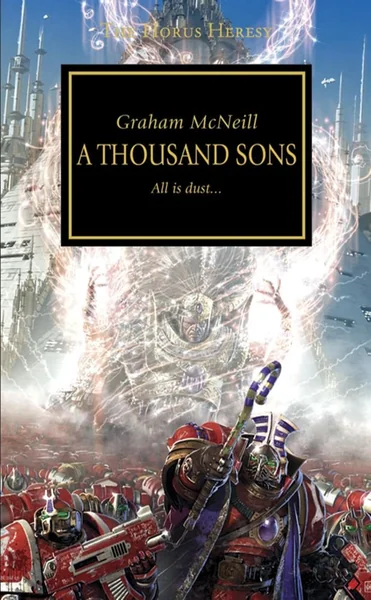
A Thousand Sons is the twelfth book in the Horus Heresy series, written by Graham McNeill, following Magnus the Red and his psyker legion from the Council of Nikaea through the devastating Burning of Prospero. It is one of the series' most character-driven entries, tracing how loyalty and forbidden knowledge can accelerate a fall that feels both inevitable and unjust.
Read the Full ReviewBooks like A Thousand Sons
Curated picks for readers who enjoyed A Thousand Sons, with our reasoning for each match.

If you liked A Thousand Sons