8 min read
4.5
· 2,011 Amazon ratingsShare This Review
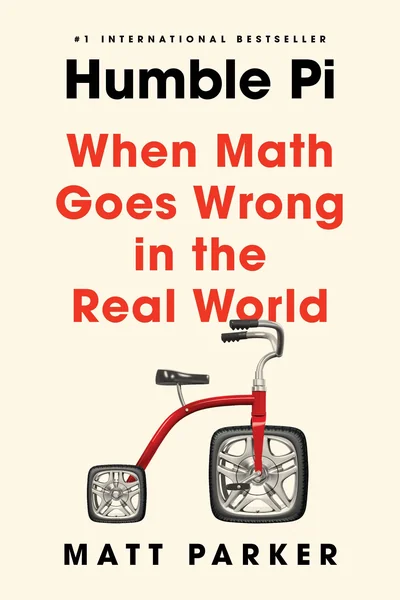
Humble Pi: When Math Goes Wrong in the Real World by Matt Parker Review: A Gloriously Entertaining Catalogue of Mathematical Mishaps
Humble Pi is a #1 international bestseller in which standup mathematician Matt Parker tours the real-world wreckage left behind by mathematical errors — from a misplaced decimal point that rattles the stock market to a unit-conversion blunder that brings down a plane — making a quietly serious case that math is everywhere, and that getting it wrong carries genuine consequences.
LuvemBooks Verdict
Best for
Mathematically curious readers with little or no formal training who want to understand why math actually matters — through a curated, witty tour of real-world disasters caused by numerical and computational failures.
Worth it if
You've ever suspected a misplaced decimal or a wrong formula could quietly unravel something important, and you'd rather laugh your way to that realisation than wade through equations.
Skip if
You're seeking a unified analytical thesis about why humans are structurally bad at mathematics — the episodic, anthology-style structure is designed to delight and illuminate, not to build toward a single synthesised argument.
What readers & critics say
Critical reception was broadly enthusiastic: BookPage called it a "brilliant new book" in which Parker uses "a unique combination of witty prose and factual examples" to make real mathematical disasters both accessible and entertaining. The Washington Independent Review of Books praised Parker's "light touch and dry wit" across a wide range of mishaps, while Bookmarks Reviews noted that "the text moves quickly" but that "Parker does a mixed job on giving the book a larger meaning."
“Parker uses a unique combination of witty prose and factual examples… a brilliant new book.”
— BookPageAsk LuvemBooks
Was this helpful?
- Is it worth reading?
- For anyone mathematically curious but not mathematically trained, Humble Pi delivers on its premise consistently and entertainingly. Reviewers at The Guardian, Library Journal, and Kirkus Reviews all praised it strongly, with critics calling Parker "consistently very funny" and the book "highly entertaining" — and fellow authors Tim Harford ("brilliant"), Jordan Ellenberg, and Ryan North all offered enthusiastic endorsements. The key caveat worth knowing in advance is that the book is designed to delight and illuminate rather than to prescribe: readers seeking a unified thesis about why humans are structurally bad at mathematics may find the episodic anthology structure stops short of deeper analytical synthesis, as the Washington Independent Review of Books noted.
- Similar books
- Readers who enjoy Humble Pi will find kindred pleasures in several books on the curated shelf below. Jordan Ellenberg's How Not to Be Wrong: The Power of Mathematical Thinking covers overlapping territory with more analytical depth — and Ellenberg himself is quoted praising Parker's book. Simon Singh's The Simpsons and Their Mathematical Secrets offers another witty, pop-culture-anchored approach to mathematical ideas. For readers drawn to the broader "hidden systems shaping reality" angle, James Gleick's Chaos: Making a New Science is a landmark popular-science exploration of how small errors cascade into large consequences. Carl Sagan's The Demon-Haunted World: Science as a Candle in the Dark shares Parker's spirit of accessible, entertaining scientific advocacy, while Sean Carroll's The Biggest Ideas in the Universe: Space, Time, and Motion appeals to readers ready to step up the conceptual ambition.
- Who should read this?
- Humble Pi is squarely aimed at the mathematically curious but not mathematically trained — people who found school math abstract and pointless and who will find in Parker's case studies a compelling retroactive justification for the subject. It also rewards readers who already engage with popular science and mathematics: Jordan Ellenberg's and Tim Harford's fans, in particular, are well-primed for it, given that both authors are quoted praising the book. Because the structure is episodic rather than cumulative, it works especially well for readers who prefer to dip in and out rather than follow a sustained argument from start to finish.
- About Matt Parker
- Matthew Thomas Parker is an Australian recreational mathematician, author, comedian, YouTube personality, and science communicator based in the United Kingdom.
- What are the main themes?
- The book's central theme is the invisible ubiquity of mathematics — the argument that math underlies nearly every system humanity has constructed, and that failures in that math produce consequences ranging from the absurdly comic to the genuinely fatal. A secondary theme is systemic fragility: Parker examines how systems designed to prevent errors can themselves become sources of new failures, including a well-developed section on the dangers of using spreadsheets as databases. The book also implicitly makes a case for mathematical literacy as a public good, positioning ignorance of math not as a personal quirk but as a structural societal vulnerability.
- What's the reading experience like?
- The reading experience is light, dry, and fast-moving. The Washington Independent Review of Books noted that "the text moves quickly" and that Parker sustains genuine humor across the full book rather than front-loading the wit. The tone is consistently conversational and equation-free, so even readers who approach math with anxiety will find the material more entertaining than stressful — the genuine stakes of the disasters described never tip the tone into alarm. The episodic anthology structure means it reads comfortably in chunks rather than demanding sustained cover-to-cover momentum.
Summarize this book
Follow up
Synthesized from verified book data & published reviews · How we review
Press Enter to ask. Answers come from our editorial Q&A — start typing to see related questions.
Age & Reading Level
Recommended age
Adult
Reading level
Adult
who it suits
Skip if you want a unified analytical thesis rather than an entertaining anthology of mathematical disasters
Our Review
What the Book Actually Is and Does
Significance and Reception
What Parker Does Exceptionally Well
Where the Book Has Real Limitations
Who This Book Is genuinely For
Sources & Further Reading
The key facts and claims in this review are grounded in the retrieved, verified sources listed below.
- Cited in this review
- 1
- 2
bookpage.com
- 3
washingtonindependentreviewofbooks.com
- Further reading
- 4
Matt Parker, Wikipedia
- 5
- 6
- 7
penguinrandomhouse.com
Books like Humble Pi
Curated picks for readers who enjoyed Humble Pi, with our reasoning for each match.
If you liked Humble Pi