

9 min read
4.5
· 1,307 Amazon ratingsShare This Review
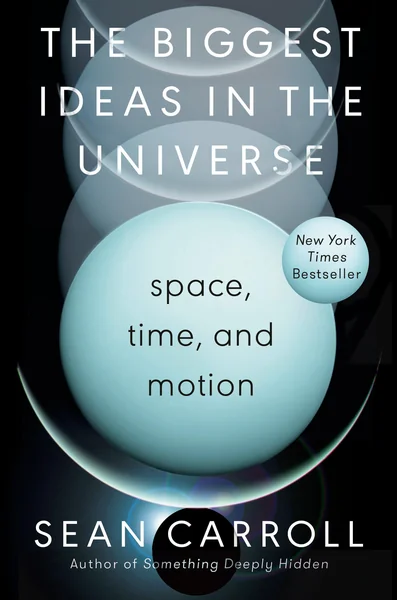
The Biggest Ideas in the Universe: Space, Time, and Motion by Sean Carroll Review: A Math-Forward Popular Physics Triumph
Sean Carroll's The Biggest Ideas in the Universe: Space, Time, and Motion, published by Dutton on September 20, 2022, is a nonfiction popular-physics book that deliberately breaks with convention — it includes the actual mathematics. As the first volume in a planned trilogy, it covers classical mechanics, Einstein's theory of relativity, and the geometry of spacetime, building toward black holes and the warped structure of gravity. Carroll, a theoretical physicist and host of the Mindscape podcast, designs the book for readers who have no more than a high school algebra background but are willing to engage with equations. Kirkus Reviews praised it as offering "no-nonsense, not-dumbed-down explanations of basic laws of the universe that reward close attention," while also cautioning that some of the math may challenge readers despite Carroll's reassurances. This is Carroll's sixth book, and it marks his most ambitious pedagogical undertaking yet.
LuvemBooks Verdict
Best for
Curious readers — whether students of introductory physics or mathematically willing adults — who want to understand how physics actually works through its real equations, not just polished metaphors.
Worth it if
You're prepared to slow down, work through calculus-level equations, and engage with physics at its own level rather than a softened popular-science approximation of it.
Skip if
You're expecting a breezy, equation-free popular science read — readers with no mathematical confidence and no prior exposure to calculus may find Carroll's concision a barrier rather than a bridge.
What readers & critics say
Kirkus Reviews praises the book as offering "no-nonsense, not-dumbed-down explanations" that reward close attention, while cautioning that some of the math will still challenge readers despite Carroll's accessibility claims. Publishers Weekly echoes that tension, suggesting Carroll doesn't quite deliver on his promise that equations are "not that scary," finding them at times overwhelming for the general reader.
“No-nonsense, not-dumbed-down explanations of basic laws of the universe that reward close attention.”
— Kirkus Reviews“Carroll doesn't quite deliver on his insistence that it is possible to learn about modern physics for real, equations and all — they are certainly overwhelming.”
— Publishers WeeklyAge & Reading Level
Recommended age
Adult
Reading level
Adult
who it suits
Skip if you want a metaphor-driven popular science read with no mathematical demands.
In This Review
- What Works & What Doesn't
- What the Book Actually Is — and What It Sets Out to Do
- Its Place in the Field — and in Carroll's Own Work
- Where Carroll's Approach Genuinely Excels
- The Real Limitation — Mathematical Demands on the Reader
- Who This Book Is For — and Why It Matters Now
What Works & What Doesn't
What Works
- Deliberately includes real calculus and equations rather than relying on metaphors, giving readers access to how physics actually works
- Structured progression from Newtonian dynamics and conservation laws through spacetime and black holes provides a clear conceptual arc
- Carroll's informal, non-condescending register — praised by physicist Chanda Prescod-Weinstein and John Gribbin — makes demanding material approachable without diluting it
- Kirkus Reviews praised it as offering no-nonsense, not-dumbed-down explanations that reward close attention
- Opens the first volume of a planned trilogy, establishing foundational vocabulary in physics and mathematics for readers who want to go deeper
What Doesn't
- Kirkus Reviews cautions that some of the math will challenge readers despite Carroll's claims of broad accessibility — the gap between willingness and preparedness is real
- Best suited to readers with some prior exposure to calculus; those arriving with only high school algebra and no mathematical confidence may find the material demanding
What the Book Actually Is — and What It Sets Out to Do
Its Place in the Field — and in Carroll's Own Work
Where Carroll's Approach Genuinely Excels
The Real Limitation — Mathematical Demands on the Reader
Who This Book Is For — and Why It Matters Now
Frequently Asked Questions
Sources & Further Reading
The key facts and claims in this review are grounded in the retrieved, verified sources listed below.
- Cited in this review
- 1
en.wikipedia.org
- 2
preposterousuniverse.com
- 3
publishersweekly.com
- Further reading
- 4
Sean Carroll, Wikipedia
- 5
- 6
kirkusreviews.com
- 7
- 8
- 9
- 10
- 11
Related Reviews
Reviews of books we picked for readers who enjoyed The Biggest Ideas in the Universe.
Reader Comments
No comments yet
Be the first to share your thoughts!