At a glance

LuvemBooks Verdict
Best for: Curious general readers with no specialist mathematics background who want to understand how chaos theory emerged and why it matters — told through the human stories of the scientists who built it.
Worth it? Skip it? Read the full verdict →Ask LuvemBooks
Was this helpful?
- Is it worth reading?
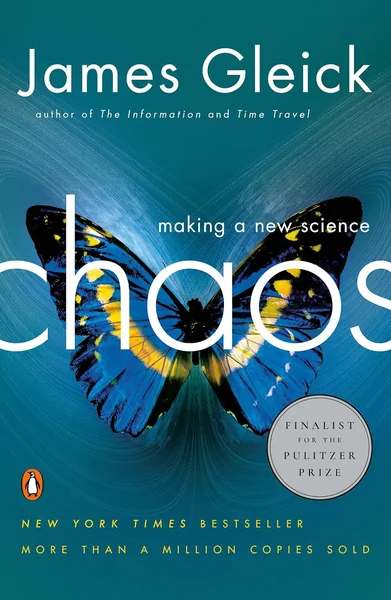
- For any reader curious about why classical physics fails to describe the irregular, unpredictable behavior found throughout nature — from weather systems to turbulence to population dynamics — Chaos remains an essential read nearly four decades after its publication. Its standing in the popular science canon is documented rather than merely claimed: a Pulitzer Prize finalist, a National Book Award finalist, a New York Times bestseller, and by Wikipedia's account the first popular book ever written on the subject. Neuroscientist Robert Sapolsky's endorsement captures what many readers report — he described it as the most influential book in his thinking about science since college and the first book since childhood where he immediately started re-reading from the front upon finishing. The main caveat is that readers who already have strong technical grounding in dynamical systems will find it a work of history and communication rather than instruction.
- Similar books
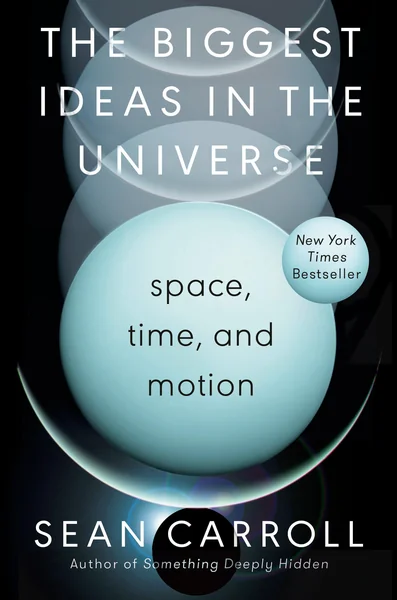
- Readers who responded to Chaos are well served by several nearby titles. Carl Sagan's The Demon-Haunted World: Science as a Candle in the Dark shares Gleick's commitment to making rigorous science legible and urgent for a general audience. Sean Carroll's The Biggest Ideas in the Universe: Space, Time, and Motion offers a similarly ambitious popular account of fundamental physics, pitched at the curious non-specialist. For readers drawn to the mathematical underpinnings, Simon Singh's The Simpsons and Their Mathematical Secrets and Matt Parker's Humble Pi: When Math Goes Wrong in the Real World both demonstrate that advanced mathematical ideas can be communicated with wit and accessibility. Steven Strogatz's Sync: How Order Emerges from Chaos in the Universe, Nature, and Daily Life is a natural companion, picking up many of the same complex-systems themes from a researcher who is himself part of the tradition Gleick chronicles.
- Who should read this?
- Chaos is designed for anyone curious about why classical physics fails to describe the irregular, unpredictable behavior observable throughout nature — weather, turbulence, population dynamics — and who wants to understand how scientists came to grapple with that irregularity. Because Gleick builds the science through biography and narrative rather than equations, readers with no mathematics background beyond secondary school are the clear intended audience. It is also well suited to readers interested in the history and sociology of science: how new disciplines form, how heterodox ideas gain legitimacy, and how a scattered community of researchers coalesces into a field. Specialists who already have technical grounding in dynamical systems will find it a work of history and communication rather than instruction.
- About James Gleick
- James Gleick is an American author and historian of science whose work has chronicled the cultural impact of modern technology.
- Awards and critical reception
- Chaos accumulated an unusual constellation of recognition across commercial, critical, and institutional categories. It earned finalist nominations for both the Pulitzer Prize and the National Book Award in 1987, was shortlisted for the Science Book Prize in 1989, achieved New York Times bestseller status, and has sold over a million copies. Kirkus Reviews noted, a quarter-century after publication, that the butterfly effect had become a household term in large part because of this book. Robert Sapolsky offered perhaps the most striking personal endorsement on record, calling it the most influential book in his thinking about science since college.
- What formats is it available in?
- Chaos: Making a New Science is available in standard print via the Penguin Books anniversary and reprint edition. An enhanced ebook edition was released by Open Road Media in 2011, adding embedded video and hyperlinked notes for readers who want a multimedia experience alongside Gleick's original text. The book has remained continuously in print since its original Viking Books publication in 1987.
Summarize this book
Follow up
Synthesized from verified book data & published reviews · How we review
The Butterfly Effect Explained: How Tiny Changes Create Massive Consequences
Edward Lorenz discovered the butterfly effect in 1961 when a 0.000127 rounding difference in a weather model produced a completely different forecast.
Read more →
Chaos Theory in the Real World: 7 Surprising Applications
Chaos theory, formalized in the 1960s–80s, now shapes weather forecasting, cardiology, ecology, and financial modelling across modern science.
Read more →
What Are Fractals? The Hidden Geometry of Chaos Explained
Mandelbrot coined "fractal" in 1975 for self-similar patterns that repeat at every scale, linking geometry to chaos theory.
Read more →
Press Enter to ask. Answers come from our editorial Q&A — start typing to see related questions.
Age & Reading Level
Recommended age
Adult
Reading level
Adult
who it suits
Skip if you're looking for a rigorous, up-to-date technical treatment of dynamical systems rather than a narrative popular history
Editorial Review
James Gleick's Chaos: Making a New Science is the book that brought chaos theory out of specialist journals and into the public imagination — a New York Times bestseller, a finalist for both the Pulitzer Prize and the National Book Award, and, according to Wikipedia, the first popular book ever written on the subject.
Read the Full ReviewBooks like Chaos
Curated picks for readers who enjoyed Chaos, with our reasoning for each match.
If you liked Chaos