Published

Read Time

10 min read

Age & reading levelAdult
Reader rating

4.4

· 167 Amazon ratings
reader ratings, not a LuvemBooks score

Reading order

The Horus Heresy

Book 12 of 64 books
  1. Fallen Angels book cover
    Before thisFallen Angels2009
  2. A Thousand Sons book cover
    You're readingA Thousand Sons
  3. Nemesis book cover
    Up nextNemesis2010
  4. The First Heretic book cover
    ThenThe First Heretic2010 · on Amazon
All 64 in order →
Curated & edited by

LuvemBooks Editorial

How we create our reviews →
Share This Review
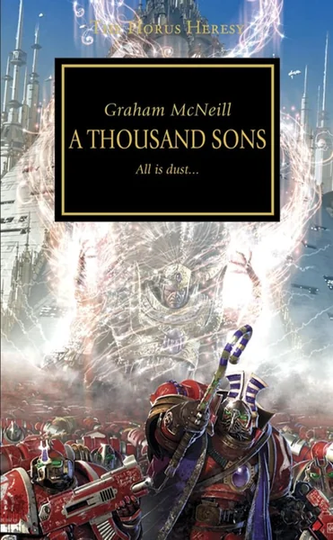
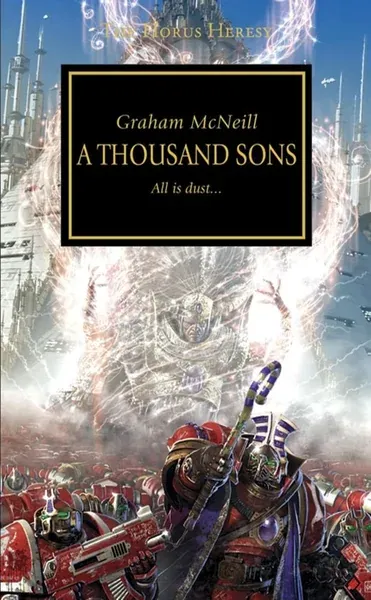
A Thousand Sons (Horus Heresy) by Graham McNeill front cover

Our review

A Thousand Sons by Graham McNeill Review: A Tragic, Slow-Burn Legion Epic

A Thousand Sons is the twelfth book in the Horus Heresy series, written by Graham McNeill, following Magnus the Red and his psyker legion from the Council of Nikaea through the devastating Burning of Prospero. It is one of the series' most character-driven entries, tracing how loyalty and forbidden knowledge can accelerate a fall that feels both inevitable and unjust.
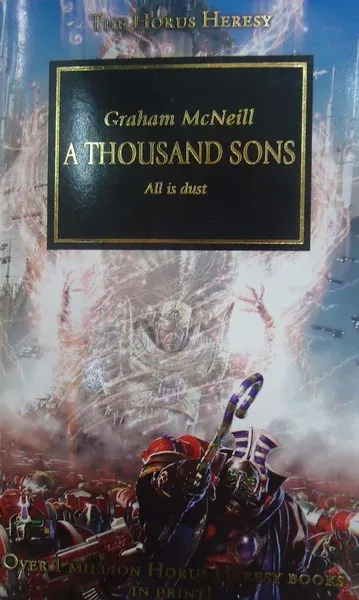
Front cover featuring armored figures in battle formation with gold lettering and "Horus Heresy" branding.Tap to enlarge

LuvemBooks Verdict

Best for

Horus Heresy readers who want a character-driven tragedy exploring loyalty, institutional power, and the cost of pride through the eyes of the Thousand Sons Space Marine Legion and their primarch Magnus the Red.

Worth it if

Worth reading if you are invested in the Horus Heresy series and drawn to political drama, sustained dramatic irony, and the internal culture of Space Marine legions more than front-loaded action.

Skip if

Skip it if you are new to the series and expecting fast-paced military action from the opening pages, or are unwilling to pick up companion volume Prospero Burns to complete the structurally paired story.

Speculiction.blogspot.com calls it "one of the best Horus Heresy books published yet — anything but bolters on auto-fire," praising how it slowly reveals itself to be one of the best-plotted and most satisfying novels in the series. Bitsandpieces.games describes it as "a masterclass in Horus Heresy fiction," comparing its tragic arc to Greek myths such as Oedipus.

Sources: speculiction.blogspot.com, bitsandpieces.games, adventureswithpeps.com, civilianreader.com, boomtron.com
4.4from 167 Amazon ratings— reader ratings, not a LuvemBooks score
Buy on Amazon
In This Review
  • What Works & What Doesn't
  • What the Book Actually Is
  • Narrative Structure and Pacing
  • Thematic Weight and the Series' Significance
  • Strengths Grounded in the Record
  • Who This Book Is For and Where It Fits

What Works & What Doesn't

What Works
  • Part of the New York Times bestselling Horus Heresy series, written by a Games Workshop veteran with deep lore fluency
  • Structurally ambitious three-viewpoint narrative that inhabits the tragedy at the level of primarch, astartes, and civilian observer
  • Sustained dramatic irony — the reader watches loyal, gifted warriors walk toward a destruction they cannot prevent — gives the story unusual emotional depth
  • Engages seriously with themes of knowledge, institutional power, and the political mechanics of betrayal rather than reducing the conflict to simple heroism or villainy
What Doesn't
  • The deliberately slow opening pacing — noted in published commentary — will test readers who come to the series expecting front-loaded action
  • The novel is designed as the first half of a paired story with Dan Abnett's Prospero Burns, meaning the narrative is structurally incomplete on its own
This review covers the book's content, structure, and published reception — not a hands-on read or tested application of its narrative mechanics.

What the Book Actually Is

A Thousand Sons is a 560-page military science-fantasy novel set in Games Workshop's Warhammer 40,000 universe. As the twelfth entry in the New York Times bestselling Horus Heresy series, it tells the story of the Thousand Sons Space Marine Legion and their primarch, Magnus the Red. The premise, as established in the novel's record and confirmed by the Warhammer 40,000 Lexicanum, turns on a cascade of tragic decisions: censured at the Council of Nikaea for his legion's unsanctioned use of sorcery, Magnus retreats with his sons to their homeworld of Prospero to continue practising the arcane arts in secret. When Magnus foresees the treachery of Warmaster Horus and warns the Emperor using the very powers he was forbidden to wield, the Emperor dispatches the Space Wolves primarch Leman Russ to assault Prospero itself. The novel's chapter summary recorded by one source closes on the ominous line — "The Wolves are coming" — a phrase that encapsulates the slow-building dread McNeill sustains across much of the book.

Narrative Structure and Pacing

The novel is structured as the first half of a two-part story — its companion volume, Prospero Burns, covers the same events from the Space Wolves' perspective. Within A Thousand Sons itself, the narrative is delivered primarily through three viewpoints: Ahriman, described in published sources as Magnus's favoured son and a future Chaos champion; Magnus himself, the proud and philosophically driven primarch; and a group of Remembrancers, civilian observers embedded with the legion. Readers and commentators note that McNeill opens at a deliberately measured pace, using the early sections to build the political, cultural, and psychological world of the Thousand Sons before the confrontation accelerates. The adventureswithpeps.com review describes this arc plainly: the novel "starts slow, very slow, to be honest, but soon gains pace until we are running headfirst into the title fight of this stage of the Horus Heresy." That slow burn is a feature of the design — McNeill is constructing dramatic irony as much as action, letting readers watch a catastrophe unfold in what the same source memorably calls a "slow-motion car crash you can't escape."

Thematic Weight and the Series' Significance

What distinguishes A Thousand Sons within the broader Horus Heresy is its sustained engagement with questions of knowledge, loyalty, and the cost of pride. The Lexicanum records Magnus delivering a powerful speech at the Council of Nikaea arguing that knowledge of the wider universe is the greatest good the Great Crusade can offer — a position that makes his subsequent punishment feel all the more bitter. McNeill frames the Thousand Sons explicitly as the Emperor's most loyal sons, so that their destruction reads not as the defeat of traitors but as the annihilation of true believers by institutional fear and political manoeuvre. The Lexicanum notes that Magnus keeps his temper and strives for civility even with his critics, which means the tragedy is not one of arrogance careening into recklessness, but of a figure whose virtues — curiosity, foresight, restraint — fail to protect him. The adventureswithpeps.com source summarises the thematic core succinctly: "the main point of this tale is that pride always comes before a fall. The pride was Magnus, and the fall was the Thousand Sons."
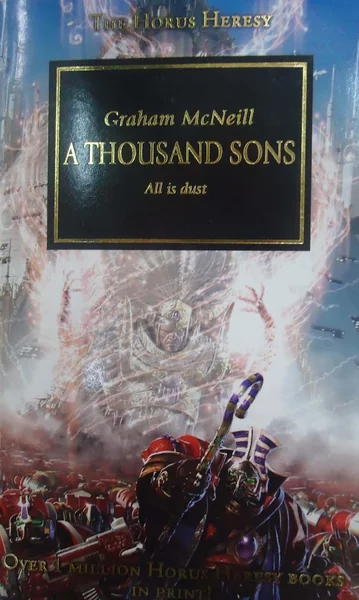
Front cover featuring armored figures in battle formation with gold lettering and "Horus Heresy" branding.

Strengths Grounded in the Record

McNeill's background as a longtime Games Workshop author — he is credited with acclaimed Warhammer novels including Nightbringer, Warriors of Ultramar, and Storm of Iron — gives him deep fluency with the lore and factions he is writing. That institutional knowledge shows in how the novel handles the Council of Nikaea, the internal culture of the Thousand Sons, and the political dynamics of the Great Crusade. The three-viewpoint structure allows the book to inhabit the tragedy at different distances: the primarch's grandeur, Ahriman's ground-level perspective, and the Remembrancers' outsider eyes. Published commentary consistently praises the emotional weight McNeill brings to a story whose ending is already known to anyone familiar with Warhammer 40,000 lore — the dramatic irony is the point, not a spoiler.

Who This Book Is For and Where It Fits

Readers invested in the Horus Heresy series — and particularly in the psychic, philosophically complex factions of the setting — are the natural audience here. Because the novel is the first half of a paired story, new readers coming to it in isolation will find the ending structurally open; Prospero Burns by Dan Abnett covers the complementary perspective, and the two novels are frequently read together. Existing familiarity with the series' major figures and political landscape will deepen the experience, though McNeill builds enough context that the emotional stakes remain legible to patient newcomers. The measured opening pacing means those seeking immediate action-heavy reading may find the first third demanding. For readers drawn to character-driven tragedy, political drama, and the internal culture of Space Marine legions, A Thousand Sons sits among the most substantive entries the series has produced at this point in the story.

Age & Reading Level

Recommended age

Adult

Reading level

Adult

Content to know about

graphic large-scale military violence
mass destruction of a civilian population

Skip if you want a self-contained story with a decisive ending and front-loaded action.

Sources & Further Reading

The key facts and claims in this review are grounded in the retrieved, verified sources listed below.

  1. Cited in this review
  2. 1
  3. 2
  4. Further reading
  5. 3

    Graham McNeill, Wikipedia

  6. 4
  7. 5
  8. 6
  9. 7