BOOKS
Published

Read Time

7 min read

Our Rating

3.8

False Gods delivers a credible, emotionally grounded account of Horus's fall, honoring the characterization established in Horus Rising — though McNeill's prose lacks the polish of his predecessor and pacing falters in places.

A necessary read for Heresy fans, if not a flawless one.

Reviewed by

LuvemBooks

Share This Review

False Gods by Graham McNeill Review: Horus Falls Into Darkness

Our Rating

3.8

False Gods delivers a credible, emotionally grounded account of Horus's fall, honoring the characterization established in Horus Rising — though McNeill's prose lacks the polish of his predecessor and pacing falters in places. A necessary read for Heresy fans, if not a flawless one.

In This Review
  • What Works & What Doesn't
  • The Point of No Return
  • A Fall Written in Fire and Shadow
  • Brotherhood Under Strain
  • Grimdark at Its Most Purposeful
  • Where McNeill Pulls His Punches
  • The Verdict for Horus Heresy Readers
  • Where to Buy

What Works & What Doesn't

What Works
  • The central corruption sequence is staged with genuine emotional weight, not just spectacle
  • Maintains sympathetic complexity for Horus rather than reducing him to an instant villain
  • Brotherhood dynamics among the Luna Wolves are specific and affecting
  • Thematically consistent with Horus Rising — a worthy steward of Abnett's setup
  • Grimdark tone is purposeful and controlled, not gratuitous for its own sake
What Doesn't
  • Prose is functional rather than distinguished — lacks Abnett's stylistic polish
  • Supporting characters occasionally feel like plot instruments rather than fully realized people
  • Pacing sags in the middle section and the climax resolves slightly too quickly
  • Not accessible to readers unfamiliar with Warhammer 40,000 — requires series context

The Point of No Return

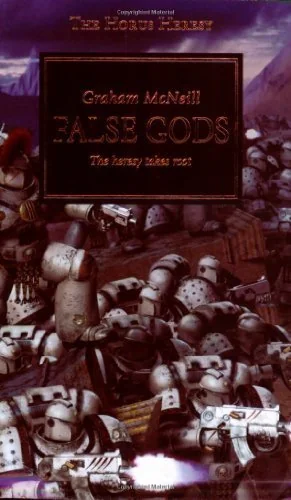
False Gods (The Horus Heresy) by Graham McNeill (2006-06-15)_main_0
Is False Gods worth reading if you've just finished Dan Abnett's Horus Rising? The short answer is yes — and the longer answer is that this grimdark military science fiction novel, the second book in the Horus Heresy series, does something considerably more difficult than a standard sequel. Graham McNeill takes a character readers have spent an entire book rooting for and begins the work of making him a monster. That is not easy to pull off. Graham McNeill largely manages it. A credible if uneven successor: McNeill earns the fall of Horus even when his prose and pacing fall short of Abnett's standard.
Where Horus Rising planted seeds of doubt and manipulation, False Gods accelerates the harvest. The story moves Horus — Warmaster of the Imperium, beloved son of the Emperor — through a catastrophic turning point that commits him irrevocably to Chaos. The novel's central dramatic question isn't whether Horus will fall. Anyone familiar with Warhammer 40,000 lore already knows the answer. The question is whether McNeill can make that fall feel earned rather than inevitable, tragic rather than mechanical. For the most part, he succeeds.

A Fall Written in Fire and Shadow

The novel's pivotal sequence — Horus's wounding and subsequent corruption on Davin's moon — is the engine that drives everything. Graham McNeill stages it with appropriate gravity. The Warmaster's vulnerability, the manipulations of the Chaos entities working through the warrior lodge on Davin, and the desperate choices made by those closest to him all converge in a way that feels both structurally sound and emotionally resonant.
The tragedy works because McNeill keeps the focus on character rather than spectacle. Horus isn't simply overwhelmed by dark power. He is deceived, at his lowest moment, by forces that understand his pride and his love for his sons. The manipulation is psychological before it is supernatural. That grounding in recognizable human weakness is what separates the best Heresy fiction from mere battle narrative.
Readers who found Abnett's handling of Horus sympathetic in Horus Rising — the portrayal of a genuinely great leader being slowly hollowed out — will find that Graham McNeill honors that characterization rather than abandoning it. The Horus of False Gods is not yet a cartoon villain. He is a man making choices whose full implications he cannot yet see, which is precisely what makes those choices devastating.

Brotherhood Under Strain

The Luna Wolves — soon to be renamed the Sons of Horus — carry much of the novel's emotional freight. The relationships between Horus and his most devoted commanders are tested as the corruption spreads. McNeill is strongest when writing these bonds under pressure. There is genuine pathos in watching warriors who would die for their Primarch begin to serve something far darker than duty.
The supporting cast is handled with varying effectiveness. Some figures feel fully realized; others function more as narrative instruments than as people. This is one of the novel's notable weaknesses: the ensemble occasionally thins out under the weight of the plot's requirements. Characters who might have offered meaningful resistance or moral counterpoint sometimes feel rushed past, their complexity sacrificed for momentum.
That said, the dynamics of loyalty and betrayal among the Luna Wolves are drawn with enough specificity to feel distinct from generic military science fiction. Graham McNeill clearly understands the Horus Heresy not as a war story but as a tragedy of institutional collapse — what happens when the most trusted figures in a civilization turn against its foundations.

Grimdark at Its Most Purposeful

The Warhammer 40,000 setting is, famously, not subtle. It operates in extremes — of scale, of violence, of theological stakes. False Gods leans into that register without losing narrative control. The Chaos influence is rendered in appropriately unsettling terms, and the book doesn't shy away from the horror of what corruption means for individuals who were once genuinely heroic.
Parents and younger readers should note that this is firmly adult grimdark fiction. Violence is graphic and purposeful, the themes of manipulation and spiritual corruption are handled without softening, and the emotional tone is relentlessly bleak. This is not appropriate for young readers, and it makes no attempt to be. The content is calibrated for adult fans of dark fantasy and military science fiction.

Where McNeill Pulls His Punches

Honest assessment requires noting where False Gods falls short of its predecessor. Abnett's Horus Rising has a stylistic polish and a gift for grounding vast cosmic events in intimate human moments that McNeill doesn't quite replicate. The prose here is functional rather than distinguished — it carries the story efficiently but rarely achieves the kind of sentence-level distinction that elevates genre fiction to something more.
Pacing is also uneven in stretches. The novel's middle section occasionally loses focus, and some sequences feel like they exist to fulfill series obligations rather than to advance character. The climax, while dramatically satisfying, arrives with a speed that slightly undercuts the accumulated weight of everything preceding it.
These are genuine criticisms, but they should be kept in proportion. False Gods is doing difficult narrative work under significant constraints: it must advance a predetermined plot whose outcome the audience already knows, while keeping that audience emotionally engaged. The fact that it succeeds more than it stumbles is no small achievement.

The Verdict for Horus Heresy Readers

Graham McNeill's False Gods is the essential second step in one of genre fiction's most ambitious shared-universe projects. It is not the strongest entry in the Horus Heresy series by most accounts, but it delivers what readers who loved Horus Rising need: a credible, emotionally grounded account of the moment everything broke. McNeill serves the arc faithfully, if not always brilliantly.
Ideal for readers who: have finished Horus Rising and want to see where the tragedy goes; enjoy grimdark military science fiction with genuine emotional stakes; can tolerate knowing the destination and still finding the journey worthwhile.
Less suited to: newcomers to Warhammer 40,000 lore (start with Horus Rising); readers who prefer cleaner narrative resolution; those sensitive to graphic violence or themes of corruption and spiritual decay.

Where to Buy

If you've finished Horus Rising and need to see the fall through, False Gods earns its place in the read-through — check the Amazon link in the sidebar for the current price.