BOOKS
Published

Read Time

8 min read

Curated & edited by

LuvemBooks Editorial

How we create our reviews →
Share This Review

The Correspondent by James Wood Davidson Review: A Classic Reprint in Modern Dress

The Correspondent, published by Leopold Classic Library in 2016, is a restored reprint of a historical work by nineteenth-century American author James Wood Davidson — a title that should not be confused with the several contemporary novels sharing its name. The Leopold Classic Library edition makes a long-out-of-print text newly accessible in paperback form, though readers seeking a modern epistolary novel will find themselves in very different literary territory here.

LuvemBooks Verdict

Best for

Researchers, scholars, or collectors with a pre-existing, specific interest in the nineteenth-century American writer James Wood Davidson who need affordable access to an otherwise out-of-print historical text.

Worth it if

You arrive knowing exactly what you're purchasing — a no-frills Leopold Classic Library reprint of a historical nineteenth-century text — and your primary need is basic access rather than scholarly apparatus or editorial guidance.

Skip if

You were drawn in by the name "James Wood" expecting the celebrated New Yorker critic's analytical prose, or by the title "The Correspondent" expecting any of the contemporary novels sharing it — especially Virginia Evans's acclaimed 2025 epistolary debut — because this edition is an entirely different work with no connection to either.

No independent critical reception exists for this specific Leopold Classic Library reprint of James Wood Davidson's text. It is worth noting that the retrieved sources — including Kirkus Reviews and Wikipedia — confirm that a highly praised, unrelated 2025 novel titled The Correspondent by Virginia Evans (a New York Times bestseller and PEN/Hemingway Award winner) shares this title, creating a significant confusion risk for prospective buyers.

An affecting portrait of a prickly woman — a lifetime's worth of letters combine to portray a singular character.

Kirkus Reviews
Sources: Kirkus Reviews, Wikipedia
In This Review
  • What Works & What Doesn't
  • What This Book Actually Is
  • Its Place in the Literary Landscape
  • What the Edition Offers
  • Genuine Limitations to Consider
  • Who Will Find Value Here

What Works & What Doesn't

What Works
  • Makes a historical, out-of-print text accessible in an affordable modern paperback format
  • The publisher describes the text as carefully preserved, maintaining fidelity to Davidson's original writing
  • Serves a genuine niche for researchers and collectors of nineteenth-century American literature
  • Leopold Classic Library's restoration model provides access without requiring rare-book resources
What Doesn't
  • No editorial introduction, scholarly notes, or contextual apparatus to help readers situate the historical text
  • Significant title confusion risk: at least one major 2025 contemporary novel shares this exact title, making accidental mispurchase a real hazard
  • The name 'James Wood Davidson' is easily conflated with prominent New Yorker critic James Wood, misleading some buyers about the book's nature and authorship
A reprint edition deserves to be evaluated on its own terms — and on the accuracy of what it claims to deliver.

What This Book Actually Is

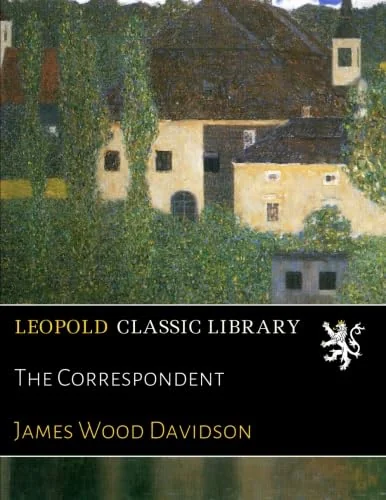
The Correspondent by James Wood Davidson front cover
The Correspondent attributed to James Wood Davidson is a restored reprint issued by Leopold Classic Library in June 2016. Leopold Classic Library is a specialist reprinting imprint that recovers historical and public-domain texts, reproducing them in standardized paperback editions for readers who want access to older works that have otherwise fallen out of print. The Davidson volume follows this model: it presents a historical text associated with nineteenth-century American writer James Wood Davidson, preserved in its original form. Readers approaching this title should understand clearly that it is not a new work of contemporary fiction, not an epistolary novel in the tradition of recent literary releases, and not connected in any way to the celebrated British-American critic James Wood, who is a staff writer and book critic at The New Yorker, the former chief literary critic of the Guardian, and the author of works including How Fiction Works and The Broken Estate: Essays on Literature and Belief. The name overlap is a meaningful source of confusion that any prospective buyer should resolve before purchasing.
the enduring value of thoughtful communication

Its Place in the Literary Landscape

James Wood Davidson (not to be confused with the New Yorker critic) was a nineteenth-century American author, and the Leopold Classic Library reprint exists to serve the narrow but genuine readership of scholars, historians, and collectors interested in recovering texts from that era. Leopold Classic Library positions its editions explicitly as restorations: the Amazon description frames this volume as "a masterfully restored literary treasure," emphasizing that the text has been preserved with care to bridge historical knowledge and contemporary access. That is the explicit promise of the imprint — documentary fidelity to a source text — rather than editorial enrichment, new introductory scholarship, or critical apparatus contextualizing the work for modern readers. Within the specialized reprint market, that is a coherent and legitimate purpose; evaluated as a scholarly critical edition, however, it is something more modest.

What the Edition Offers

The Leopold Classic Library edition's stated value proposition, drawn from its own promotional framing, centers on preservation: each word, readers are told, has been retained with care. For readers whose primary need is access to a text that would otherwise require a library archive or a rare-book search, that straightforward availability has genuine utility. The paperback format makes the text portable and reasonably affordable compared with antiquarian alternatives. The Amazon description characterizes Davidson's writing as marked by "insightful observations and eloquent prose," framing the work as relevant to "the enduring value of thoughtful communication" — though that characterization comes from the publisher's own promotional copy rather than from independent critical review, and should be weighed accordingly.

Genuine Limitations to Consider

The most significant limitation of this edition is structural rather than textual: Leopold Classic Library reprints are produced without new introductions, editorial notes, or scholarly context, which means a reader encountering Davidson's work for the first time receives no guidance on the historical moment that produced it, its original reception, or its significance within nineteenth-century American letters. For general readers rather than specialists, that absence can make the text harder to situate and appreciate. There is also the persistent confusion hazard: the title The Correspondent is shared by at least one highly praised 2025 contemporary novel — an epistolary work by Virginia Evans published by Crown/Penguin Random House, featuring protagonist Sybil Van Antwerp — and by other recent releases. Readers who arrive at the Davidson reprint via a general title search may be purchasing a work entirely unlike what they intended.

Who Will Find Value Here

This edition is most purposefully aimed at readers with a specific, pre-existing interest in James Wood Davidson's historical writing, at researchers working in nineteenth-century American literature, or at collectors building comprehensive holdings of a period's output. It is not an entry point for readers drawn in by the name "James Wood" expecting the New Yorker critic's analytical prose, nor is it a substitute for any of the contemporary novels sharing its title. Approached with clear expectations — as a reprint of a historical text, made accessible in a no-frills modern paperback — it fulfills the basic mandate Leopold Classic Library sets for itself. Approached with any other expectation, it is likely to disappoint.

Sources & Further Reading

The key facts and claims in this review are grounded in the retrieved, verified sources listed below.

  1. Cited in this review
  2. 1
  3. 2
  4. 3
  5. Further reading
  6. 4

    James Wood Davidson, Wikipedia