BOOKS
Published

Read Time

3 min read

Reader rating

4.7

· 977 Amazon ratings
reader ratings, not a LuvemBooks score
Curated & edited by

LuvemBooks Editorial

How we create our reviews →
Share This Review

The Perennial Philosophy by Aldous Huxley Review: A Landmark Comparative Study of Mysticism

First published in 1945 and reissued in a Harper Perennial Modern Classics edition in 2009, Aldous Huxley's The Perennial Philosophy remains one of the most ambitious anthological studies of mysticism in the English language — assembling sacred texts and mystical writings from across the world's great religious traditions to argue for a common spiritual ground beneath them all.

LuvemBooks Verdict

Best for

Serious readers of comparative religion or philosophy who want a thematically organized, primary-source anthology of cross-traditional mystical thought — from Taoism and Buddhism to Christian mysticism and Sufism — guided by Huxley's own synthesizing intelligence.

Worth it if

Worth engaging with if you're drawn to mysticism across traditions and are willing to sit with a deliberately slow-paced, meditative argument rather than a conventional survey of world religions.

Skip if

Skip it if you need rigorous academic apparatus — no specific source citations are provided for the assembled passages — or if you're new to the Christian tradition and the Bible, since Huxley's commentary assumes that familiarity as a baseline.

Kirkus Reviews described the work as tracing "the ultimate reality as apprehended by the 'pure in heart and poor in spirit,' by sages who were saints as well, by mystics rather than professional philosophers," situating it as a landmark in Huxley's intellectual evolution. The Contemplative Life notes a persistent critical reservation: some observers feel Huxley "finds too much commonality and not enough diversity in world mysticism" and effectively makes the pieces fit a predetermined common core — a tension that has shaped debate around the book since its first publication.

Passages connected by a commentary which expands, and where necessary, elucidates — indicating the evolution of Huxley's thinking from extreme negation to extreme ascetic faith.

Kirkus Reviews
Sources: Kirkus Reviews, The Contemplative Life
4.7from 977 Amazon ratings— reader ratings, not a LuvemBooks score
In This Review
  • What Works & What Doesn't
  • What the Book Actually Is
  • The Central Argument and Its Scope
  • Reception and Place in the Field
  • Genuine Strengths
  • Who It Suits and Where It Challenges

What Works & What Doesn't

What Works
  • Draws on an exceptionally wide range of primary mystical sources — Taoist, Buddhist, Islamic, Hindu, and Christian — assembled in one thematically organized volume
  • Deliberately surfaces lesser-known mystical writers alongside canonical figures, giving even well-read readers new material to encounter
  • Huxley's connecting commentaries provide an organizing intellectual framework without replacing the primary voices he anthologizes
  • Recognized at publication by the Reverend W. R. Inge in the journal Philosophy as 'probably the most important treatise we have had on mysticism for many years'
  • Reissued as a Harper Perennial Modern Classic, reflecting the book's enduring place in comparative religion and philosophy of mysticism
What Doesn't
  • No specific source citations are provided for the assembled passages, limiting the book's value as a scholarly reference for readers wishing to consult original texts
  • The book assumes prior familiarity with the Christian tradition and the Bible, which may create an uneven entry point for readers from non-Christian backgrounds or those new to religious literature
A sweeping comparative study of mysticism drawn from Eastern and Western sacred traditions, this book rewards serious readers while demanding genuine engagement with its dense, wide-ranging sources.

What the Book Actually Is

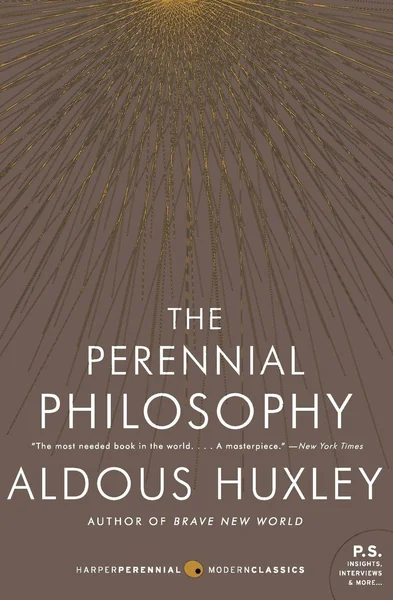
The Perennial Philosophy: A Study of Universal Mystical Philosophy (Harper Perennial Modern Classics) by Aldous Huxley front cover
The Perennial Philosophy, first published in 1945 by Harper & Brothers in the United States (and in 1946 by Chatto & Windus in the United Kingdom), is a comparative study of mysticism structured as an anthology. As Wikipedia's entry on the book explains, it is "essentially an anthology of short passages taken from traditional Eastern texts and the writings of Western mystics, organised by subject and topic, with short connecting commentaries." Huxley's method is curatorial and argumentative at once: he assembles primary source material — passages from the Bhagavad-Gita, from Chuang Tzu and the Chinese Taoist philosophers, from followers of Buddha and Mohammed, from the Brahmin scriptures, and from Christian mystics including St. John of the Cross and William Law — and uses these to build a cumulative case for what the book's jacket text calls the "Highest Common Factor of all theologies." Huxley gives deliberate preference to sources whose writings, as the British first-edition jacket states, are "often illuminated by genius" yet unfamiliar to most modern readers, making the anthology as much an act of excavation as synthesis.
insane and often criminal behaviour of the national societies we have created

The Central Argument and Its Scope

The title derives from the longstanding theological tradition of the philosophia perennis — the idea that beneath the surface differences of the world's religions lies a shared mystical core. Huxley does not set out to found a new religion; the British jacket text is explicit that his purpose is instead to analyze what he calls the "Natural Theology of the Saints," offering what he frames as an absolute standard of faith against which both individual moral life and collective societal behavior can be measured. That the book appeared immediately after the Second World War gave its argument about the "insane and often criminal behaviour of the national societies we have created" — language from the original jacket — a sharp contemporary urgency. The index alone signals the book's ambition: Aquinas, Augustine, St. Bernard, Buddha, Jean Pierre Camus, St. Catherine of Siena, Christ, the Cloud of Unknowing, and dozens more each receive sustained attention across multiple pages.

Reception and Place in the Field

Contemporary critical reception was divided but serious. Writing in the journal Philosophy, the Anglican priest Rev. W. R. Inge called the book "probably the most important treatise we have had on mysticism for many years" and commended its well-chosen quotations. Not all responses were as warm: as Wikipedia's reception summary records, C. E. M. Joad argued that Huxley's "intellectual whole-hoggery" led him toward ideas untempered by ordinary human experience, and Chad Walsh, writing in the Journal of Bible and Religion in 1948, took a skeptical view of Huxley's late-career turn to mysticism. This range of response at publication reflects the book's genuinely provocative ambition — it is not a work that has ever been easy to dismiss or easy to fully accept. Its place in the literature of comparative religion and philosophy of mysticism has proved durable, earning reissue as a Harper Perennial Modern Classic more than six decades after its original publication.

Genuine Strengths

The book's most distinctive strength is its design as a primary-source anthology guided by an organizing intelligence. Rather than paraphrasing other traditions, Huxley lets figures like Aquinas, the Buddha, and the Sufi mystics speak in their own voices, with his connecting commentaries functioning as editorial gloss rather than substitution. The British first-edition jacket notes that Huxley deliberately favors sources "unfamiliar to the modern reader," which gives the anthology genuine discovery value even for readers already versed in one or two traditions. The thematic organization by subject and topic — rather than by tradition or chronology — is a structuring choice that forces unexpected juxtapositions, placing Christian mysticism alongside Taoist philosophy and Brahmin scripture in ways that serve the book's central argument about shared mystical ground.

Who It Suits and Where It Challenges

The book is designed with an assumed baseline: as Wikipedia notes, readers are expected to arrive already familiar with the Christian religion and the Bible. Readers without that background may find the commentary's frame of reference harder to navigate. More broadly, the anthology's lack of specific source citations — as John Robert Colombo observed, "no specific sources are given" — limits the book's usefulness for anyone wishing to trace Huxley's selections back to their original contexts for deeper scholarly study. The work operates best as an introduction to cross-traditional mystical thought and as a humanistic argument rather than as a rigorous academic reference. Readers drawn to Huxley through his fiction will find a very different register here — systematic, meditative, and deliberately slow-paced — and those who come to the book expecting a conventional survey of world religions will find instead something closer to a sustained philosophical thesis illustrated by sacred literature.

Sources & Further Reading

The key facts and claims in this review are grounded in the retrieved, verified sources listed below.

  1. Cited in this review
  2. 1
  3. 2
  4. Further reading
  5. 3

    Aldous Huxley, Wikipedia

  6. 4
  7. 5
  8. 6
  9. 7