
9 min read
4.4
· 47,369 Amazon ratingsShare This Review
Brave New World by Aldous Huxley Review: A Foundational Dystopian Novel Still Unsettling
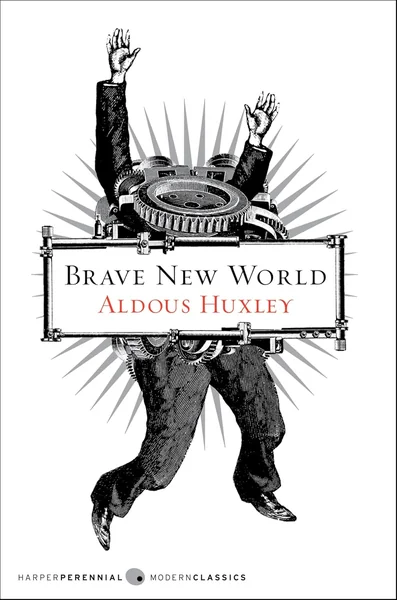
First published in 1932, Aldous Huxley's Brave New World remains one of the most celebrated and challenged dystopian novels in the English language — ranked number 5 on the Modern Library's list of the 100 Best Novels in English of the 20th century, and a perennial fixture on banned-books lists. Set in a future World State where citizens are biologically engineered into a rigid caste hierarchy and kept compliant through psychological conditioning and the pleasure-drug soma, the novel uses protagonist John the Savage to expose the hidden violence beneath a society engineered for contentment. Huxley's dense, philosophically charged prose rewards patient readers willing to wrestle with its ideas about freedom, technology, and the cost of stability.
LuvemBooks Verdict
Best for
Readers drawn to novels of ideas — particularly those curious about how dystopian fiction interrogates freedom, technology, and social control — who want to understand the canonical counterpart to Orwell's Nineteen Eighty-Four.
Worth it if
Worth reading if you're prepared to engage with a novel that argues a philosophical case as much as it tells a story, and whose central warning — that a society engineered for pleasure at the cost of freedom is its own form of tyranny — has only grown more relevant with biotechnology and algorithmic conditioning becoming everyday realities.
Skip if
Skip it, or approach with lowered expectations, if you need psychologically rich, emotionally intimate characters and a propulsive plot — Huxley's figures are primarily philosophical positions, and his prose is dense, elevated, and deliberately expository.
What readers & critics say
Wikipedia records that upon publication the novel was praised as the most accomplished work Huxley had written to that point, and by 1998–1999 the Modern Library had ranked it number 5 on its list of the 100 Best Novels in English of the 20th century. The Guardian's reader review identifies the novel's enduring tension as stability "only achieved by sacrificing freedom in its true sense and the idea of personal responsibility," while also noting Huxley's highly complex, adult-register prose as a genuine demand on the reader.
“Brave New World is a classic — stability is only achieved by sacrificing freedom in its true sense and the idea of personal responsibility.”
— The GuardianAge & Reading Level
Recommended age
Ages 16+
Reading level
Adult
4 content notes · who it suits
Content to know about
Best for: Adults / mature 16+ — frank treatment of state-mandated promiscuity, eugenics, and Huxley's deliberately elevated, philosophically dense prose suit older and adult readers.
Skip if you're looking for character-driven emotional drama or propulsive plotting.
Brave New World by Aldous Huxley is Trending
Brave New World Feels More Relevant Than Ever in 2026
Readers keep returning to Huxley's 1932 dystopia because its vision of engineered happiness, social stratification, and compliance-by-comfort hits uncomfortably close to home right now. It's one of those books that seems to find its audience in every generation — and this one is no exception.
Brave New World has never really gone away, but right now readers and booksellers are talking about it with fresh urgency. Bolen Books sums it up well: the novel is 'as prescient today as when it was first published in 1932,' describing a world that has become 'increasingly artificial, automated and socially stratified.' That description doesn't feel like a stretch in 2026, which is probably why people keep picking it up.
The book's core ideas — a population kept compliant through pleasure and conditioning rather than force, a rigid caste system baked in from birth, and a society that trades freedom for frictionless contentment — resonate deeply at a moment when conversations about AI, automation, algorithmic influence, and widening inequality are everywhere. Huxley imagined a dystopia that doesn't feel like oppression from the outside; it feels like comfort. That's a much harder thing to argue against, and readers seem to find that tension worth wrestling with right now.
If you haven't read it, or read it years ago in school, this is a good moment to give it your full attention. It's a demanding read — Huxley's prose is dense and philosophical — but the payoff is a book that genuinely changes how you look at the world around you.
In This Review
- What Works & What Doesn't
- What the Novel Actually Contains
- Place in the Canon and History of Reception
- What the Novel Does Well
- Genuine Limitations and Who May Struggle
- Relevance and Audience Today
What Works & What Doesn't
What Works
- Ranked number 5 on the Modern Library's 100 Best Novels in English of the 20th century, one of the most formally recognized works in the dystopian genre
- Its interlocking social mechanisms — biological caste engineering, sleep-learning, soma, enforced promiscuity — form a coherent and unsettling system rather than a collection of isolated conceits
- The Shakespearean irony embedded in the title and throughout the text rewards careful reading and adds layers of meaning to its critique of engineered contentment
- Huxley followed the novel with Brave New World Revisited (1958) and Island (1962), giving engaged readers a broader intellectual ecosystem to explore
- Its central argument — that stability purchased through the elimination of freedom and personal responsibility is its own form of tyranny — remains as pertinent as it was in 1932
What Doesn't
- Huxley's prose is dense and highly complex, with elaborate sentence constructions and elevated vocabulary that can be demanding for general or younger readers
- Characters function primarily as philosophical positions rather than psychologically developed individuals, which may disappoint readers seeking strong emotional or narrative intimacy
What the Novel Actually Contains
Place in the Canon and History of Reception
What the Novel Does Well
Genuine Limitations and Who May Struggle
Relevance and Audience Today
Frequently Asked Questions
Sources & Further Reading
The key facts and claims in this review are grounded in the retrieved, verified sources listed below.
- Cited in this review
- 1
- 2
- 3
- Further reading
- 4
Aldous Huxley, Wikipedia
- 5
en.wikipedia.org
- 6
- 7
- 8
- 9
- 10
words-and-dirt.com
- 11
reviewsfeed.net
- 12
nutfreenerd.com
- 13
barnesandnoble.com
Related Reviews
Reviews of books we picked for readers who enjoyed Brave New World.
Reader Comments
No comments yet
Be the first to share your thoughts!