BOOKS
Published

Read Time

3 min read

Curated & edited by

LuvemBooks Editorial

How we create our reviews →
Share This Review

Big Ideas for Curious Minds: An Introduction to Philosophy by The School of Life Review: Accessible Philosophy for Young Thinkers

Big Ideas for Curious Minds: An Introduction to Philosophy, edited by Alain de Botton and illustrated by Anna Doherty, is a children's illustrated book from The School of Life that distills ideas from 25 philosophers — including Socrates, Seneca, Hypatia of Alexandria, Simone de Beauvoir, and Matsuo Bashō — into conversational, practically framed chapters designed to help readers aged roughly 9–12 apply philosophical thinking to everyday life. Publishers Weekly calls it "a useful, if narrow, introduction to emotional intelligence via philosophical thought," and The Guardian named it among its Best Children's Books, praising it as "a plain-speaking guide to philosophers, what matters and how to deal with things."

LuvemBooks Verdict

Best for

Parents, primary school educators, and school librarians seeking a structured, illustrated entry point to philosophy for children aged roughly 9–12 who are already asking "why" questions about fairness, emotions, and how to treat others.

Worth it if

The reader wants philosophy framed as a practical, emotionally grounded toolkit — with relatable scenarios, biographical context, and reader prompts — rather than as a formal academic survey of the discipline.

Skip if

Anyone hoping for broad coverage of non-Western philosophical traditions or a more rigorous introduction to logic, metaphysics, or epistemology will find the book's scope too narrow for those purposes.

What readers & critics say

Publishers Weekly characterises the book as "useful, if narrow," noting it connects young readers to influential thinkers "via self-help tropes" and that the 25 philosophers featured are "mostly Western." The book was named among Critics Children's Books, a recognition cited by Barnes & Noble, which also quotes a Youth Services Book Review describing it as "a formidable introduction for a middle schooler interested in philosophy."

Connects young readers to influential thinkers via self-help tropes — useful, if narrow.

Publishers Weekly
Sources: Publishers Weekly, Barnes & Noble
4.8from 1,491 Amazon ratings— reader ratings, not a LuvemBooks score
In This Review
  • What Works & What Doesn't
  • What the Book Actually Is and Does
  • Its Place in Children's Philosophy Publishing
  • Strengths: Structure, Voice, and Range of Thinkers
  • An Honest Limitation: The Self-Help Framing and Its Narrowing Effect
  • Who This Book Is For

What Works & What Doesn't

What Works
  • Distills ideas from 25 named philosophers — including Socrates, Seneca, Hypatia of Alexandria, Simone de Beauvoir, and Matsuo Bashō — into individually structured, accessible chapters
  • Conversational prose explicitly introduces unfamiliar vocabulary and uses relatable everyday scenarios, making philosophical concepts approachable for readers with no prior background
  • Named by The Guardian among its Best Children's Books as 'a plain-speaking guide to philosophers, what matters and how to deal with things'
  • Each chapter is paired with a short biographical spread and reader prompts, giving the book practical, interactive depth beyond simple explanation
  • Represents The School of Life's first children's title, extending the organization's established approach to accessible philosophical and emotional intelligence
What Doesn't
  • Publishers Weekly characterizes the approach as 'useful, if narrow,' noting the book connects readers to thinkers primarily via self-help tropes rather than broader philosophical inquiry
  • The 25 philosophers featured are described by Publishers Weekly as 'mostly Western,' limiting the book's representation of non-Western philosophical traditions
A children's illustrated introduction to philosophy that is both genuinely accessible and, by design, deliberately bounded in scope.

What the Book Actually Is and Does

Big Ideas for Curious Minds: An Introduction to Philosophy by The School of Life front cover
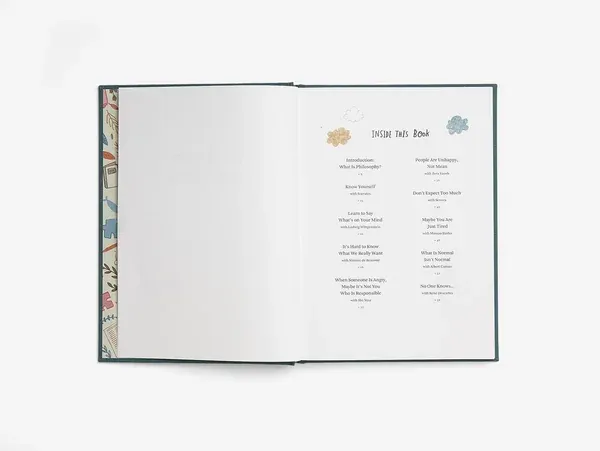
Big Ideas for Curious Minds: An Introduction to Philosophy is the first book for children from The School of Life, an organization co-founded by Alain de Botton, who serves here as series editor. The book's central argument — stated plainly within its pages — is that "philosophy helps us to live wise lives." Working from that premise, the volume distills ideas from 25 philosophers into individual chapters, each organized around a single, practically worded precept: "Know Yourself" from Socrates, "Don't Expect Too Much" from Seneca, "Why We Procrastinate" from Hypatia of Alexandria, and mindfulness toward small pleasures from the poet Matsuo Bashō, among others. Each chapter is written in a conversational register, illustrated by Anna Doherty, and followed by a short biographical spread on the philosopher in question, plus prompts designed to help readers work through their own concerns.

Its Place in Children's Philosophy Publishing

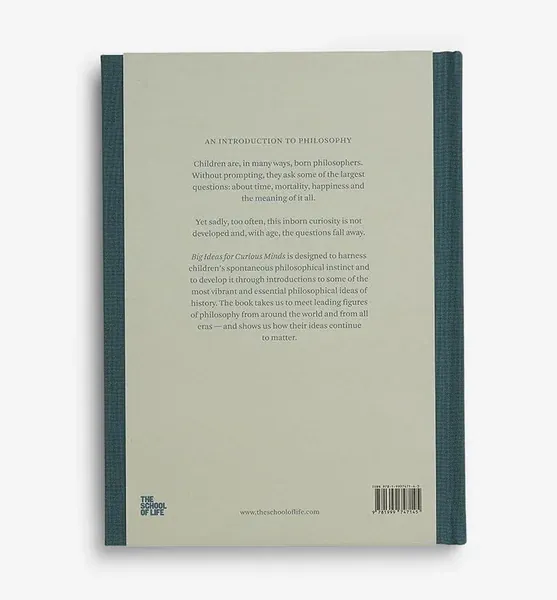
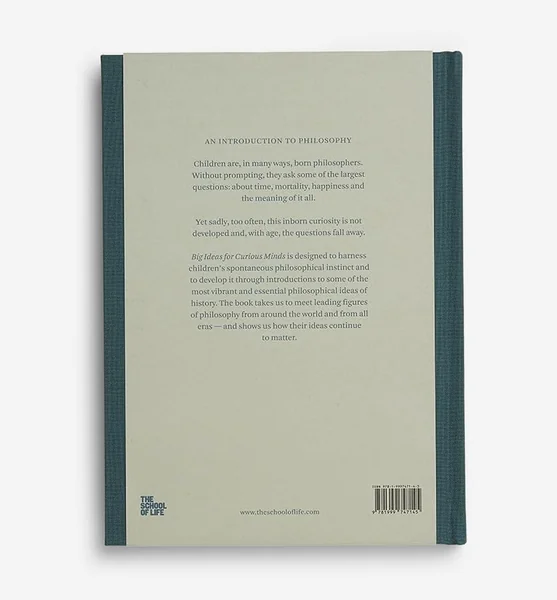
This is The School of Life's inaugural children's title, extending the organization's broader mission — already established in its adult publishing — of making philosophical and emotional intelligence accessible to general audiences. The book is designed, per The School of Life's own description, to "harness children's spontaneous philosophical instinct" and develop it through introductions to vibrant and essential philosophical ideas from history. The Guardian singled it out among its Best Children's Books, describing it as "a plain-speaking guide to philosophers, what matters and how to deal with things." That recognition reflects the book's ambition to occupy a specific and underserved niche: philosophy framed not as academic history but as a practical toolkit for young readers navigating real life.

Strengths: Structure, Voice, and Range of Thinkers

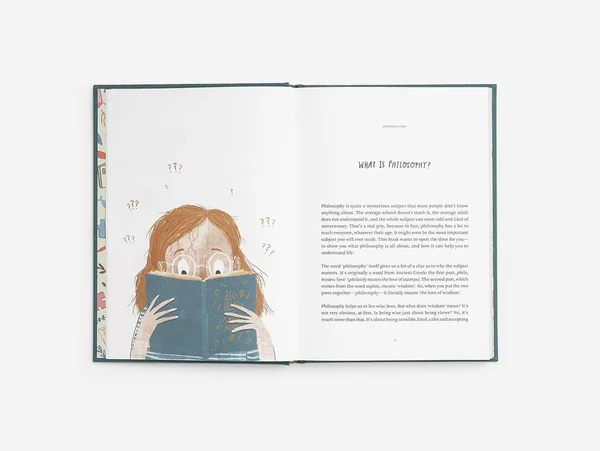
The book's chapter structure is one of its clearest design strengths. Each idea receives its own dedicated space, presented through relatable, everyday scenarios — a child putting off weekend homework to illustrate procrastination, for instance — before connecting that scenario to the relevant philosopher. The conversational prose is calibrated for readers who may have no prior exposure to philosophical vocabulary, explicitly acknowledging unfamiliar terms and easing readers into them. The roster of 25 philosophers is notably broad in ambition, spanning ancient Greece (Socrates), Roman Stoicism (Seneca), late antiquity (Hypatia of Alexandria), early modern France (Simone de Beauvoir), and classical Japanese poetry (Matsuo Bashō), among others. Anna Doherty's illustrations, which Publishers Weekly describes as "wide-eyed, Quentin Blake–esque figures," accompany each chapter and biographical spread. Chapter titles highlighted by readers include "People Are Unhappy, Not Mean," "Learn to Say What's on Your Mind," "Good Things Are (Unexpectedly) Hard," and "Politeness Matters" — titles that signal the book's focus on emotional and social intelligence alongside traditional philosophical thought.

An Honest Limitation: The Self-Help Framing and Its Narrowing Effect

Publishers Weekly's review is direct about the book's central trade-off: it connects young readers to influential thinkers "via self-help tropes," and the result is, in that review's measured verdict, "useful, if narrow." The philosophical tradition the book draws on is described as "mostly Western," which means the global sweep implied by phrases like "leading figures from around the world" in the publisher's own materials is not fully realized within the 25 thinkers selected. Readers or parents hoping for a survey of non-Western philosophical traditions — East Asian, South Asian, African, or Indigenous thought — will find limited coverage here. Additionally, the self-help framing, while effective for accessibility, means the book approaches philosophy primarily as a tool for emotional regulation rather than as a discipline concerned with logic, metaphysics, political theory, or epistemology. That is a deliberate editorial choice, not an oversight, but it does define what the book is and is not.

Who This Book Is For

The book is designed for readers in roughly the 9–12 age range — consistent with Publishers Weekly's own age guidance — and its chapter-by-chapter structure makes it suitable for reading in portions rather than straight through. It is oriented toward children who are already asking "why" questions about fairness, emotions, and how to behave, and who would benefit from seeing those questions reflected back through the ideas of named, historical thinkers. For parents, educators, and school librarians looking to introduce philosophical concepts as a framework for social-emotional learning, the book offers a structured, illustrated entry point grounded in recognizable names and ideas. Readers seeking a more comprehensive or academically rigorous survey of philosophy's full scope will need to look elsewhere, but as an emotionally focused, child-centered introduction to the subject, the book fulfills precisely what it sets out to do.

Sources & Further Reading

The key facts and claims in this review are grounded in the retrieved, verified sources listed below.

  1. Cited in this review
  2. 1
  3. 2
  4. 3
  5. Further reading
  6. 4

    The School of Life, Wikipedia

  7. 5
  8. 6
  9. 7
  10. 8
  11. 9
  12. 10