BOOKS
Published

Read Time

9 min read

Reader rating

4.6

· 768 Amazon ratings
reader ratings, not a LuvemBooks score
Curated & edited by

LuvemBooks Editorial

How we create our reviews →
Share This Review

Great Thinkers by The School of Life Review: A Curated Canon for Curious Minds

Great Thinkers: Simple Tools from Sixty Great Thinkers to Improve Your Life Today is a wide-ranging illustrated reference book that distils the intellectual canon of The School of Life — drawing on philosophy, political theory, sociology, psychotherapy, art, architecture, and literature — into accessible profiles designed to help readers navigate the dilemmas, joys, and griefs of everyday life.


Interior spread featuring a text passage on the left and a portrait photograph of a Native American man on the right.Back cover with book synopsis, publisher logo, and barcode.Book set showing boxed case with illustrated cover and two open interior spreads featuring text and portrait illustrations.Tap to enlarge

LuvemBooks Verdict

Best for

Curious generalists — especially those new to philosophy or the history of ideas — who want an accessible, visually engaging orientation to sixty influential thinkers across Eastern and Western traditions, filtered through The School of Life's lens of emotional intelligence and practical utility.

Worth it if

You want a durable single-volume browser's companion that makes millennia of human thought immediately relevant to everyday life, and you're happy to engage with an openly partial, editorially curated canon rather than a neutral academic survey.

Skip if

You're a specialist or advanced reader in any of the fields covered, or you want rigorous philosophical analysis and comprehensive intellectual history — the profiles are deliberately compressed and the canon is shaped by one organisation's therapeutic and aesthetic values, which may feel narrow or reductive.

Sobrief.com reports that Great Thinkers receives mostly positive reviews for its accessible introduction to influential thinkers, with readers appreciating its concise format and ability to spark interest in further exploration, though some criticise oversimplification of complex ideas. Mrulster.com's review notes the book is a compilation of sixty short essays dedicated to "developing emotional intelligence through the help of culture," while also raising a specific criticism about the dearth of women — pointing out that the first female thinker, Margaret Mead, appears only past the halfway point.

Sources: sobrief.com, mrulster.com
4.6from 768 Amazon ratings— reader ratings, not a LuvemBooks score

Preview the book

Great Thinkers: Simple tools from sixty great thinkers to improve your life today. (The School of Life Library) by The School of Life front cover
Interior spread featuring a text passage on the left and a portrait photograph of a Native American man on the right.
Back cover with book synopsis, publisher logo, and barcode.
Book set showing boxed case with illustrated cover and two open interior spreads featuring text and portrait illustrations.
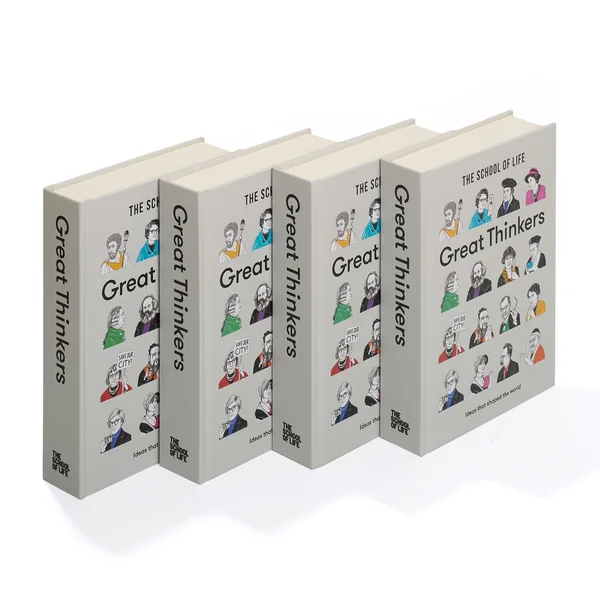
Box set of four volumes with cream spines featuring illustrated portraits of historical figures and thinkers.

Ask LuvemBooks

Was this helpful?

Great Thinkers: Simple Tools from Sixty Great Thinkers to Improve Your Life Today is an illustrated single-volume reference from The School of Life that distils sixty figures from philosophy, political theory, sociology, psychotherapy, art, architecture, and literature into accessible profiles designed to help readers apply great ideas to everyday life. Edited by Alain de Botton and illustrated by Stuart Patience, it is an ideal entry point for curious generalists who want orientation rather than academic rigour. Readers seeking comprehensive intellectual history or scholarly depth will find the canon purposefully narrow — a real constraint the book itself openly acknowledges.
Is it worth reading?
For curious generalists new to the history of ideas, Great Thinkers delivers genuine value: it makes millennia of human thought navigable in a single accessible volume, curated by one of the most recognised popularisers of philosophy for general audiences. The unusually broad sweep of disciplines — spanning psychotherapy and architecture alongside philosophy and literature — and the inclusion of Eastern alongside Western thinkers give it more range than its format might suggest. The key caveat is that specialists, advanced readers, or anyone seeking rigorous analytical engagement will find the profiles too compressed and the canon too shaped by The School of Life's therapeutic aesthetic to be satisfying. Readers who align with the premise that culture is a vehicle for self-understanding will find it a richly stocked companion.
Similar books
Readers who enjoy Great Thinkers will find strong common ground with other School of Life titles reviewed by LuvemBooks. A Simpler Life: A Guide to Greater Serenity, Ease, and Clarity by The School of Life shares the same practical, emotionally intelligent approach to self-improvement, while Big Ideas for Curious Minds: An Introduction to Philosophy by The School of Life offers a more foundational entry into philosophical thinking. Both titles carry the same accessible, visually considered house style and the same conviction that ideas are tools for living rather than objects of purely academic study.
Who should read this?
Great Thinkers is built for curious generalists — readers new to philosophy or the history of ideas who want orientation and practical relevance rather than exhaustive academic treatment. It also suits existing School of Life enthusiasts seeking a single volume that consolidates the organisation's intellectual framework. Readers who share the premise that culture and emotional intelligence are vehicles for self-understanding will find it most rewarding; those who prefer rigorous analytical philosophy, scholarly debate, or comprehensive coverage of intellectual history are likely to find the editorial lens too narrow.
About The School of Life
The School of Life is a British multinational publishing and education company founded in 2008 by British author and public speaker Alain de Botton.
How does this compare to other School of Life books?
Compared to Big Ideas for Curious Minds: An Introduction to Philosophy — also reviewed by LuvemBooks — Great Thinkers casts a wider disciplinary net, encompassing political theory, sociology, psychotherapy, art, and architecture alongside philosophy, and does so through the lens of individual thinker profiles rather than conceptual themes. A Simpler Life: A Guide to Greater Serenity, Ease, and Clarity is narrower in scope but shares the same practical, emotionally intelligent house style. Great Thinkers is the most ambitious in breadth of the three, functioning as something close to a master reference for The School of Life's intellectual canon at 480 pages.
What are the main themes of the book?
The overarching theme of Great Thinkers is that the history of human thought — spanning philosophy, political theory, sociology, psychotherapy, art, architecture, and literature — contains practical tools for navigating the dilemmas, joys, and griefs of everyday life. A secondary theme running through the entire volume is emotional intelligence: the book's selection of thinkers is explicitly shaped by a bias in favour of figures whose ideas serve consolation and self-understanding. The inclusion of Eastern alongside Western thinkers, and the unusually broad disciplinary range, reflect a further editorial commitment to treating intellectual history as a living resource rather than a fixed Western canon.

Summarize this book

Summarize this book

Great Thinkers is a curated illustrated reference volume published by The School of Life in 2018 and edited by Alain de Botton. It profiles sixty thinkers drawn from Eastern and Western traditions across philosophy, political theory, sociology, psychotherapy, art, architecture, and literature — each entry accompanied by original colour illustrations by Stuart Patience. Rather than pursuing encyclopaedic coverage, the book operates as an explicitly chosen canon: the figures The School of Life believes have the most to offer contemporary readers navigating the dilemmas, joys, and griefs of daily life. At 480 pages with a premium hardcover presentation including a ribbon marker and belly band, it is designed to be dipped into rather than read from cover to cover.

Follow up

How is each thinker's entry structured?
Does the book have a particular editorial slant?
What does the physical book look like?

Synthesized from verified book data & published reviews · How we review

Press Enter to ask. Answers come from our editorial Q&A — start typing to see related questions.

Age & Reading Level

Recommended age

Adult

Reading level

Adult

Skip if you want rigorous scholarly analysis or comprehensive coverage of intellectual history rather than an emotionally intelligent, editorially curated guide to great ideas.

Our Review

A functional reference book that makes millennia of human thought genuinely navigable for a general audience — though its editorial point of view is one readers should enter with open eyes.

What the Book Actually Is and Contains

Great Thinkers is a curated reference volume published by The School of Life in 2018 and edited by Alain de Botton. It profiles sixty thinkers drawn from Eastern and Western traditions across the fields of philosophy, political theory, sociology, psychotherapy, art, architecture, and literature. Rather than attempting an encyclopaedic survey of intellectual history, the book operates as an explicitly chosen canon: the collection of figures The School of Life believes have the most to offer contemporary readers. Each entry is accompanied by original colour illustrations by Stuart Patience. The book's stated ambition, as expressed in its introduction, is direct: it aims to succeed "if, in the days and years ahead, you find yourself turning to our thinkers to illuminate the multiple dilemmas, joys and griefs of daily life." That framing positions the volume less as a neutral academic reference and more as a practical guide to living, organised through the lens of intellectual history.
Back cover with book synopsis, publisher logo, and barcode.

Scope and Editorial Standpoint

One of the most important things to understand about Great Thinkers is that it makes no pretence of neutrality. The School of Life acknowledges in the book's introduction that its selection reflects deliberate bias — specifically, bias in favour of emotional intelligence and the use of culture as a tool for consolation and enlightenment. This transparency is disarming and useful. Readers approaching the book as a comprehensive history of ideas will find it purposefully partial; readers approaching it as The School of Life's argument for which thinkers matter most, and why, will find it coherent and consistent. The range of disciplines covered — spanning sociology and psychotherapy alongside the more expected philosophy and literature — gives the canon an unusually broad sweep for a book of this kind, and the inclusion of Eastern alongside Western thinkers signals a genuine, if editorially filtered, attempt at breadth.
Book set showing boxed case with illustrated cover and two open interior spreads featuring text and portrait illustrations.

Strengths: Accessibility and Design Intent
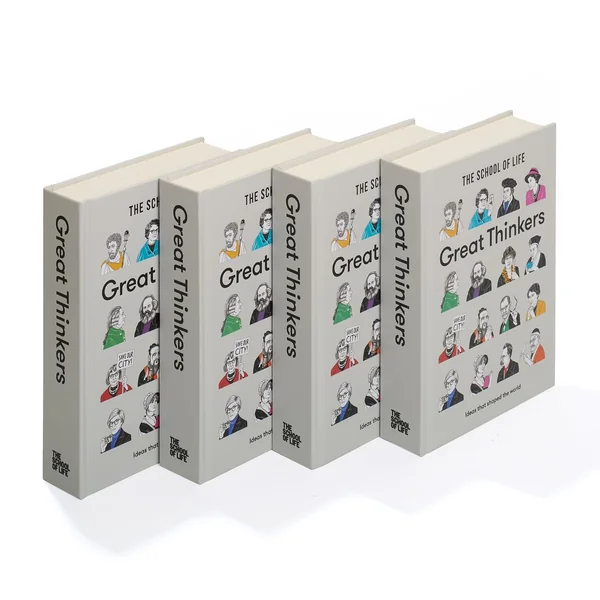
The book is explicitly designed to make complex intellectual traditions clear and relevant to non-specialist readers. The School of Life describes the effort as "mining the history of knowledge" to surface ideas of greatest importance to contemporary life, with each thinker's profile written to be clear, relevant, and approachable. The inclusion of original colour illustrations by Stuart Patience for each featured thinker gives the volume a visual structure that supports browsability — this is a book designed to be dipped into rather than read cover to cover, and its format supports that use. The premium gift presentation, including a ribbon marker and belly band, reflects The School of Life's characteristic attention to physical design as part of the reading experience.
Box set of four volumes with cream spines featuring illustrated portraits of historical figures and thinkers.

Genuine Limitations and Who It May Frustrate

The book's greatest strength — its strong editorial voice and emotional-intelligence focus — is also its most significant limitation. Readers who come to intellectual history expecting rigorous philosophical analysis, engagement with scholarly debate, or coverage of thinkers outside The School of Life's aesthetic and therapeutic orbit are likely to find the canon frustratingly narrow. The selection of sixty figures, however wide-ranging across disciplines, is ultimately shaped by one organisation's particular values. Specialists or advanced readers in any of the fields represented may find the profiles too compressed to be satisfying. This is a book built for curious generalists seeking practical relevance from great ideas, not for those seeking academic depth or comprehensive coverage. That is an honest design choice — but it is a real constraint worth naming.
Interior spread featuring a text passage on the left and a portrait photograph of a Native American man on the right.

Who It Is Genuinely For

Great Thinkers occupies a distinct and well-defined niche: it is an entry point, a gift, and a browser's companion for readers who want to understand why certain historical figures still matter, explained through a lens of emotional and practical utility. It suits readers new to philosophy or the history of ideas who want orientation rather than exhaustive treatment, as well as existing School of Life enthusiasts looking for a single volume that consolidates the organisation's intellectual framework. As a hardcover illustrated reference running to 480 pages and edited by Alain de Botton — one of the most recognised popularisers of philosophy for general audiences — it carries genuine curatorial authority within its stated remit. Readers who align with The School of Life's conviction that culture is a vehicle for self-understanding will find it a richly stocked companion; those who do not share that premise may find the framing reductive.

Sources & Further Reading

The key facts and claims in this review are grounded in the retrieved, verified sources listed below.

  1. Cited in this review
  2. 1
  3. 2
  4. Further reading
  5. 3

    The School of Life, Wikipedia

  6. 4
  7. 5
  8. 6
  9. 7
  10. 8

Books like Great Thinkers

Curated picks for readers who enjoyed Great Thinkers, with our reasoning for each match.