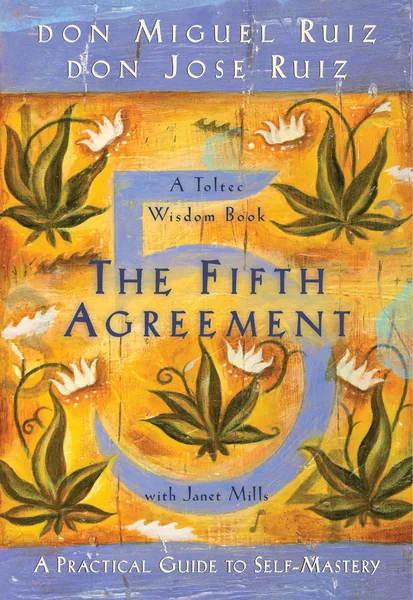
The Fifth Agreement, by don Miguel Ruiz, don Jose Ruiz, and Janet Mills, is a sequel to the New York Times bestseller The Four Agreements, revisiting Toltec wisdom with a fifth principle designed to deepen self-awareness and restore authenticity. It earns attention as a substantive expansion of the original framework rather than a simple repackage.
Readers who found The Four Agreements transformative and want to deepen their engagement with Toltec philosophy through a genuine conceptual development — not a retread — of the original framework.
Worth it if
Worth reading if you connected with The Four Agreements and are ready to interrogate inherited beliefs more rigorously through the lens of the fifth agreement's call to be skeptical yet open.
Skip if
Skip it if you prefer personal development grounded in contemporary psychology or empirical research, or if you haven't read the original and are wary of a sequel structure that delivers its full payoff only with prior context.
What readers & critics say
Thecannonmovement.com describes the book as "a thought-provoking and transformative read that expands upon the foundational principles of The Four Agreements," praising its encouragement of healthy skepticism and discernment. Reader voices on app.thestorygraph.com are more divided, with some finding the recapping of the original four agreements repetitive and the fifth agreement feeling like an afterthought rather than a meaningful addition.
The Fifth Agreement is a spiritual self-help sequel co-authored by don Miguel Ruiz, don Jose Ruiz, and Janet Mills that builds on the Toltec wisdom framework of the landmark The Four Agreements, introducing a fifth principle aimed at deepening self-awareness and reclaiming personal authenticity. Best suited for readers already familiar with the original, it functions as a genuine philosophical development rather than a repackage, revisiting the four foundational agreements before layering a new, transformative lens on top. Those seeking empirically grounded or psychology-backed personal development may find the ancient Toltec spiritual register less aligned with their preferences.
Is it worth reading?
For readers who found The Four Agreements transformative, The Fifth Agreement earns attention as a substantive expansion rather than a cash-in sequel — it genuinely develops the Toltec philosophy rather than simply restating it. The collaboration between don Miguel Ruiz and his son don Jose Ruiz brings a fresh generational voice to a teaching lineage with sustained global readership over decades. Those new to Toltec philosophy can use it as an entry point, though the full philosophical payoff is richer with context from the original. Readers seeking research-backed or empirically grounded personal development frameworks may find the spiritual register a poor fit.
The primary audience is readers who found The Four Agreements transformative and want to go deeper into the Toltec wisdom framework — the book is explicitly designed to deepen rather than replace that experience. Those coming to Toltec philosophy for the first time may find the framework rewarding, though they will gain less from the sequel structure than returning readers. It is not well-suited for readers seeking empirical, research-backed, or psychology-grounded personal development, as the spiritual and philosophical register is consistent throughout.
About don Miguel Ruiz
Miguel Ángel Ruiz Macías, better known as Don Miguel Ruiz, is a Mexican author of Toltec spiritual and personal development texts.
How does it compare to The Four Agreements?
The Fifth Agreement is a genuine sequel rather than a repackage — it revisits and recaps the original four agreements in a new light before introducing the fifth, which the authors frame as a deeper corrective lens for inherited beliefs and a path to reclaiming personal freedom. Where The Four Agreements introduced the foundational Toltec framework and the concept of human 'domestication,' The Fifth Agreement builds directly on that base, adding a new dimension rather than repeating the same material. The notable structural addition is the co-authorship with don Jose Ruiz, which introduces a fresh generational perspective absent from the original.
What are the main themes?
The Fifth Agreement centers on authenticity, self-knowledge, and the liberation from inherited conditioning. The authors argue that human beings are shaped by a 'collective dream' — the sum of social expectations absorbed during childhood — that obscures their innate wisdom, and that the five agreements serve as tools to reclaim personal freedom and a more authentic experience of the self. A key philosophical thread is skepticism toward inherited beliefs: the authors contend that the world perceived through the senses is not an accurate portrayal of reality, and that human beings are conditioned by symbology in ways that make all perceived truths relative.
Where should I start with don Miguel Ruiz?
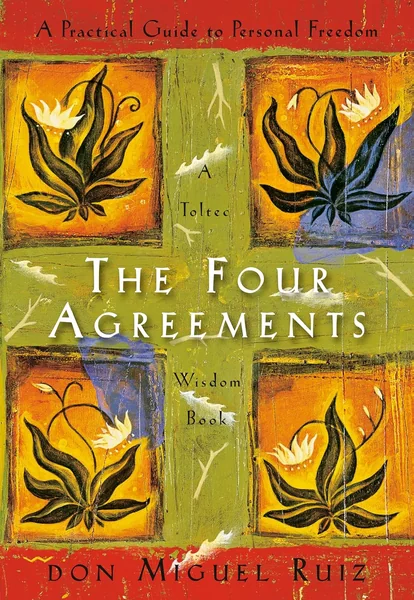
The natural starting point is The Four Agreements: A Practical Guide to Personal Freedom, the New York Times bestseller that introduced the Toltec wisdom framework and the concept of human 'domestication' to a global readership. The Fifth Agreement is designed to follow it, building directly on its foundation, so the reading order matters for the fullest experience. Both titles are part of the A Toltec Wisdom Book series, which provides a coherent shelf of Ruiz teachings.
Summarize this book
Is it worth reading?
Who should read this?
About don Miguel Ruiz
How does it compare to The Four Agreements?
What are the main themes?
Where should I start with don Miguel Ruiz?
Summarize this book
The Fifth Agreement is a self-help and spiritual philosophy book co-written by don Miguel Ruiz, don Jose Ruiz, and Janet Mills, published by Tarcher as a direct sequel to don Miguel Ruiz's landmark The Four Agreements. It revisits the Toltec concept of human 'domestication' — the idea that habits, attitudes, and behaviors absorbed from society during childhood cause people to forget their innate wisdom — and introduces a fifth agreement as a corrective lens for skepticism toward inherited beliefs and a return to authentic selfhood. The book is structured to recap the original four agreements before presenting the fifth, giving new readers enough grounding to engage while offering returning readers a genuine deepening of the philosophy.
Synthesized from verified book data & published reviews · How we review
Ask LuvemBooks
What would you like to know about The Fifth Agreement?
Answers come from our editorial notes on this book. If we haven't covered something, we'll say so.
Readers often ask
Our Review
We review the evidence: published critics, reader verdicts and BookTube reviews, gathered and weighed with AI assistance and edited by LuvemBooks, rather than one reader's first-hand take.
A sequel that earns its place alongside the original, The Fifth Agreement builds on Toltec wisdom to invite deeper self-knowledge.
What the Book Is and What It Argues
The Fifth Agreement is a self-help and spiritual philosophy book co-written by don Miguel Ruiz, don Jose Ruiz, and Janet Mills, published in paperback by Tarcher. It functions as a direct sequel to don Miguel Ruiz's landmark The Four Agreements, which introduced the concept that the process of human "domestication" — the habits, attitudes, and behaviors absorbed from parents, teachers, and society during childhood — causes people to forget the wisdom they were born with.
Don Miguel Ruiz described this collective conditioning as a "collective dream," the sum of what society expects of us. The Fifth Agreement returns to that foundation and layers a new, fifth agreement on top, one the authors frame as a pathway to a deeper awareness of the power of the Self and a return to the authenticity each person was born with.
The Collaboration and Its Context
The book marks a notable creative shift: for the first time, don Miguel Ruiz co-authors a Toltec Wisdom title with his son, don Jose Ruiz. That collaboration is central to the book's design, with don Jose bringing his own voice to a lineage of teaching that has reached readers worldwide.
Don Miguel Ruiz's background is itself remarkable — he graduated from medical school in Mexico City and worked as a practicing neurosurgeon in Tijuana before a near-fatal car crash redirected the course of his life toward Toltec philosophy. That trajectory from surgeon to spiritual teacher informs the analytical yet accessible register that distinguishes the Ruiz body of work.
The Fifth Agreement is part of the A Toltec Wisdom Book series, situating it within a coherent shelf of titles rather than as a standalone departure.
The Core Framework and Its Expansion
At its heart, the book presents five "agreements" — principles the authors describe as intuitively common-sense commitments that most people recognize but few consistently practice. The first four agreements were established in the predecessor volume; The Fifth Agreement both recaps those and introduces the fifth, which is framed as a tool for transforming one's life and reclaiming personal freedom.
The authors argue that the world experienced through the senses is not an accurate portrayal of reality, and that human beings are conditioned by symbology in ways that make all perceived truths relative. The fifth agreement is offered as a corrective lens — a way to be skeptical of inherited beliefs while remaining open to a more authentic experience of the self.
Dan Millman, author of Way of the Peaceful Warrior, has described the Ruiz approach as distilling "essential Toltec wisdom, expressing with clarity and impeccability what it means for men and women to live as peaceful warriors in the modern world."
Strengths and What the Book Is Designed to Do
As Penguin Random House's description notes, The Fifth Agreement is conceived to take readers "to a deeper level of awareness of the power of the Self." For readers already familiar with The Four Agreements, that depth is the primary draw — the sequel is not a repetition but a genuine development of the philosophy.
The book is structured to revisit the original four agreements in a new light before introducing the fifth, giving readers who are new to the series enough grounding to engage without requiring a separate read of the first book. The authors ground their teaching in the Toltec tradition, a lineage that, as the wider series demonstrates, has sustained substantial global readership over decades.
Who This Book Is For and Where It Has Limits
Readers who found The Four Agreements transformative are the natural audience here, and the book is explicitly designed to deepen rather than replace that experience. Those coming to Toltec philosophy for the first time may find the framework rewarding, but the sequel structure means the full payoff is richer for those with context from the original.
Readers seeking empirical or research-backed frameworks for personal development may find the Toltec philosophical mode — rooted in ancient wisdom tradition rather than contemporary psychology — less suited to their preferences. The book's spiritual register is consistent throughout, which is a strength for its intended readership and a limitation for those outside it.
Sources & Further Reading
The key facts and claims in this review are grounded in the retrieved, verified sources listed below.
Skip if you prefer empirically grounded or research-backed personal development over ancient wisdom traditions.
Don Miguel Ruiz on The Fifth Agreement
Don Miguel Ruiz speaks with Charlamagne tha God about Toltec wisdom, mastering awareness, and the teachings behind The Four Agreements and The Fifth Agreement.
Ruiz considers practicing skepticism while learning to listen the most crucial agreement because the initial four agreements merely prepare a person for it. He explains that applying doubt to one's own assumptions frees individuals from the untruths they tell themselves.
From our readers
Reader reviews
Be one of the first readers to answer.
Read it? Was it right for you?
Books like The Fifth Agreement
Curated picks for readers who enjoyed The Fifth Agreement, with our reasoning for each match.