
At a glance
About the Author
DK3 books reviewed
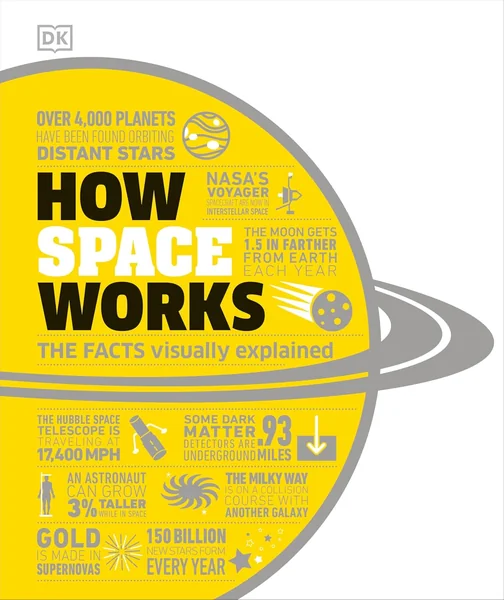
How Space Works
The Facts Visually Explained
by DK
LuvemBooks Verdict
Best for: A curious teen (14+) or adult newcomer who wants an attractive, browseable first reference that answers concrete space questions without assuming any science background.
Worth it? Skip it? Read the full verdict →Preview the book
Ask LuvemBooks
Was this helpful?
- Is it worth reading?
- For its intended reader, yes — the strongest documented reception is a starred Booklist review praising how a breadth of information is covered in a browsable format, and that notice comes from a publication that reviews reference material professionally. The spread-based design means ten minutes or two hours both yield something, and no prior knowledge is assumed. The honest limits: readers who already know their pulsars from their quasars will find little new here, and anyone seeking mathematical treatment or astrophysical depth should pick a different kind of book entirely.
- Similar books
- Readers ready to move past the beginner stage should consider The Biggest Ideas in the Universe: Space, Time, and Motion by Sean Carroll or Stephen Hawking's classic A Brief History of Time, both of which offer more argument and depth. Those who love the visually explained format itself will find a kindred spirit in David Macaulay's The Way Things Work, and DK's companion volume How Science Works applies the same formula beyond astronomy. For a focused modern take, Brian Cox and Jeff Forshaw's Black Holes: The Key to Understanding the Universe goes deep on one subject, while Randall Munroe's What If? delivers rigorous science in a playful Q&A register.
- Who should read this?
- The book is pitched explicitly at armchair astronomers and space-technology enthusiasts — people who want reliable, current facts without a physics prerequisite. LuvemBooks' review identifies three ideal readers: a teenager developing an interest in astronomy, an adult who watches rocket launches and wants the background science explained plainly, and a household that wants one reliable, attractive reference for the questions space documentaries raise.
- What age is it for?
- Best for ages 14 and up, which is the book's listed reading age. That floor is about comprehension, not content: it is a reference work that assumes a confident teen reader, even though no science background is required. The visual, jargon-free format positions it for teens and adults rather than as a children's picture book.
- Is it a good gift book?
- Yes — LuvemBooks' review calls it a gift book in the best sense: substantial, browsable, and pitched so that no prior knowledge is assumed. It is a heavily illustrated hardcover of around two pounds, designed as an at-home reference to be pored over, which makes it a physical present with real presence. The one caveat for gift-givers: it suits a curious beginner, so an astronomy-savvy recipient would likely already know everything in it.
- How does it compare to DK's Big Ideas books?
- They share a publisher and a philosophy — complex subjects made accessible through strong visual organization and plain language — but sit in different series. How Space Works belongs to the How Stuff Works line of facts visually explained, organized as discrete browsable spreads, while The Psychology Book: Big Ideas Simply Explained and The Philosophy Book, both reviewed by LuvemBooks, come from the Big Ideas Simply Explained strand. A reader who enjoys DK's approach in one subject can expect the same beginner-first design sensibility across the others.
- Hardcover or ebook — which edition?
- The hardcover is the definitive edition: this is a heavily illustrated DK volume of around two pounds, designed as an at-home reference to be pored over — a feature for a shelf and a drawback for a bag, in the review's phrasing. Ebook editions are stocked by major booksellers, but the book's entire value proposition is its bold graphics and annotated spreads, which are experienced best at full print size. Buyers who want portability should know they are trading away the book's core strength.
Summarize this book
Follow up
Synthesized from verified book data & published reviews · How we review
Press Enter to ask. Answers come from our editorial Q&A — start typing to see related questions.
Age & Reading Level
Recommended age
Ages 12–18
Reading level
Young adult
who it suits
Best for: Ages 14+ — the publisher's stated reading age; no science background is assumed, but the reference format expects a confident teen reader.
Skip if you already know your pulsars from your quasars — this breadth-first visual survey is a starting map, and anyone past the beginner stage will find little new in it.
Editorial Review
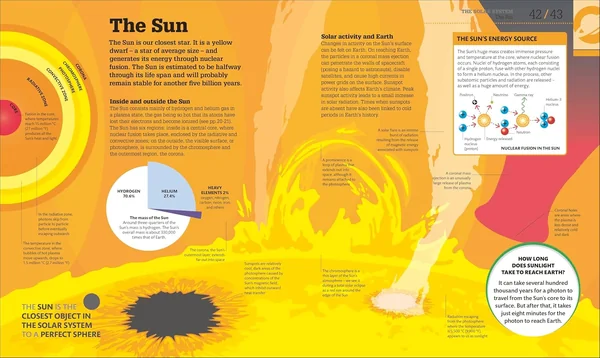
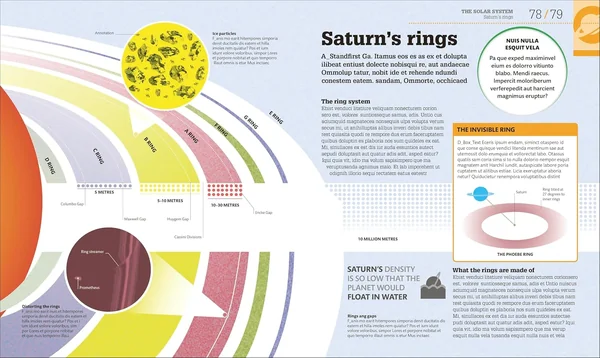
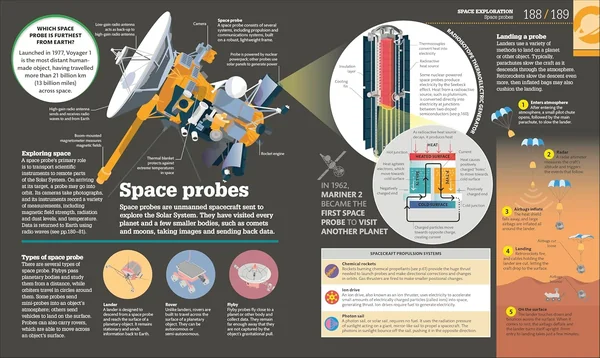
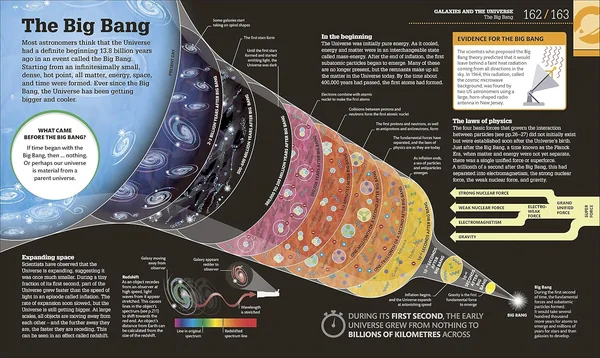
How Space Works: The Facts Visually Explained is DK's illustrated, jargon-free tour of the Universe — from the Big Bang and white dwarfs to the Mars Rover — built on bold graphics and step-by-step artworks. A starred Booklist review backs its browsable, beginner-first design.
Read the Full ReviewRelated reading
Adjacent titles worth exploring. We haven't reviewed these yet, so they link out to Amazon.