8 min read
4.6
· 18,750 Amazon ratingsShare This Review

Our review
What If?
What If? by Randall Munroe Review: Science Meets Absurdity With Rigorous Delight
What If?: Serious Scientific Answers to Absurd Hypothetical Questions is a New York Times bestseller from Randall Munroe — xkcd creator and former NASA roboticist — that applies genuine scientific methodology to deliberately ridiculous questions, making it one of popular science's most inventive and entertaining reference-style works. This review covers the book's content and published reception; it does not represent hands-on use or testing of the science within.


 Tap to enlarge
LuvemBooks Verdict
Best for
Curious general readers and science enthusiasts — especially fans of xkcd or anyone who wants to see what genuine scientific thinking looks like when applied without restraint to gloriously absurd premises.
Worth it if
You want popular science that is neither dumbed down nor self-serious, and you're happy dipping in and out of self-contained chapters rather than following a linear argument.
Skip if
You're seeking a conventional popular-science book with a cumulative narrative or progressive depth — the deliberately loose, episodic structure and xkcd-native comedic register won't satisfy that need.
What readers & critics say
The Scholarly Kitchen praised the book as "one of my favorite journeys… from the ridiculous to the sublime," noting that the answers illuminate genuine scientific phenomena as a byproduct of chasing absurd premises to their logical ends. Wired called it "a great book" overall, while PPLD described it as answering completely strange questions "with complete scientific accuracy, and a bit of humor."
Sources: The Scholarly Kitchen, Wired, PPLDPreview the book
Ask LuvemBooks
Was this helpful?
- Is it worth reading?
- For readers who want popular science that is neither dumbed down nor self-serious, What If? is one of the more distinctive titles in the genre — a New York Times bestseller and a recurring recommendation across popular-science reading lists. Munroe's methodology is both the joke and the substance simultaneously: the absurdity of each premise forces readers through the actual underlying mechanics of lightning, orbital mechanics, thermodynamics, and relativistic physics in order to arrive at an answer. The episodic format is a genuine strength for casual reading, though readers seeking a conventional popular-science book with a linear argument or progressive depth will find the structure deliberately loose.
- Similar books
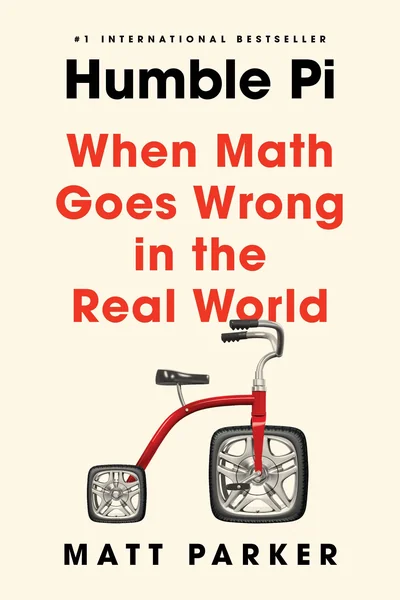
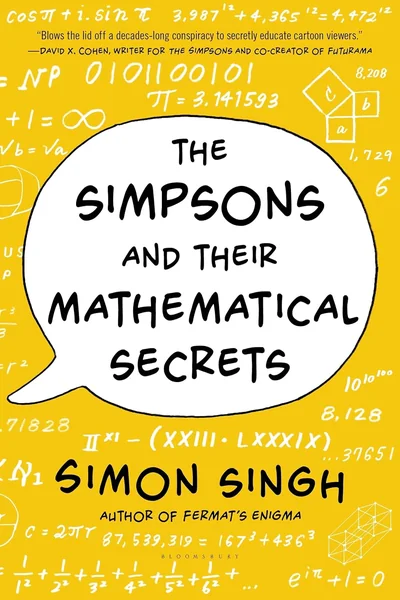
- Readers who enjoy What If? will find strong companions in several titles that blend rigorous thinking with wit and accessibility. Matt Parker's Humble Pi: When Math Goes Wrong in the Real World shares Munroe's delight in using real-world absurdity as a vehicle for genuine mathematical insight. Sean Carroll's The Biggest Ideas in the Universe: Space, Time, and Motion offers a more sustained but still accessible treatment of the physics concepts — relativity, thermodynamics, and motion — that underpin many of Munroe's answers. Simon Singh's The Simpsons and Their Mathematical Secrets similarly bridges pop-culture familiarity and serious mathematical content, making it another natural follow-on for readers who appreciate science communicated through an unexpected lens.
- Who should read this?
- What If? is designed for curious general readers, science enthusiasts, and fans of Munroe's xkcd webcomic. Its accessible framing of real scientific concepts also makes it a credible gateway for younger readers developing an interest in physics and quantitative reasoning. Readers who are already comfortable with an internet-native, physics-adjacent comedic sensibility will get the most out of the book; those who prefer conventional popular-science narratives with a linear argument may find the episodic structure less satisfying.
- What age is it for?
- What If? is broadly suited to readers aged 13 and up, with confident middle-schoolers and high-schoolers likely to find the question-driven format especially engaging as a gateway into physics and quantitative reasoning. The science involves concepts like relativistic collisions, thermodynamics, and orbital mechanics, which reward readers with some foundational science exposure, though Munroe's explanations are accessible rather than textbook-dense. Adult readers and science enthusiasts of all ages are the book's primary audience.
- What's the reading experience like?
- One published reviewer described the experience as 'one of my favorite journeys… from the ridiculous to the sublime,' capturing how each chapter illuminates specific scientific phenomena — why temperature in space is a fraught concept, how to calculate momentum for a rocket engine turned inward on a submarine — as a byproduct of chasing a silly premise to its logical end. Munroe's drawing style, described by that same reviewer as 'spare, efficient, and winning,' is integral rather than supplementary, with xkcd-style comics credited in publisher materials as central to the book's communication. The answers 'often predict the complete annihilation of humankind, or at least a really big explosion,' which is both accurate and central to the appeal.
- How scientifically credible is it?
- Munroe's credentials are substantive: he studied physics at Christopher Newport University and built robots at NASA Langley Research Center before leaving in 2006 to produce xkcd full-time. In the book, he applies genuine methodology — computer simulations, differential equations, declassified military research memos, and consultation with nuclear reactor operators — to each question. Bibliographical references (pages 299–303) further reflect a commitment to sourcing that distinguishes What If? from lighter popular-science fare. The humor never came at the cost of rigor.
Summarize this book
Follow up
Synthesized from verified book data & published reviews · How we review
Press Enter to ask. Answers come from our editorial Q&A — start typing to see related questions.
Our Review
What the Book Actually Is and Does
The Significance of Munroe's Background
Strengths: Clarity, Humor, and Intellectual Modeling
Limitations and Who May Be Frustrated
Who This Book Is Genuinely For
Sources & Further Reading
The key facts and claims in this review are grounded in the retrieved, verified sources listed below.
- Cited in this review
- 1
- 2
- Further reading
- 3
- 4
- 5
- 6
- 7
- 8
- 9
- 10
- 11
Age & Reading Level
Recommended age
Adult
Reading level
Adult
who it suits
Skip if you want a popular-science book with a linear argument, structured progression, and cumulative depth.
Reader reviews
Be one of the first readers to answer.
Read it? Was it right for you?
Books like What If?
Curated picks for readers who enjoyed What If?, with our reasoning for each match.

If you liked What If?