BOOKS
Published

Read Time

3 min read

Curated & edited by

LuvemBooks Editorial

How we create our reviews →
Share This Review

Chaos: Making a New Science by James Gleick Review: The Landmark Popular Science Classic

James Gleick's Chaos: Making a New Science is the book that brought chaos theory out of specialist journals and into the public imagination — a New York Times bestseller, a finalist for both the Pulitzer Prize and the National Book Award, and, according to Wikipedia, the first popular book ever written on the subject.

LuvemBooks Verdict

Best for

Curious general readers with no specialist mathematics background who want to understand how chaos theory emerged and why it matters — told through the human stories of the scientists who built it.

Worth it if

You want the definitive popular account of one of the twentieth century's most consequential scientific revolutions, delivered as a narrative of discovery rather than a textbook.

Skip if

Readers seeking a rigorous, complete mathematical historiography of chaos theory — particularly the foundational contributions of Cartwright and Littlewood — will find the narrative focus leaves meaningful scholarly gaps.

What readers & critics say

Wikipedia identifies Chaos as the first popular book about chaos theory and notes it was a finalist for both the National Book Award and the Pulitzer Prize in 1987, remaining widely used as an introduction for the mathematical layperson. Kirkus Reviews observed, a quarter-century after publication, that the idea of a chaotic world had become commonplace in large part due to the success of Gleick's book, which made the so-called butterfly effect a household term.

The idea of a chaotic world is commonplace — in large part due to the success of Gleick's book, which made the butterfly effect a household term.

Kirkus Reviews
Sources: Wikipedia, Kirkus Reviews
4.5from 3,277 Amazon ratings— reader ratings, not a LuvemBooks score

Look inside the book

Preview the actual pages, via Google Books
Trending Now
Cultural Resurgence

Chaos: Making a New Science by James Gleick is Trending

Chaos Theory Back in the Conversation as Readers Seek Big-Picture Science

James Gleick's landmark book on chaos theory keeps finding new readers, and right now it feels especially relevant — a moment when unpredictability in technology, climate, and everyday life has people reaching for frameworks that make sense of it all.

The search results around this book don't point to a single news event, but Gleick's Chaos is the kind of title that never really goes away — and lately it seems to be making the rounds again. Readers who enjoy big-idea science writing are rediscovering it, and it's easy to see why it keeps coming back into focus.

We're living through a period where the word 'chaos' gets thrown around a lot — in conversations about AI unpredictability, extreme weather, financial markets, and geopolitics. Gleick's book was the first to explain to a general audience how seemingly random systems actually follow deeper patterns, and that idea resonates just as much in 2026 as it did when the book was first published. It's the kind of read that makes you feel like you understand the world a little better.

If you haven't picked this one up yet, it's genuinely accessible — Gleick is a science writer first, not a mathematician, and he wrote this specifically for curious readers with no specialist background. It's a classic for a reason, and right now feels like exactly the right time to give it a try.

Read more
Updated Jun 17, 2026
In This Review
  • What Works & What Doesn't
  • What the Book Is and What It Argues
  • Historical Significance
  • Strengths: Accessibility, Structure, and Scientific Breadth
  • A Notable Scholarly Critique
  • Who This Book Is For Today

What Works & What Doesn't

What Works
  • The first popular book ever written on chaos theory, giving it a foundational place in the popular science canon
  • Finalist for both the Pulitzer Prize and the National Book Award in 1987, and a New York Times bestseller with over a million copies sold
  • Explains the Mandelbrot set, Julia sets, and Lorenz attractors without requiring advanced mathematics, making it genuinely accessible to the mathematical layperson
  • Chronological, scientist-by-scientist structure turns abstract theory into a compelling human narrative spanning dozens of contributors
  • Endorsed by Robert Sapolsky as the most influential book in his thinking about science since college
What Doesn't
  • Freeman Dyson specifically critiqued the book for omitting the foundational contributions of Dame Mary L. Cartwright and J. E. Littlewood, a gap that matters to readers seeking a complete mathematical history of the field
  • The narrative focus on a particular cohort of scientists, while effective for general audiences, means the book functions as popular history rather than a rigorous scholarly account
Nearly four decades after its original publication, Chaos: Making a New Science remains the definitive popular introduction to one of the twentieth century's most consequential scientific revolutions.

What the Book Is and What It Argues

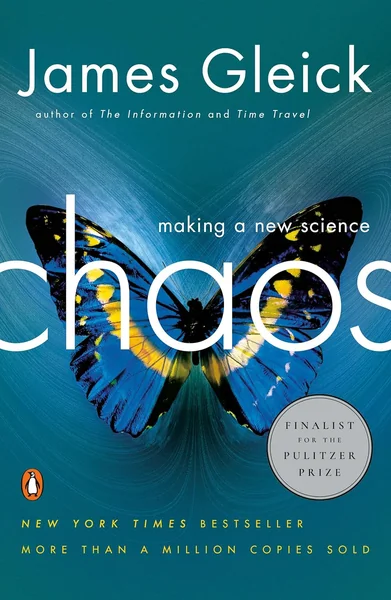
Chaos: Making a New Science by James Gleick front cover
Chaos: Making a New Science is a work of popular science non-fiction in which James Gleick chronicles the birth and early development of chaos theory for a general audience. As Wikipedia records, Gleick organizes the narrative chronologically, opening with meteorologist Edward Norton Lorenz and his discovery of what became known as the butterfly effect, moving through the work of physicist Mitchell Feigenbaum, and extending to more modern applications of the field. The book is structured so that each chapter profiles a particular scientist or group of scientists whose research contributed to the emerging discipline, while the arc of the whole recounts how chaos theory coalesced from separate strands of inquiry across multiple fields. Gleick frames the subject around four core themes — sensitive dependence on initial conditions, self-similarity, universality, and nonlinearity — and describes mathematical objects such as the Mandelbrot set, Julia sets, and Lorenz attractors without requiring the reader to engage with advanced mathematics. The publisher's description, echoed at Barnes & Noble, positions the book as popular science in the tradition of Stephen Hawking and Carl Sagan.

Historical Significance

First published on October 29, 1987, by Viking Books, Chaos holds a genuinely rare distinction: Wikipedia identifies it as the first popular book about chaos theory, making it not merely a document of a scientific moment but the primary vehicle through which that moment reached the broader public. Kirkus Reviews noted, a quarter-century after publication, that the idea of a chaotic world had become commonplace in large part because of the success of Gleick's book, which made the so-called butterfly effect a household term. The book went on to sell over a million copies, achieving New York Times bestseller status and earning finalist nominations for both the Pulitzer Prize and the National Book Award in 1987, as well as a shortlisting for the Science Book Prize in 1989. That constellation of recognition — commercial, critical, and institutional — is unusual in popular science writing and reflects the book's reach well beyond any single readership.

Strengths: Accessibility, Structure, and Scientific Breadth

One of the book's most documented achievements is its ability to convey complex mathematical ideas to readers without a specialist background. Wikipedia notes that it describes sophisticated mathematical constructs without using complicated mathematics, and the text has remained continuously in print, widely used as an introduction to the topic for the mathematical layperson. The chronological, scientist-by-scientist structure serves both clarity and narrative momentum: rather than presenting chaos theory as an abstract system, Gleick renders it as a human story of discovery, populated by dozens of researchers whose separate contributions gradually formed a new science. The Penguin Books description frames this as making the story of chaos theory not only fascinating but also accessible to beginners. Neuroscientist Robert Sapolsky offered one of the most striking individual endorsements on record, stating: "Chaos is the first book since Baby Beluga where I've gotten to the last page and immediately started reading it over again from the front: I've found this to be the most influential book in my thinking about science since college."

A Notable Scholarly Critique

No honest account of Chaos can omit the criticism leveled by the distinguished physicist Freeman Dyson. While praising the book's popular account, Dyson, as recorded by Wikipedia, critiqued Gleick for omitting the earlier foundational work of Dame Mary L. Cartwright and J. E. Littlewood in forming the basis of chaos theory. This is a substantive scholarly objection: readers who come to the book seeking a complete historiography of the field's mathematical roots may find the narrative incomplete at that specific point. The book's chronological focus on a particular cohort of scientists, while effective as popular storytelling, necessarily compresses a longer disciplinary prehistory. Specialists in the history of mathematics are the most likely audience to find this gap meaningful; for the general reader the book was designed to serve, it remains a foundational text.

Who This Book Is For Today

The Penguin Books anniversary and reprint edition makes Chaos readily accessible to a new generation of readers. The book is designed for anyone curious about why classical physics fails to describe the irregular, unpredictable behavior observable throughout nature — from weather systems to turbulence to population dynamics — and who wants to understand how scientists came to grapple with that irregularity. Because Gleick builds the science through biography and narrative rather than equations, readers with no mathematics background beyond secondary school are the clear intended audience. For those who want a multimedia experience, an enhanced ebook edition released by Open Road Media in 2011 added embedded video and hyperlinked notes. Readers who already have a strong technical grounding in dynamical systems will find this a work of history and communication rather than instruction. As a cultural and scientific artifact — the book that, by documented account, put chaos theory on the map for the general public — its place in the popular science canon is secure.

Sources & Further Reading

The key facts and claims in this review are grounded in the retrieved, verified sources listed below.

  1. Cited in this review
  2. 1

    publishersweekly.com

  3. 2
  4. 3

    kirkusreviews.com

  5. Further reading
  6. 4
    James Gleick — author profileHigh-authority source

    James Gleick, Wikipedia

  7. 5
  8. 6
  9. 7
  10. 8
  11. 9
  12. 10
  13. 11