
8 min read
4.6
· 11,547 Amazon ratingsShare This Review
Our review
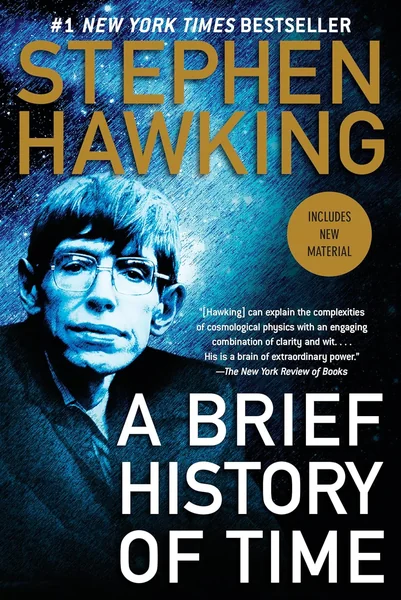
A Brief History of Time by Stephen Hawking Review: A Landmark of Popular Science Writing
First published in 1988, Stephen Hawking's A Brief History of Time remains one of the most consequential works of popular science ever written, having sold more than 25 million copies in 40 languages and earned a place on Time magazine's list of the 100 best nonfiction books since the publication's founding — a record that speaks for itself.
LuvemBooks Verdict
Best for
Curious non-specialists who want a coherent, single-volume map of cosmology's biggest questions — from the Big Bang to black holes — without needing any mathematical background.
Worth it if
You want a culturally essential, genuinely accessible first encounter with how physicists understand the universe and are content with breadth over technical depth.
Skip if
You already have a grounding in popular science and are looking for rigorous, extended treatment of topics like quantum mechanics or black hole thermodynamics — this book's concision will leave you wanting more.
What readers & critics say
According to Wikipedia, the book became a global bestseller — selling more than 25 million copies in 40 languages — and was included on Time magazine's list of the 100 best nonfiction books since the magazine's founding. The Guardian notes that Hawking himself later told collaborator Thomas Hertog that A Brief History of Time was "written from the wrong perspective," a remarkable postscript to one of the biggest-selling scientific books in publishing history.
“Hawking announced: 'I have changed my mind. My book, A Brief History of Time, is written from the wrong perspective.'”
— The GuardianAge & Reading Level
Recommended age
Adult
Reading level
Adult
who it suits
Skip if you're looking for deep mathematical rigour or extended technical treatment of any single cosmological topic
In This Review
- What Works & What Doesn't
- What the Book Is and What It Covers
- Significance and Cultural Standing
- The Accessibility Gambit — and How It Works
- Where the Book Tests Its Readers
- Who This Book Is For Today
What Works & What Doesn't
What Works
- Extraordinary sales reach: more than 25 million copies sold in 40 languages, demonstrating unmatched broad appeal for a cosmology title
- Covers a sweeping range of foundational topics — space, time, quarks, gravity, general relativity, quantum mechanics, black holes, and the search for a unified theory — within a single concise volume
- Deliberately written in non-technical terms, with only a single equation, making advanced cosmological ideas accessible to general readers
- Recognized by Time magazine on its list of the 100 best nonfiction books since the magazine's founding
- Carl Sagan, in his introduction, called Hawking the worthy successor to Newton and Paul Dirac as Lucasian Professor of Mathematics at Cambridge
What Doesn't
- Some readers, including a University of Oxford review, describe it as a 'slightly difficult read,' suggesting that even with its accessible intent, certain passages present a genuine challenge for readers with no science background
- The book's brevity and broad scope mean that individual topics — from black holes to wormholes to quantum mechanics — receive concise treatment rather than deep exploration, which may leave readers wanting more rigour
What the Book Is and What It Covers
Significance and Cultural Standing
The Accessibility Gambit — and How It Works
Where the Book Tests Its Readers
Who This Book Is For Today
Frequently Asked Questions
Sources & Further Reading
The key facts and claims in this review are grounded in the retrieved, verified sources listed below.
- Cited in this review
- 1
- 2
- Further reading
- 3
Stephen Hawking, Wikipedia
- 4
en.wikipedia.org
- 5
- 6
aestheticblasphemy.com
Related Reviews
Reviews of books we picked for readers who enjoyed A Brief History of Time.
Reader Comments
No comments yet
Be the first to share your thoughts!