
At a glance
About the Author
Demian Goldstraj Esq1 book reviewed
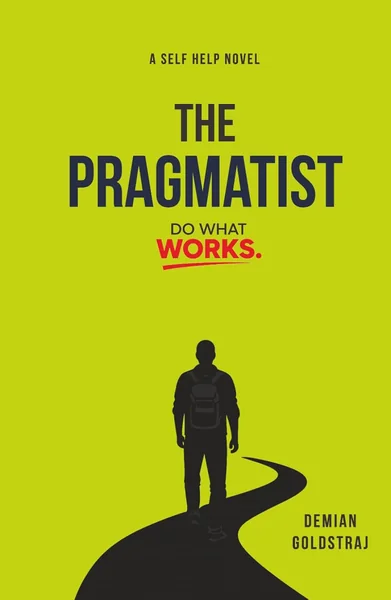
The Pragmatist
Do What Works
by Demian Goldstraj Esq
LuvemBooks Verdict
Best for: A general reader in a moment of personal transition who senses their inherited beliefs no longer fit and wants a short, story-anchored, non-academic prod to test what they believe against what actually works.
Worth it? Skip it? Read the full verdict →Ask LuvemBooks
Was this helpful?
- Is it worth reading?
- For the right reader, yes. LuvemBooks highlights its concrete, story-driven premise — a named character with recognizable wants gives the philosophy a human anchor — plus its plainly stated anti-dogma thesis and its genuinely low-commitment 186-page length. The trade-off is depth: it is an opening argument rather than a systematic exploration, and its hybrid form sits between a fully developed novel and a structured philosophical treatise, so readers wanting either of those completely may leave unsatisfied.
- Similar books
- Readers drawn to accessible philosophy with a narrative frame have several strong options. Jostein Gaarder's Sophie's World wraps a history of philosophy inside a story, while Alain de Botton's The Consolations of Philosophy applies great thinkers to everyday problems — both share this book's general-audience pitch. Viktor E. Frankl's Man's Search for Meaning offers a deeper, lived meditation on belief under pressure, and Massimo Pigliucci's How to Be a Stoic delivers the structured, practice-oriented program this book deliberately is not. Simon Blackburn's Think is a concise entry into philosophy's big questions for readers who want more systematic ground.
- Who should read this?
- It is aimed squarely at the general reader in a moment of transition — someone who senses the scripts they were handed no longer fit and wants a short, direct prod to examine why, with a narrative frame to carry them through. LuvemBooks also notes it suits readers of reflective, idea-driven fiction and readers of self-examination literature who prefer philosophy unvarnished by academic apparatus. No background in academic philosophy is required.
- Is it a novel or a self-help book?
- Neither completely — that is both its design and its risk. It is built around the story of Lucas, a man whose certainties fail him, but it is pitched as a method: a challenge to test assumptions and confront limitations. LuvemBooks cautions that readers seeking either a fully developed novel with rich interiority or a rigorously structured philosophical treatise may find it sits between those two satisfactions rather than delivering either one completely.
- Does it cover classical pragmatism?
- No — and the book does not pretend to. It borrows the pragmatist spirit popularized by William James — truth as what proves itself in practice — and aims it at the individual reader's choices rather than at philosophical debate. Readers wanting engagement with James, Dewey, and their successors will need to look elsewhere; the review is explicit that this is not the book's project.
- Is this a good book club pick?
- It can be, for the right group. Its plainly stated anti-dogma thesis — beliefs should be judged by their consequences — is a natural discussion prompt, and the challenge-to-the-reader structure invites members to compare which inherited scripts they have tested or kept. At 186 pages it is a low-commitment pick, though groups wanting a rich plot or a systematic argument to debate may find the hybrid form thin on both counts.
Summarize this book
Follow up
Synthesized from verified book data & published reviews · How we review
Press Enter to ask. Answers come from our editorial Q&A — start typing to see related questions.
Age & Reading Level
Recommended age
Adult
Reading level
Adult
who it suits
Skip if Skip this if you want a scholarly engagement with the classical pragmatist canon (James, Dewey), a fully developed novel, or a step-by-step program with exercises and protocols — this brief hybrid delivers none of those completely.
Editorial Review
Demian Goldstraj Esq.'s The PRAGMATIST: (Do What Works), a 186-page hardcover from HMD Publishing, follows Lucas — a man whose inherited beliefs fail him in an accelerating world — and challenges readers to trade dogma for what actually works.…
Read the Full ReviewRelated reading
Adjacent titles worth exploring. We haven't reviewed these yet, so they link out to Amazon.