Every Time I Find the Meaning of Life, They Change It: Wisdom of the Great Philosophers on How to Live
by Daniel Klein
At a glance
About the Author
Daniel Klein1 book reviewed
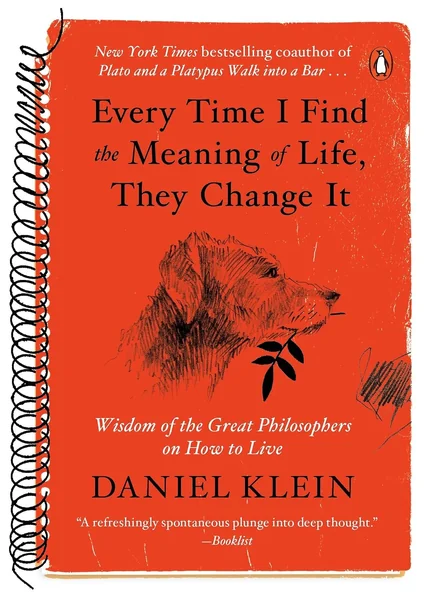
Every Time I Find the Meaning of Life, They Change It
Wisdom of the Great Philosophers on How to Live
by Daniel Klein
LuvemBooks Verdict
Best for: Reflective readers—especially those in or approaching later life—who want a browsable commonplace book of great-philosopher quotations annotated with jokes, doubts, and hard-won candor rather than a systematic answer to life's biggest question.
Worth it? Skip it? Read the full verdict →Ask LuvemBooks
Was this helpful?
- Is it worth reading?
- Yes, for the right reader: Kirkus emphasizes its warmth, candor, and accessibility, and its combination of canonical names, popular sages, self-deprecation, and late-life perspective is its real strength — it offers company rather than commandments. It is less suited to anyone wanting a sustained argument or practical program, since the miscellany form is episodic by design and depth varies entry by entry. Readers drawn by the mention of Singer or Parfit should also know Klein openly doubts that abstract moral philosophy is relevant to everyday life.
- Similar books
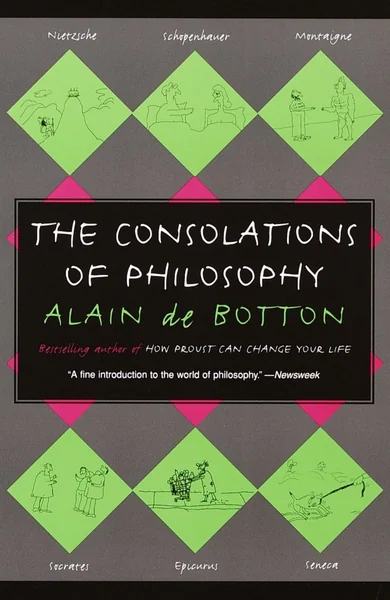
- Readers who enjoy this blend of philosophy and consolation have several natural companions. Alain de Botton's The Consolations of Philosophy likewise applies great thinkers to everyday troubles, while Viktor E. Frankl's Man's Search for Meaning offers a graver, firsthand account of the same question Klein circles. Massimo Pigliucci's How to Be a Stoic supplies the practical program this book deliberately avoids, and Jostein Gaarder's Sophie's World is the classic narrative introduction to the canon. Klein's own earlier books — Travels with Epicurus and Plato and a Platypus Walk into a Bar — share the same jokester-philosopher voice, though they sit outside our catalogue.
- Who should read this?
- It suits adult readers who like philosophy delivered with entertainment — fans of Plato and a Platypus Walk into a Bar and Travels with Epicurus will recognize the franchise's promise. It also works for newcomers, since the structure lowers the barrier to entry: a reader can meet Hume or Mill in a few lines and move on without mastering a system, and a glossary covers the few philosophical terms. Readers expecting ethics rigorously defended, or a treatise rather than a miscellany, are the ones likely to be disappointed.
- What are the main themes?
- The spine is the changing meaning of life itself: a line that looked definitive at twenty can look evasive at seventy, and the book treats quotation as a tool for living and re-living rather than a fixed doctrine. Running alongside that are mortality and aging (the eighth-decade vantage point), candor about depression and meaninglessness, and a skepticism toward abstract moral philosophy that Klein states openly. Comedy is a theme in its own right — a comic aside, the book suggests, can land harder than a formal proof.
- How does it compare to Travels with Epicurus?
- It comes from the same author and keeps the same voice — enlightenment delivered with entertainment — but the premise is broader. Where Travels with Epicurus builds a sustained meditation on aging around one philosopher, this book ranges across the whole "Pithies" notebook, from Epicurus and Emerson to Camus, Niebuhr, and Woody Allen. Readers who liked the earlier book's late-life perspective will find it deepened here, at the cost of that book's tighter focus.
- How long is it, and which edition?
- The edition under review is the 2017 Penguin Books reprint, which the back cover notes adds an afterword for that edition. The book itself is compact — short aphorism-plus-annotation entries totaling roughly 200-odd pages — and it is designed to be dipped into rather than read straight through as a course.
Summarize this book
Follow up
Synthesized from verified book data & published reviews · How we review
Press Enter to ask. Answers come from our editorial Q&A — start typing to see related questions.
Age & Reading Level
Recommended age
Adult
Reading level
Adult
1 content note · who it suits
Content to know about
Skip if you want a sustained philosophical argument, a practical program for living, or ethics rigorously defended on analytic terms.
Editorial Review
Daniel Klein’s Every Time I Find the Meaning of Life, They Change It revisits the “Pithies” quotations he collected as a young philosophy student, now annotated from his eighth decade. Its draw is range—Epicurus to Camus, Niebuhr to Woody Allen—paired with candid, comic reflections rather than a system.
Read the Full ReviewBooks like Every Time I Find the Meaning of Life, They Change It
Curated picks for readers who enjoyed Every Time I Find the Meaning of Life, They Change It, with our reasoning for each match.
If you liked Every Time I Find the Meaning of Life, They Change It