7 min read
4.6
· 1,387 Amazon ratingsShare This Review
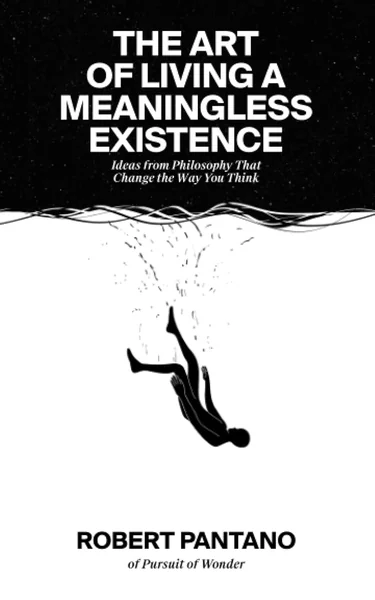
The Art of Living a Meaningless Existence by Robert Pantano Review: Honest Philosophy for Everyday Readers
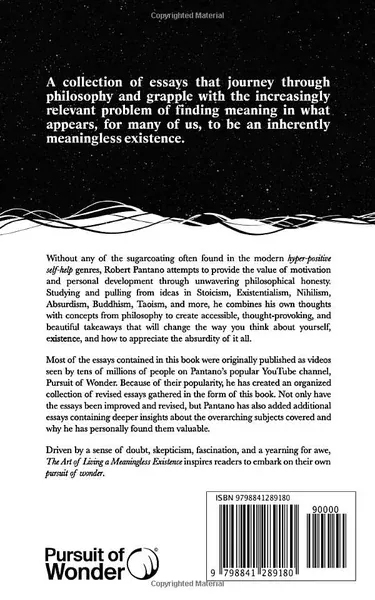
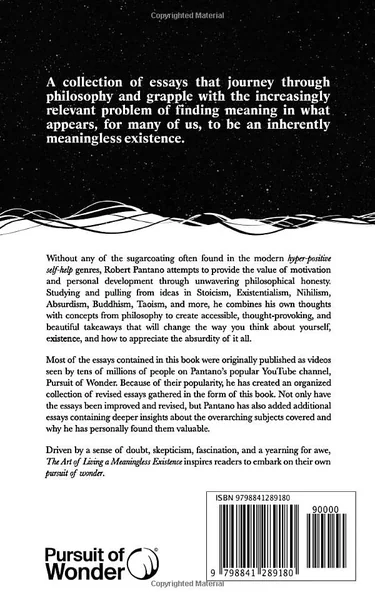
Robert Pantano's independently published essay collection draws on Stoicism, Existentialism, Nihilism, Absurdism, Buddhism, Taoism, and more to tackle one of philosophy's most enduring questions: how to find meaning in what many experience as an inherently meaningless existence — and it does so without the sugarcoating that saturates much of the modern self-help genre.
 Tap to enlarge
LuvemBooks Verdict
Best for
Readers curious about existential philosophy — particularly Stoicism, Absurdism, Nihilism, and Buddhism — who want an accessible, honest entry point without the relentless positivity of mainstream self-help, and fans of Pantano's Pursuit of Wonder YouTube channel seeking a revised, expanded print edition of his essays.
Worth it if
Worth reading if you're fatigued by sugarcoated self-help and want a philosophically honest framework for constructing meaning in the face of absurdity, written in a conversational style that requires no academic background.
Skip if
Skip it if you're already well-versed in Stoic, Buddhist, or Absurdist philosophy and want new depth rather than synthesis, or if you prefer a single sustained philosophical argument over an episodic essay collection.
What readers & critics say
According to sobrief.com, the book receives mostly positive reviews, praised for its accessible introduction to philosophy and thought-provoking ideas about finding meaning in life's absurdity. Befreed.ai notes that the book challenges readers with paradoxical thought experiments while examining how subjective interpretations shape perceptions of identity, morality, and reality through an absurdist philosophical lens.
Sources: sobrief.com, befreed.ai, shortform.comAsk LuvemBooks
Was this helpful?
- Is it worth reading?
- For readers fatigued by relentlessly upbeat personal-development content, The Art of Living a Meaningless Existence offers a meaningful departure — it earns its motivational payoff through rigorous, unflinching inquiry rather than easy comfort. Readers have responded positively to its accessible treatment of existential philosophy and its thought-provoking examination of meaning and absurdity, according to aggregated feedback. The main caveat is structural: because the essays originated as standalone video scripts, those seeking a single, architecturally unified philosophical argument may find the format episodic rather than cumulative.
- Similar books
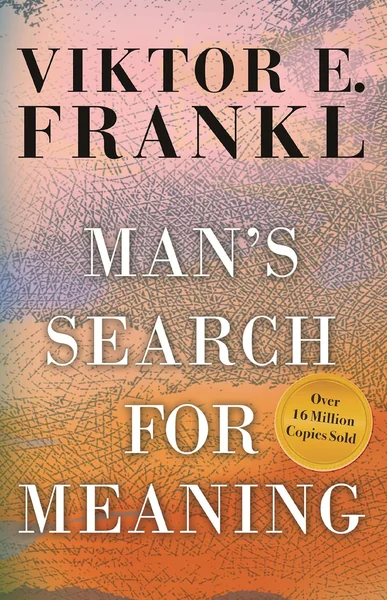
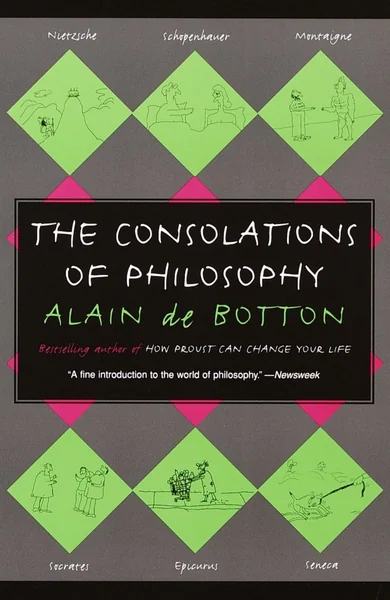
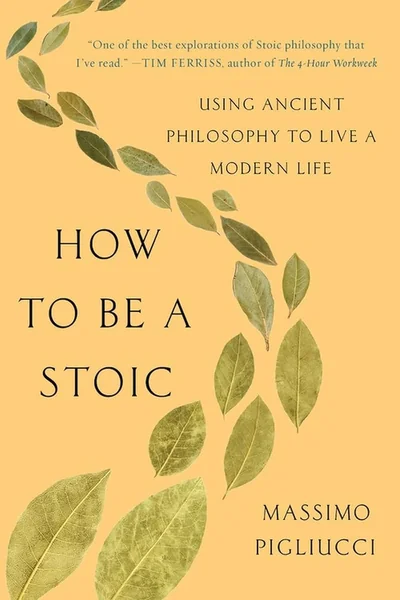
- Readers drawn to The Art of Living a Meaningless Existence will find natural companions in several works curated below. Viktor E. Frankl's Man's Search for Meaning is perhaps the most direct parallel — a foundational text on constructing meaning in the face of suffering, though rooted in personal testimony rather than philosophical synthesis. Albert Camus's The Myth of Sisyphus is the landmark Absurdist text that underpins much of Pantano's framework around meaninglessness and the necessity of self-constructed purpose. For readers who want philosophy made accessible without losing substance, Alain De Botton's The Consolations of Philosophy and Massimo Pigliucci's How to Be a Stoic: Using Ancient Philosophy to Live a Modern Life offer similar aims from a consolatory and Stoic angle respectively. Friedrich Nietzsche's Beyond Good and Evil provides deeper grounding in the philosophical tradition Pantano synthesises from.
- Who should read this?
- The Art of Living a Meaningless Existence is particularly well suited to readers who are curious about existential philosophy but approaching it without academic preparation — the writing is designed to make Stoicism, Absurdism, Nihilism, and related traditions digestible without stripping them of substance. It is also a strong pick for existing Pursuit of Wonder viewers on YouTube who want a more durable, revised version of content they already value. Readers fatigued by relentlessly upbeat self-help content will find Pantano's commitment to philosophical honesty over easy reassurance a refreshing departure. Those who require a single, architecturally unified argument — rather than a curated collection of standalone essays — may be less satisfied with the format.
- What are the main themes?
- The animating theme is the problem of meaning in what Pantano frames as an inherently meaningless existence — not resolved with reassurance, but worked through philosophically via Stoicism, Existentialism, Nihilism, Absurdism, Buddhism, and Taoism. Central to the book's argument is the Absurdist position that meaning, to the extent it can be found at all, must be constructed in full awareness of absurdity rather than discovered through optimism. The publisher describes the book's spirit as 'doubt, skepticism, fascination, and a yearning for awe,' with the stated aim of inspiring readers to embark on their own pursuit of wonder rather than arriving at a settled conclusion.
- How did this book come to exist?
- Most of the essays in The Art of Living a Meaningless Existence originated as video scripts for the Pursuit of Wonder YouTube channel, which Robert Pantano created and which reached tens of millions of viewers. Those scripts were revised, expanded, and supplemented with additional essays written specifically for the print edition. The book's origins in audience-tested video content mean the material was refined through significant engagement before reaching print, contributing to the conversational register and accessibility that characterise the writing.
- Is the structure unified or fragmented?
- The book's structure is episodic rather than architecturally unified, a direct consequence of its origins as standalone video scripts. Each essay functions largely independently, and the book builds its worldview through accumulation rather than through a single sustained philosophical argument. This suits readers who are comfortable with essay collections and enjoy dipping in and out, but it is a genuine caveat for those who prefer one cohesive thesis developed at length across a book.
Summarize this book
Follow up
Synthesized from verified book data & published reviews · How we review
Press Enter to ask. Answers come from our editorial Q&A — start typing to see related questions.
Age & Reading Level
Recommended age
Adult
Reading level
Adult
1 content note · who it suits
Content to know about
Skip if you're looking for uplifting, optimistic self-help that resolves existential uncertainty with reassurance.
Our Review
What the Book Actually Is
The Philosophical Range
A Deliberate Break from Self-Help Conventions
Reception and Audience Fit
Genuine Limitations to Consider
Sources & Further Reading
The key facts and claims in this review are grounded in the retrieved, verified sources listed below.
- Cited in this review
- 1
- 2
- Further reading
- 3
pursuitofwonder.com
- 4
Books like The Art of Living a Meaningless Existence
Curated picks for readers who enjoyed The Art of Living a Meaningless Existence, with our reasoning for each match.
If you liked The Art of Living a Meaningless Existence