
7 min read
4.6
· 1,387 Amazon ratingsShare This Review
The Art of Living a Meaningless Existence by Robert Pantano Review: Honest Philosophy for Everyday Readers
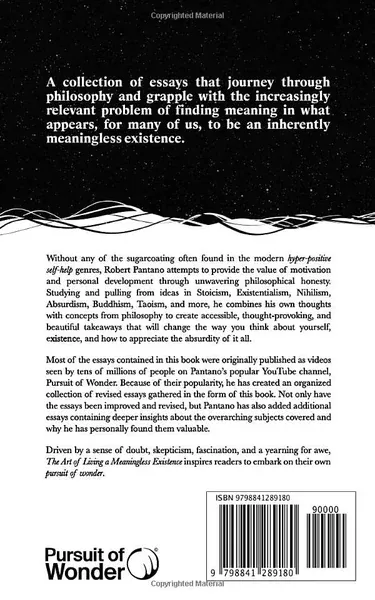
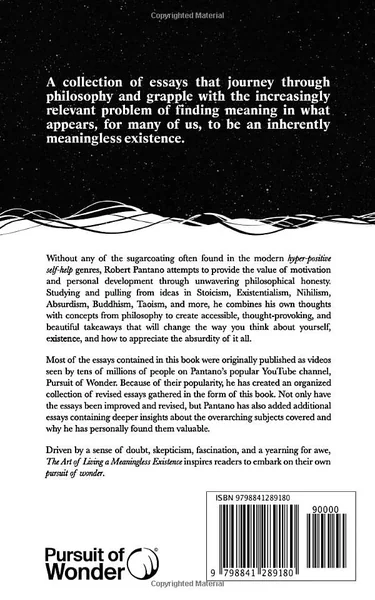
Robert Pantano's independently published essay collection draws on Stoicism, Existentialism, Nihilism, Absurdism, Buddhism, Taoism, and more to tackle one of philosophy's most enduring questions: how to find meaning in what many experience as an inherently meaningless existence — and it does so without the sugarcoating that saturates much of the modern self-help genre.
 Tap to enlarge
LuvemBooks Verdict
Best for
Readers curious about existential philosophy — particularly Stoicism, Absurdism, Nihilism, and Buddhism — who want an accessible, honest entry point without the relentless positivity of mainstream self-help, and fans of Pantano's Pursuit of Wonder YouTube channel seeking a revised, expanded print edition of his essays.
Worth it if
Worth reading if you're fatigued by sugarcoated self-help and want a philosophically honest framework for constructing meaning in the face of absurdity, written in a conversational style that requires no academic background.
Skip if
Skip it if you're already well-versed in Stoic, Buddhist, or Absurdist philosophy and want new depth rather than synthesis, or if you prefer a single sustained philosophical argument over an episodic essay collection.
What readers & critics say
According to sobrief.com, the book receives mostly positive reviews, praised for its accessible introduction to philosophy and thought-provoking ideas about finding meaning in life's absurdity. Befreed.ai notes that the book challenges readers with paradoxical thought experiments while examining how subjective interpretations shape perceptions of identity, morality, and reality through an absurdist philosophical lens.
Sources: sobrief.com, befreed.ai, shortform.comIn This Review
- What Works & What Doesn't
- What the Book Actually Is
- The Philosophical Range
- A Deliberate Break from Self-Help Conventions
- Reception and Audience Fit
- Genuine Limitations to Consider
What Works & What Doesn't
What Works
- Draws on a wide range of philosophical traditions — Stoicism, Existentialism, Nihilism, Absurdism, Buddhism, Taoism — giving readers multiple entry points into existential inquiry
- Deliberately rejects the sugarcoating of mainstream self-help, grounding motivational content in philosophical honesty
- Essays originated as video content that reached tens of millions of viewers, then were revised and expanded for print — meaning the material has been refined through significant audience engagement
- Accessible writing style designed to make complex philosophical ideas digestible for readers without an academic background
- Readers have responded positively to its thought-provoking treatment of meaning and absurdity, according to aggregated feedback
What Doesn't
- The essay-collection format, rooted in standalone video scripts, is episodic rather than architecturally unified — readers seeking a single sustained philosophical argument may find the structure unsatisfying
- The breadth of traditions covered is designed for accessibility, which means readers already familiar with Stoicism, Nihilism, or Buddhist philosophy may not encounter new depth in those areas
What the Book Actually Is
The Philosophical Range
A Deliberate Break from Self-Help Conventions
Reception and Audience Fit
Genuine Limitations to Consider
Frequently Asked Questions
Sources & Further Reading
The key facts and claims in this review are grounded in the retrieved, verified sources listed below.
- Cited in this review
- 1
- 2
- Further reading
- 3
pursuitofwonder.com
- 4
Related Reviews
Reviews of books we picked for readers who enjoyed The Art of Living a Meaningless Existence.

Reader Comments
No comments yet
Be the first to share your thoughts!