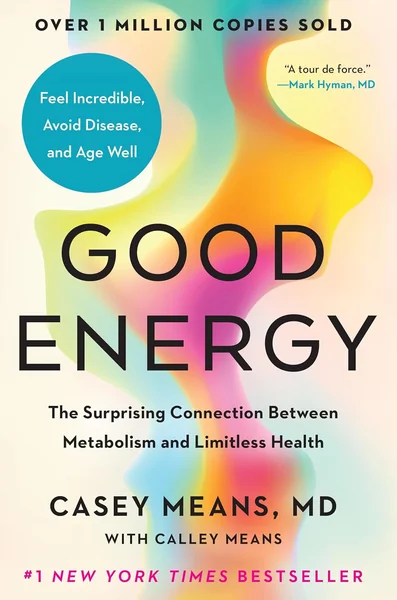
Good Energy: The Surprising Connection Between Metabolism
by Casey Means, Calley Means
At a glance
About the Author
Casey Means, Calley Means1 book reviewed
Good Energy
The Surprising Connection Between Metabolism
by Casey Means, Calley Means
LuvemBooks Verdict
Best for: Readers who feel let down by conventional medicine and want a single, evidence-referenced framework — plus a concrete four-week action plan — for understanding how metabolic health connects to chronic symptoms like fatigue, mood instability, hormonal disruption, and weight resistance.
Worth it? Skip it? Read the full verdict →Ask LuvemBooks
Was this helpful?
- Is it worth reading?
- Good Energy has demonstrably resonated: it debuted as a #1 New York Times bestseller and has sold over a million copies since its May 2024 release, reflecting broad and sustained reader demand. Its most distinctive value is the combination of a unifying scientific framework with a genuinely actionable plan — Terry Wahls, MD, author of The Wahls Protocol, specifically notes that it shows readers how to get blood sugar and metabolic health under control as a foundation for better energy and health outcomes. The key caveat, particularly for readers with scientific or clinical backgrounds, is that linking conditions as neurologically, hormonally, and oncologically distinct as Alzheimer's, cancer, and erectile dysfunction to a single cellular mechanism is a bold claim that the text does not always acknowledge as contested. Readers who come primarily for practical protocols may also find the sustained systemic critique of American medicine more prominent than expected.
- Similar books
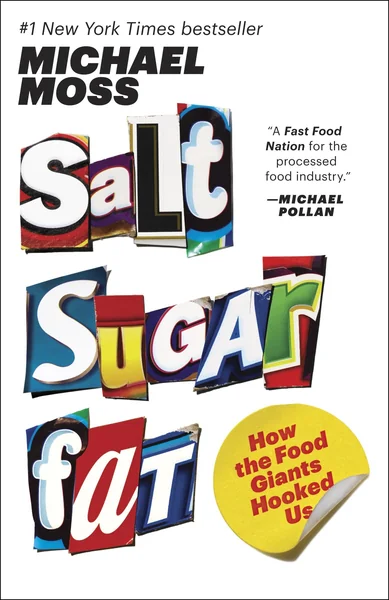
- Readers drawn to Good Energy's metabolic health framework and critique of conventional medicine will find natural companions in the curated titles below. Peter Attia MD's Outlive: The Science and Art of Longevity shares the data-driven, longevity-focused approach and similarly centers five key biomarkers of health risk. Jason Fung's The Obesity Code: Unlocking the Secrets of Weight Loss offers another physician-authored argument that mainstream dietary advice has misunderstood the hormonal and metabolic roots of chronic disease. For the systemic food-industry critique woven through Good Energy, Michael Moss's Salt Sugar Fat: How the Food Giants Hooked Us and Michael Pollan's In Defense of Food: An Eater's Manifesto provide compelling parallel reads. Gabor Maté M.D.'s When the Body Says No: Exploring the Stress-Disease Connection shares the book's interest in how modern conditions manifest in the body when its underlying systems are dysregulated.
- Who should read this?
- Good Energy is specifically designed for readers who feel that conventional medical advice has failed to resolve persistent, frustrating symptoms — fatigue, mood instability, weight resistance, and hormonal disruption — and who are open to a metabolic explanation for those experiences. Its dietary principles are structured to be accessible across philosophies from carnivore to vegan, so no particular eating style is a prerequisite. Readers with clinical or scientific backgrounds will find the central thesis stimulating but may want to engage it as a provocation rather than a settled consensus. Those who want purely practical protocols without systemic critique of the American medical system may find the book's advocacy framing more prominent than they expect.
- About Casey Means MD, Calley Means
- Paula Casey Means, known as Casey Means, is an American wellness influencer, author, and former physician. Good Energy is co-authored with her brother Calley Means.
- What is 'good energy' vs 'bad energy'?
- The authors use "good energy" to describe a state in which the body's cells create and use energy optimally, and "bad energy" to describe the breakdown of that cellular machinery. According to the book, "bad energy" signals — fatigue, mood disruption, metabolic syndrome — are not isolated symptoms but early warnings of potentially life-threatening disease. The framework positions cellular metabolism as the master system whose health or dysfunction cascades into conditions as varied as depression, type 2 diabetes, Alzheimer's, cancer, and infertility.
- How does the book critique the medical system?
- The book's critique of the American medical system is central rather than incidental — it argues that the system has systematically obscured the metabolic causes of chronic illness, prioritizing treatment over prevention and leaving patients without the diagnostic information they need. Robert Lustig, MD, describes it as telling "the story of a medical system run amuck," and the book includes a dedicated section on how to navigate the medical system to obtain the specific tests and metabolic information readers need. Readers who come to the book primarily for practical health protocols rather than systemic critique should be aware that this advocacy framing is woven throughout all 400 pages.
Summarize this book
Follow up
Synthesized from verified book data & published reviews · How we review
Press Enter to ask. Answers come from our editorial Q&A — start typing to see related questions.
Age & Reading Level
Recommended age
Adult
Reading level
Adult
1 content note · who it suits
Content to know about
Skip if you want purely practical health protocols without an advocacy-driven critique of the American medical system.
Editorial Review
Good Energy, co-authored by Dr. Casey Means and Calley Means and published by Avery on May 14, 2024, is a #1 New York Times bestseller — with over a million copies sold — that advances a sweeping argument: that poor metabolic function is the common root cause underlying conditions as varied as depression, type 2 diabetes, Alzheimer's, cancer, and infertility.…
Read the Full ReviewBooks like Good Energy
Curated picks for readers who enjoyed Good Energy, with our reasoning for each match.
If you liked Good Energy