

9 min read
4.6
· 5,511 Amazon ratingsShare This Review
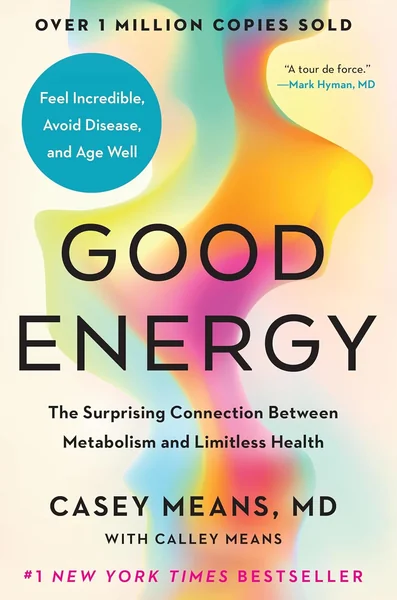
Good Energy: The Surprising Connection Between Metabolism and Limitless Health by Casey Means MD & Calley Means Review: A Bold, Practical Metabolic Health Manifesto
Good Energy, co-authored by Dr. Casey Means and Calley Means and published by Avery on May 14, 2024, is a #1 New York Times bestseller — with over a million copies sold — that advances a sweeping argument: that poor metabolic function is the common root cause underlying conditions as varied as depression, type 2 diabetes, Alzheimer's, cancer, and infertility. Part memoir, part manifesto, and part practical guide, the book pairs its central thesis with a four-week action plan, data drawn from the health technology company Dr. Means founded, and six food principles designed to be usable across dietary philosophies from carnivore to vegan.
LuvemBooks Verdict
Best for
Readers who feel let down by conventional medicine and want a single, evidence-referenced framework — plus a concrete four-week action plan — for understanding how metabolic health connects to chronic symptoms like fatigue, mood instability, hormonal disruption, and weight resistance.
Worth it if
You are open to the argument that cellular metabolism is a unifying root cause of modern chronic illness and want both the science behind that claim and practical, biomarker-tracked steps to act on it — regardless of whether you eat plant-based or animal-based.
Skip if
You come primarily for quick, system-neutral protocols and have little appetite for a sustained critique of American medicine as structurally complicit in metabolic disease — that argument is woven throughout, not confined to a chapter.
What readers & critics say
NPR's health desk covered the book substantively, highlighting Dr. Means's path from Stanford surgical training to metabolic health advocacy and her argument that mitochondrial dysfunction underpins a wide range of chronic conditions. Red Pen Reviews, a science-accuracy-focused book review site, notes the book argues that "nearly every health problem we face can be explained by how well the cells in our body create and use energy," encompassing both physical and mental health conditions — a scope it treats as the book's central and most contestable claim.
“A doctor lays out how to measure and boost your metabolic health — tracing her path from Stanford classrooms to a sweeping metabolic framework.”
— NPRAge & Reading Level
Recommended age
Adult
Reading level
Adult
1 content note · who it suits
Content to know about
Skip if you want purely practical health protocols without an advocacy-driven critique of the American medical system.
In This Review
- What Works & What Doesn't
- What the Book Actually Argues
- The Book's Significance and Place in the Genre
- Strengths: Scope, Structure, and Accessibility
- The Critique: Breadth vs. Depth, and the Medical System Framing
- Who This Book Is For
What Works & What Doesn't
What Works
- #1 New York Times bestseller with over a million copies sold, reflecting broad and sustained reader demand
- Pairs its central metabolic thesis with a concrete four-week action plan anchored in five measurable biomarkers
- Covers a wide range of practical domains — sleep, circadian rhythm, movement, temperature exposure, and medical navigation — in a single volume
- Deliberately designed to be usable across diverse dietary philosophies, from carnivore to vegan
- Co-authored by a physician whose personal experience losing her mother to metabolic disease gives the argument urgency and grounding
What Doesn't
- The claim that conditions as distinct as Alzheimer's, cancer, and anxiety share a single cellular root cause is a bold unifying argument that readers with clinical or scientific backgrounds may find more contested than the text sometimes acknowledges
- The book's sustained critique of the American medical system is woven throughout, which may feel more prominent than expected for readers seeking purely practical protocols
What the Book Actually Argues
The Book's Significance and Place in the Genre
Strengths: Scope, Structure, and Accessibility
The Critique: Breadth vs. Depth, and the Medical System Framing
Who This Book Is For
Frequently Asked Questions
Sources & Further Reading
The key facts and claims in this review are grounded in the retrieved, verified sources listed below.
- Cited in this review
- 1
- 2
- 3
- Further reading
- 4
Casey Means MD, Calley Means, Wikipedia
- 5
pmc.ncbi.nlm.nih.gov
- 6
caseymeans.com
- 7
- 8
- 9
Related Reviews
Reviews of books we picked for readers who enjoyed Good Energy.


Reader Comments
No comments yet
Be the first to share your thoughts!