BOOKS
Published

Read Time

9 min read

Reader rating

4.6

· 3,430 Amazon ratings
reader ratings, not a LuvemBooks score
Curated & edited by

LuvemBooks Editorial

How we create our reviews →
Share This Review

Full Catastrophe Living by Jon Kabat-Zinn Review: A Landmark in Mind-Body Medicine

First published in 1990 and substantially revised in 2013, Jon Kabat-Zinn's Full Catastrophe Living is widely regarded as a defining text in mind-body medicine and the secular mindfulness movement, offering a comprehensive guide to the Mindfulness-Based Stress Reduction (MBSR) program he developed at the University of Massachusetts Medical Center's Stress Reduction Clinic. The book covers the full eight-week MBSR curriculum — from body scan and mindfulness of breathing to mindful hatha yoga and walking meditation — while also surveying scientific research on the benefits of mindfulness for chronic pain, stress, and illness. With a preface by Thich Nhat Hanh and a scope that spans medical symptoms, emotional disturbance, work pressure, and relationship stress, this revised edition remains the essential reference for anyone serious about mindfulness as a clinical and personal practice.

LuvemBooks Verdict

Best for

Anyone dealing with chronic stress, pain, or illness — whether as a patient, clinician, or serious general reader — who wants a rigorous, science-backed, eight-week program guide rather than a breezy wellness primer.

Worth it if

You're willing to commit to a 720-page immersive program guide and want a foundational, clinically grounded text — not a surface-level introduction — that integrates decades of mindfulness research with step-by-step practice instruction.

Skip if

You're looking for a quick overview of mindfulness concepts or a light introductory read, as the book's depth and density — mirroring the full eight-week MBSR course structure — demands sustained engagement that casual browsers will likely find overwhelming.

Wikipedia describes the book as having been called "one of the great classics of mind/body medicine" and identifies it as "a landmark in the development of the secular mindfulness movement in the United States and internationally," with over fifteen thousand scholarly citations. Spirituality & Practice highlights its broad scope, noting its coverage of physical and emotional pain, fear, panic, anxiety, and a wide range of life stressors including time stress, work stress, and world stress.

Sources: Wikipedia, Spirituality & Practice
4.6from 3,430 Amazon ratings— reader ratings, not a LuvemBooks score

Look inside the book

Preview the actual pages, via Google Books
In This Review
  • What Works & What Doesn't
  • What the Book Is and Does
  • Significance and Place in the Field
  • What the Revised Edition Adds
  • Genuine Strengths
  • Who It Suits — and Where It Demands Commitment

What Works & What Doesn't

What Works
  • A verified landmark text — described as 'one of the great classics of mind/body medicine' — with over fifteen thousand scholarly citations, confirming its foundational authority
  • The 2013 revised edition integrates decades of new scientific research on mindfulness-based interventions alongside the original eight-week MBSR curriculum
  • Covers an unusually broad range of stressors, from chronic pain and medical symptoms to relationship difficulties, work pressure, and political stress
  • Grounded in real clinical practice — the MBSR program developed at the University of Massachusetts Medical Center's Stress Reduction Clinic — giving it both scientific and practical credibility
  • Preface by Thich Nhat Hanh situates the work within the broader contemplative tradition it draws from
What Doesn't
  • At 720 pages, the book demands sustained commitment and is not suited to readers seeking a brief or casual introduction to mindfulness
  • The depth and density of the program-guide format, while a strength for serious practitioners, can be challenging for those entirely new to meditation or mind-body concepts
A landmark of mind-body medicine whose influence has only grown in the three decades since its first publication, Full Catastrophe Living is both a comprehensive program guide and an argument for a fundamentally different relationship with stress, pain, and illness.

What the Book Is and Does

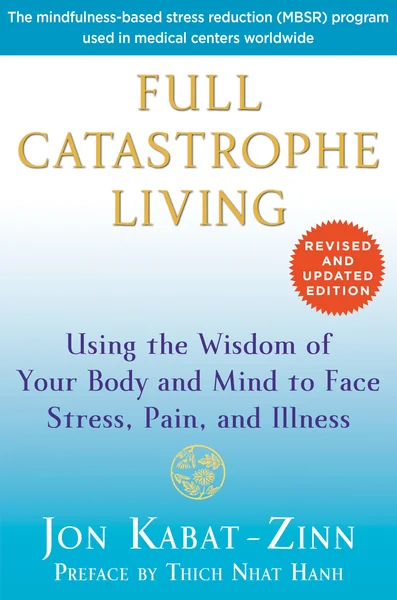
Full Catastrophe Living (Revised Edition): Using the Wisdom of Your Body and Mind to Face Stress, Pain, and Illness by Jon Kabat-Zinn front cover
Full Catastrophe Living describes, in thorough detail, the Mindfulness-Based Stress Reduction (MBSR) program that Jon Kabat-Zinn developed at the University of Massachusetts Medical Center's Stress Reduction Clinic, which he founded in 1979. The Clinic was conceived as a referral service for physicians and other health providers, designed to reach patients with a wide range of diagnoses who were not responding adequately to conventional treatments or who, as the Wikipedia entry on the book records in Kabat-Zinn's own words, were "falling through the cracks" of the health care system. The book walks readers through the eight-week MBSR course, covering the body scan, mindfulness of breathing, mindful hatha yoga, walking meditation, and mindfulness of daily activities such as eating — practices drawing on both Theravada/vipassana and Zen influences. Kabat-Zinn's Zen training is evident in particular in his treatment of "non-judging," which emphasizes the limitations of mental categorization. The result is a program guide that functions simultaneously as a philosophy of mind-body interconnection.
a landmark in the development of the secular mindfulness movement in the United States and internationally.

Significance and Place in the Field

Wikipedia's reception summary describes the book as having been called "one of the great classics of mind/body medicine" and as "a landmark in the development of the secular mindfulness movement in the United States and internationally." After its first publication, Full Catastrophe Living became a global bestseller and has been cited in scholarly works and books over fifteen thousand times. These numbers speak to the book's unusual position: it is both a practitioner-facing program manual and a text that shaped a field. The title itself carries meaning Kabat-Zinn has explained directly — the phrase kept returning to him as capturing "something very special that lies within us, our capacity for embracing the actuality of things, often when it seems utterly impossible, in ways that are healing and transforming, even in the face of the full catastrophe of the human condition." That framing — neither denial nor despair, but full engagement — defines the book's orientation throughout. The preface by Thich Nhat Hanh, one of the most recognized figures in contemporary mindfulness, underscores the work's standing within a broader contemplative tradition.

What the Revised Edition Adds

The 2013 Bantam revision, the edition currently in wide circulation, is not merely a reprint. In his new introduction, Kabat-Zinn defines mindfulness with updated precision, reflects on the massive growth of MBSR and related mindfulness-based practices since 1990, and incorporates findings from the significant body of scientific research that accumulated in the intervening decades. The book surveys studies showing benefits of mindfulness practice for chronic pain sufferers and illustrates those findings with patient stories drawn from the Stress Reduction Clinic. Kabat-Zinn also extends the program's application across a notably wide range of stressors: medical symptoms, emotional disturbance, time and work pressures, relationship issues, and stress related to political or world events. The revised edition is, in this sense, genuinely updated rather than merely repackaged — a distinction that matters for a field that has generated substantial new research since the original publication.

Genuine Strengths

The book's primary strength is its integration of rigorous scientific grounding with accessible program structure. Kabat-Zinn does not ask readers to take mindfulness on faith; he describes scientific studies, explains the mind-body connections those studies illuminate, and then provides detailed instruction in the practices themselves. The scope of stressors addressed — from chronic physical pain to relational difficulty to the weight of political events — gives the book unusual breadth for a clinical program guide. Kabat-Zinn's articulation of mindful awareness as a tool for responding to stressors wisely rather than reacting automatically, and his framing of that shift as bringing what he calls "the comfort of wisdom and inner trust, the comfort of being whole," gives the program a coherent philosophical center that distinguishes it from more superficial wellness literature. The preface by Thich Nhat Hanh adds both gravitas and a connection to the contemplative traditions from which MBSR draws.

Who It Suits — and Where It Demands Commitment

The book's depth is also its primary demand. At 720 pages, Full Catastrophe Living is an immersive text, not a quick introduction. Readers seeking a brief overview of mindfulness concepts will find more than they bargained for; this is a complete program guide designed for sustained engagement, mirroring the eight-week structure of the MBSR course itself. Those already practicing meditation or familiar with Buddhist-derived contemplative traditions will likely find the conceptual sections most reinforcing, while readers entirely new to mindfulness may find the density rewarding but requiring patience. The book is designed for anyone dealing with stress, chronic pain, or illness — whether approaching it as a patient, a clinician, or a general reader — but it asks for the kind of serious engagement its subject requires. That is a feature, not a flaw, for the right reader.

Sources & Further Reading

The key facts and claims in this review are grounded in the retrieved, verified sources listed below.

  1. Cited in this review
  2. 1
  3. 2
  4. 3
  5. Further reading
  6. 4
  7. 5
  8. 6
  9. 7
  10. 8