BOOKS
Published

Read Time

3 min read

Curated & edited by

LuvemBooks Editorial

How we create our reviews →
Share This Review

When the Body Says No by Gabor Maté M.D. Review: A Vital Exploration of Stress and Chronic Disease

An international bestseller translated into fifteen languages, When the Body Says No by Gabor Maté M.D. draws on scientific research and Maté's decades of clinical experience to argue that chronic stress and emotional suppression are significant — and underappreciated — drivers of serious illness, from cancer and multiple sclerosis to Alzheimer's disease and ALS. It is an essential read for health professionals and anyone navigating chronic conditions, though its psychosomatic framework may challenge readers accustomed to strictly biomedical models of disease.

LuvemBooks Verdict

Best for

Readers living with chronic illness, or health professionals in integrative medicine, psychotherapy, or somatic health who want a research-grounded, humanely written case for why emotional suppression and chronic stress matter to physical disease.

Worth it if

You want to understand the science and human stories behind the mind-body connection — particularly across conditions like cancer, MS, ALS, and Alzheimer's — and are open to a framework that sits at the forward edge of mainstream medical consensus.

Skip if

You are a clinician seeking consensus-endorsed treatment protocols or prescriptive clinical guidance — the book is written as accessible popular medicine for a general educated audience, not as a clinical reference.

What readers & critics say

The book is an international bestseller translated into fifteen languages, with drgabormate.com describing it as offering "transformative insights into how disease can be the body's way of saying no to what the mind cannot or will not acknowledge." Somaticmovementcenter.com calls it "a must-read for all health professionals, anyone suffering from a chronic health condition, and anyone who has trouble saying no," while bookshelfdiscovery.com found it an interesting if occasionally dry read, noting its accessible exploration of connections between stress and autoimmune conditions.

Sources: drgabormate.com, somaticmovementcenter.com, bookshelfdiscovery.com
4.7from 2,104 Amazon ratings— reader ratings, not a LuvemBooks score

Look inside the book

Preview the actual pages, via Google Books
In This Review
  • What Works & What Doesn't
  • What the Book Actually Argues
  • Scope and the Diseases Covered
  • Significance and Reception
  • Genuine Strengths
  • Limitations and Who May Struggle with It

What Works & What Doesn't

What Works
  • International bestseller translated into fifteen languages, with significant reach across medical, therapeutic, and general readership communities
  • Covers a broad range of chronic conditions — including cancer, MS, ALS, Alzheimer's, IBS, and rheumatoid arthritis — under a unified psychosomatic framework
  • Weaves scientific research with patient case studies, making psychoneuroimmunoendocrinology accessible to a non-specialist audience
  • Includes substantial bibliographical references, allowing readers to pursue the underlying science independently
  • Endorsed by prominent figures in the mind-body medicine field, including Peter Levine, PhD, who called it 'a most important book, both for patient and physician'
What Doesn't
  • The psychosomatic framework — particularly claims around a 'cancer personality' and emotional suppression as a disease driver — sits at the contested edges of mainstream medical consensus, which may frustrate readers who require broadly established clinical conclusions
  • The popular-medicine format is designed for a general educated audience rather than clinicians seeking prescriptive treatment protocols, limiting its utility as a clinical reference
An international bestseller translated into fifteen languages, When the Body Says No makes a compelling, research-grounded case that what the mind cannot acknowledge, the body will ultimately express as disease.

What the Book Actually Argues

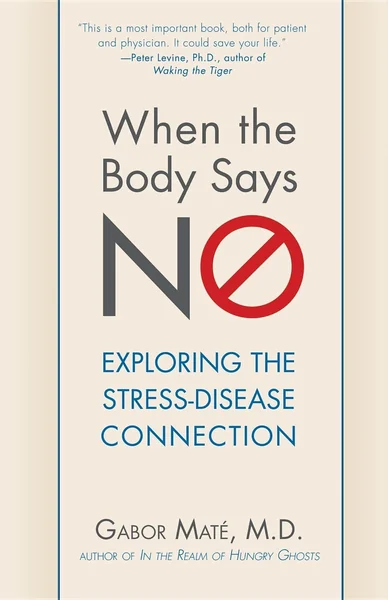
When the Body Says No: Exploring the Stress-Disease Connection by Gabor Maté M.D. front cover
At its core, When the Body Says No is a work of popular psychosomatic medicine — not a memoir, not a self-help manual, but a rigorously framed argument about the stress-disease connection. Gabor Maté M.D. draws on the emerging science of psychoneuroimmunoendocrinology — the study of how the psyche, nervous system, immune system, and endocrine system interact — to examine how chronic stress and the long-term repression of emotions can manifest as physical illness. The book poses provocative but grounded questions: Can a person literally die of loneliness? Is there a meaningful link between the inability to express emotions and the development of Alzheimer's disease? Is there such a thing as a "cancer personality"? These are not rhetorical flourishes; Maté pursues each with scientific literature and clinical case studies. The book's subtitle in the U.S. edition — Exploring the Stress-Disease Connection — accurately signals its methodological ambition.

Scope and the Diseases Covered

One of the book's most striking qualities is its breadth. Maté addresses a wide range of conditions: lung, breast, prostate, and skin cancers; multiple sclerosis; rheumatoid arthritis; irritable bowel syndrome; asthma; ALS; and Alzheimer's disease, among others. Individual chapters carry evocative titles — "The Little Girl Too Good to Be True," "Buried Alive," "Never Good Enough," "You Are Part of This Too, Mom" — that signal the book's method of anchoring medical inquiry in human stories. Chapter headings such as "Stress, Hormones, Repression, and Cancer" and "Is There a 'Cancer Personality'?" illustrate how Maté moves between scientific explanation and the lived experience of patients. This structural choice — alternating between clinical data and deeply personal case studies — is one the book is particularly well known for.

Significance and Reception

When the Body Says No is an international bestseller, translated into fifteen languages, a reach that speaks to how widely its argument has resonated beyond any single medical or cultural tradition. Peter Levine, PhD, bestselling author of In an Unspoken Voice, has called it "a most important book, both for patient and physician. It could save your life." Some readers and commentators in the health professions have described it as essential reading for anyone working with chronic illness or anyone who struggles with self-denial and boundary-setting. The book's influence extends into integrative medicine, psychotherapy, and somatic health communities, where its framework for understanding the body's response to unacknowledged stress has been widely adopted as a lens for clinical practice and personal healing.

Genuine Strengths

Maté's signal achievement is weaving scientific explanation together with compelling patient case studies in a way that makes complex psychoneuroendocrinological concepts accessible to a general readership. Rather than reducing the argument to pop-psychology generalities, the book includes bibliographical references — covering pages 283–296 in the edition catalogued by archive.org — that allow motivated readers to pursue the primary literature themselves. The framing of disease not as random misfortune but as a coherent, traceable response to chronic emotional and physiological stress offers readers a framework that is both intellectually serious and, for many, personally illuminating. Maté's voice, shaped by decades as a practicing physician, lends the clinical material a human register that pure academic treatments of psychosomatic medicine rarely achieve.

Limitations and Who May Struggle with It

The book's central thesis — that emotional suppression and chronic stress are meaningfully implicated in diseases such as cancer, MS, and ALS — is one that remains contested in mainstream medicine, and readers who require consensus-endorsed conclusions may find some of Maté's claims to sit at the forward edge of what the science has definitively established. The concept of a "cancer personality," for instance, is addressed directly in the text precisely because it is controversial; readers should approach that material as an inquiry rather than a settled verdict. Additionally, the book's psychosomatic framing, while designed to open new avenues of understanding, carries the risk — noted in some discussions of the genre — that patients could interpret it as implying personal responsibility for their illness, a tension the book must navigate carefully. Those seeking a strict clinical reference or a treatment protocol will find that When the Body Says No is written as popular medicine for a general, educated audience, not as a prescriptive guide.

Sources & Further Reading

The key facts and claims in this review are grounded in the retrieved, verified sources listed below.

  1. Cited in this review
  2. 1
  3. 2
  4. 3
  5. Further reading
  6. 4

    Gabor Maté M.D., Wikipedia

  7. 5
  8. 6
  9. 7