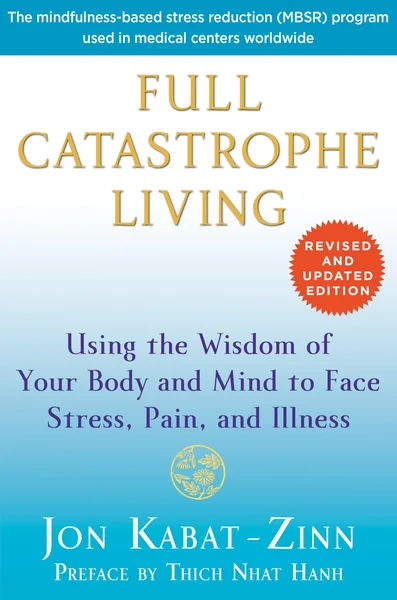
Full Catastrophe Living: Using the Wisdom of Your Body and Mind to Face Stress, Pain, and Illness
At a glance
Full Catastrophe Living
Using the Wisdom of Your Body and Mind to Face Stress, Pain, and Illness
LuvemBooks Verdict
Best for: Anyone dealing with chronic stress, pain, or illness — whether as a patient, clinician, or serious general reader — who wants a rigorous, science-backed, eight-week program guide rather than a breezy wellness primer.
Worth it? Skip it? Read the full verdict →Ask LuvemBooks
Was this helpful?
- Is it worth reading?
- For readers dealing with chronic pain, stress, or illness — whether as patients, clinicians, or serious general readers — Full Catastrophe Living is widely regarded as the essential reference in its field, described as a landmark in the development of the secular mindfulness movement in the United States and internationally. Its integration of rigorous scientific grounding with detailed program instruction sets it apart from more superficial wellness literature; Kabat-Zinn does not ask readers to take mindfulness on faith but explains the studies, the mind-body connections, and then the practices themselves. The key caveat is commitment: at 720 pages, this is an immersive program guide, not a quick overview, and it delivers most for readers prepared to match that seriousness.
- Similar books
- Readers drawn to Full Catastrophe Living often explore adjacent works in mind-body health and contemplative practice. Gabor Maté's When the Body Says No examines the connection between stress, emotional suppression, and serious illness, offering a compelling scientific and clinical complement to Kabat-Zinn's MBSR framework. Eckhart Tolle's The Power of Now shares the emphasis on present-moment awareness, though from a more philosophical than clinical angle. For those interested in the physiological dimension of breath as a health tool, James Nestor's Breath provides a rigorously researched deep dive. David D. Burns's Feeling Good, while rooted in cognitive behavioral therapy rather than mindfulness, addresses the same territory of stress, mood, and self-directed mental health practice.
- Who should read this?
- Full Catastrophe Living is designed for anyone dealing with stress, chronic pain, or illness — whether approaching it as a patient seeking a structured self-help program, a clinician looking for the foundational MBSR reference, or a general reader seriously committed to mindfulness practice. Those already practicing meditation or familiar with Buddhist-derived contemplative traditions will find the conceptual sections particularly reinforcing, though the clinical grounding and scientific evidence base make it equally valuable for readers with no prior meditation background who are prepared for the depth required. It is not suited to readers seeking a brief or casual introduction.
- About Jon Kabat-Zinn
- Jon Kabat-Zinn (born June 5, 1944) is an American professor emeritus of medicine at the University of Massachusetts Medical School, scientist, writer, and meditation teacher. He is the creator of the Stress Reduction Clinic and the founder of Mindfulness-Based Stress Reduction (MBSR). His books include Full Catastrophe Living (1990) and Wherever You Go, There You Are, among others.
- What are the main themes?
- The book's central theme is the cultivation of mindful awareness as a means of responding to stressors wisely rather than reacting automatically — a shift Kabat-Zinn frames as bringing 'the comfort of wisdom and inner trust, the comfort of being whole.' Other major themes include the mind-body interconnection as both a philosophical stance and a clinically supported reality; the breadth of human suffering the program addresses, from chronic physical pain to relational difficulty to the weight of political events; and the concept of 'non-judging,' drawn from Kabat-Zinn's Zen training, which emphasizes the limitations of mental categorization. Underlying all of these is the title's core orientation — full engagement with the actuality of the human condition, neither in denial nor despair.
- How does this compare to Kabat-Zinn's other books?
- Full Catastrophe Living is Kabat-Zinn's most comprehensive and clinically grounded work — a complete program guide running to 720 pages that documents the full eight-week MBSR curriculum alongside the scientific research supporting it. By comparison, Wherever You Go, There You Are is widely regarded as a more accessible and reflective introduction to mindfulness in everyday life, better suited to readers who want a concise entry point rather than a full clinical program. LuvemBooks has also reviewed The Mindful Way through Depression, which applies mindfulness-based approaches to the specific context of chronic unhappiness and depression.
Summarize this book
Follow up
Synthesized from verified book data & published reviews · How we review
Press Enter to ask. Answers come from our editorial Q&A — start typing to see related questions.
Age & Reading Level
Recommended age
Adult
Reading level
Adult
who it suits
Skip if you're looking for a brief, casual overview of mindfulness rather than a sustained, program-length commitment.
Editorial Review
First published in 1990 and substantially revised in 2013, Jon Kabat-Zinn's Full Catastrophe Living is widely regarded as a defining text in mind-body medicine and the secular mindfulness movement, offering a comprehensive guide to the Mindfulness-Based Stress Reduction (MBSR) program he developed at the University of Massachusetts Medical Center's Stress Reduction Clinic. The book covers the full eight-week MBSR curriculum — from body scan and mindfulness of breathing to mindful hatha yoga and walking meditation — while also surveying scientific research on the benefits of mindfulness for chronic pain, stress, and illness.…
Read the Full ReviewBooks like Full Catastrophe Living
Curated picks for readers who enjoyed Full Catastrophe Living, with our reasoning for each match.
If you liked Full Catastrophe Living