BOOKS
Published

Read Time

4 min read

Curated & edited by

LuvemBooks Editorial

How we create our reviews →
Share This Review

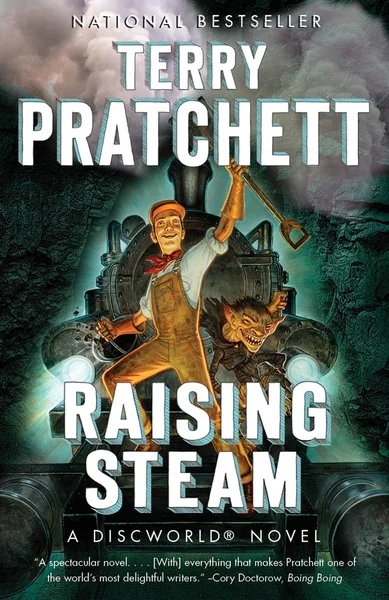
Raising Steam: A Discworld Novel by Terry Pratchett Review: A Landmark Entry in a Beloved Series

Raising Steam is the 40th Discworld novel by Terry Pratchett, starring the reformed fraudster turned civil servant Moist von Lipwig as he navigates the arrival of the steam locomotive to Ankh-Morpork — a story of progress, political intrigue, and Dwarfish fundamentalism that carries the added weight of being one of Pratchett's final works before his death in 2015.

LuvemBooks Verdict

Best for

Longtime Discworld readers — especially those who have followed Moist von Lipwig across his previous appearances — who want a thematically ambitious, ensemble-driven late-series entry that rewards deep familiarity with the world's characters and politics.

Worth it if

You've read enough Discworld to care about where Moist von Lipwig, Lord Vetinari, and the Dwarfish political situation have been — in which case the novel's layered character dynamics, its genuine themes of progress and resistance to change, and its emotional weight as a penultimate series entry all land with full force.

Skip if

You're new to Discworld, or you came to the series for the broad, freewheeling satirical comedy of the early books — the dense web of returning characters and the series' maturation into something more internally invested may feel more like homework than homecoming.

What readers & critics say

Critical reception was largely warm: Kirkus Reviews called it "brimming with Pratchett's trademark wit, a yarn with a serious point made with style and elegance," noting that Discworld humour has become implicit rather than explicit while continuing to explore serious themes. The Guardian observed that the novel marks a symbolic milestone for the series, with the railway map signalling "the world's triumphant arrival into the modern era," and identified its central concerns as genuinely large in scope — though a candid retrospective account at patricktreardon.com, drawing on Rob Wilkins' biography, notes that the writing process was severely hampered by Pratchett's declining health, with Wilkins himself calling it "a missed opportunity."

Brimming with Pratchett's trademark wit, a yarn with a serious point made with style and elegance.

Kirkus Reviews

The Discworld, created as a setting for humorous stories, began to take on a certain solidity, as if it were striving to become a real place.

The Guardian

The writing of Raising Steam was a nightmare because of Pratchett's increasing disabilities — Wilkins calls it 'a missed opportunity.'

patricktreardon.com (on Rob Wilkins' biography)

No one else has constructed a world quite like this, where the self-deprecating humour belies a breadth and richness of observation and commentary on our current world.

sjhigbee.wordpress.com
Sources: Kirkus Reviews, The Guardian, patricktreardon.com
In This Review
  • What Works & What Doesn't
  • What the Novel Is and What Happens
  • The Novel's Place in the Discworld Arc
  • Thematic Ambition
  • Critical Reception and Strengths
  • Who This Novel Is For and Where It Has Limits

What Works & What Doesn't

What Works
  • The 40th Discworld novel unites a large, beloved ensemble — Moist von Lipwig, Adora Belle Dearheart, Lord Vetinari, Sir Harry King, and others — in a plot with real political and emotional stakes
  • Cory Doctorow praised it on Boing Boing as a novel where Pratchett balanced whimsy and gravitas more carefully than ever, calling it 'a spectacular novel, and a gift from a beloved writer to his millions of fans'
  • The introduction of Dick Simnel as a credible, fully developed new character is a genuine achievement in a series with an already deep-rooted cast
  • Thematically ambitious: The Guardian identified its core concerns as 'the threat and promise of change, the individual's search for meaning within their own society, and the fine moral judgments that have to be made between competing rights and freedoms'
  • The railway map — a first for the series — signals the Discworld's arrival into a new era, making this a structurally and symbolically distinctive entry in the canon
What Doesn't
  • Best appreciated by readers already familiar with the Discworld, especially Moist von Lipwig's prior appearances — the novel's character dynamics and political references reward series veterans far more than newcomers
  • As The Guardian noted, the series has shifted considerably from its early broad satirical mode into something more invested in its own internal world and recurring characters, a transition not every reader will welcome
Raising Steam is a novel that rewards longtime Discworld readers while standing as a milestone in one of fantasy literature's most beloved and sustained series.

What the Novel Is and What Happens

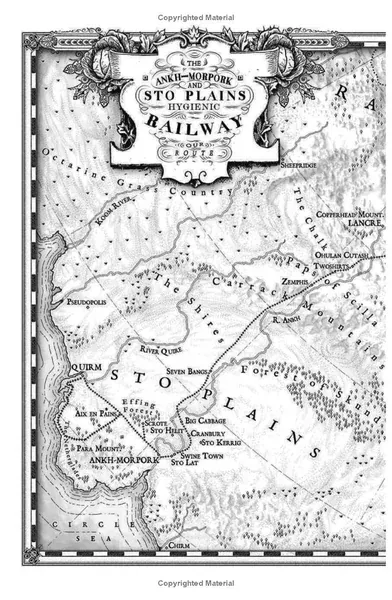
Map of the Sto Plains railway network, illustrating the industrial infrastructure central to the novel's steam-powered setting.
Raising Steam centers on Dick Simnel, a young self-taught engineer from Sto Lat, whose father Ned Simnel appeared in an earlier Discworld installment, Reaper Man. Dick has invented Discworld's first steam locomotive — named Iron Girder — and brings it to Ankh-Morpork, where it captures the imagination of Sir Harry King, a millionaire who made his fortune in waste and sanitation and now seeks a legacy untainted by that history. King invests heavily to make the railway a commercial reality. Lord Vetinari, Ankh-Morpork's Patrician, moves quickly to ensure the city retains political influence over this transformative enterprise, and to that end appoints Moist von Lipwig — the series' charming, reformed con-artist-turned-government-official — to manage the railway on behalf of the state. Moist's talent for negotiation proves immediately necessary as the rail line requires deals with landowners along its route. The plot escalates when Dwarfish fundamentalists launch a campaign of terrorism against the new railway, including murder and arson, culminating in a palace coup in Uberwald while the Dwarf King is away at a summit in Quirm. Vetinari tasks Moist with an apparently impossible mission: transport the King over twelve hundred miles back to Schmaltzberg to restore political stability — by rail, over a line that is far from complete.

The Novel's Place in the Discworld Arc

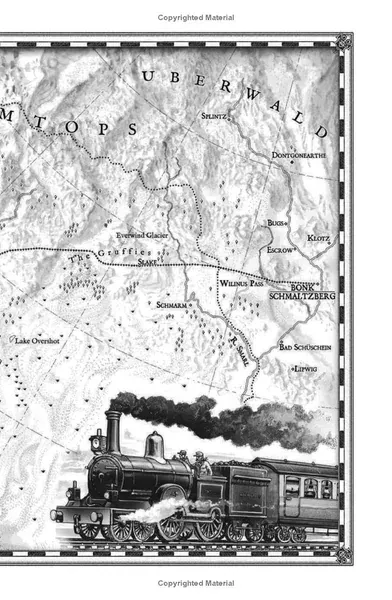
As the 40th book in the series and its penultimate entry before Pratchett's death in 2015, Raising Steam carries unusual narrative and emotional weight. As The Guardian observed in its review, the Discworld series began as satirical fantasy but underwent a long transformation in which "the Discworld, created as a setting for humorous stories, began to take on a certain solidity, as if it were striving to become a real place." That solidification came not through conventional fantasy world-building but through the deepening of recurring characters — figures like Lord Vetinari, Moist von Lipwig, and Adora Belle Dearheart — whose continued presence in Raising Steam gives the novel a resonance beyond its individual plot. The Guardian also noted the symbolic significance of the novel's inclusion of a railway map — a departure for a series that had famously never embedded maps in its texts — describing it as marking "the world's triumphant arrival into the modern era."
Map of fictional landscape with steam locomotive illustration, reflecting the novel's industrial revolution theme.

Thematic Ambition

The Guardian's review identified that Pratchett's themes in this novel are genuinely large in scope: "the threat and promise of change, the individual's search for meaning within their own society, and the fine moral judgments that have to be made between competing rights and freedoms." The arrival of steam power to the Disc functions as a lens through which the novel examines how societies absorb — or resist — technological and cultural disruption. The Dwarfish fundamentalist movement is not mere plot machinery; it gives Pratchett a vehicle to interrogate how entrenched traditionalism can turn violent when confronted with irreversible change. These are not lightweight observations, and the novel weaves them through a story that also delivers the wit and world-specific texture that defines the Discworld brand.

Critical Reception and Strengths

Critical reception for Raising Steam was notably warm. Science fiction author Cory Doctorow, reviewing the novel on Boing Boing, wrote that Pratchett "never quite balanced whimsy and gravitas as carefully as this, and it works beautifully. This is a spectacular novel, and a gift from a beloved writer to his millions of fans." The novel's structure brings together a large ensemble — Moist, Adora Belle Dearheart, Harry King, Sgt Fred Colon, and others — whose intersecting roles across the railway enterprise and the Dwarfish political crisis allow Pratchett to sustain multiple tones simultaneously. The novel is also notable for introducing Dick Simnel as a fully realized new character in a series where newcomers must earn their place among a cast of deeply established figures.
Who This Novel Is For and Where It Has Limits

Raising Steam is most fully rewarding for readers already familiar with the Discworld, and particularly those who have followed Moist von Lipwig through his previous appearances. The novel's plot depends on knowing why Vetinari's trust in Moist carries weight, and why the Dwarf political situation resonates — context that earlier Discworld novels supply. Readers new to the series will find an entertaining fantasy-comic novel, but will encounter a dense web of references and character histories that function as ongoing rewards for the loyal rather than entry points for the uninitiated. Some readers, as The Guardian's review implicitly framed, may also find that the Discworld's maturation into something more structurally substantial changes the register they first fell in love with — the broad satirical strokes of the early books have given way here to something more invested in its own world's internal stakes. Whether that is a gain or a loss is, genuinely, a matter of what a reader comes looking for.

Sources & Further Reading

The key facts and claims in this review are grounded in the retrieved, verified sources listed below.

  1. 1

    Terry Pratchett, Wikipedia

  2. 2
  3. 3
  4. 4
  5. 5
  6. 6
  7. 7
  8. 8
  9. 9
  10. 10
  11. 11
  12. 12