Best Terry Pratchett Books: Where to Start on Discworld

3 books

Raising Steam: A Discworld Novel by Terry Pratchett
Making Money by Terry Pratchett
The Colour of Magic and The Light Fantastic by Terry Pratchett
Fiction

Best Terry Pratchett Books: Where to Start on Discworld

Curated recommendations for fans of Terry Pratchett and readers of books

3 Books
3.5 Avg
Updated Jun 6, 2026

Terry Pratchett wrote over 40 Discworld novels across four decades, which means new readers face a genuinely delightful problem: where on earth (or rather, on a giant turtle floating through space) do you begin? The answer isn't as straightforward as you might hope, because Pratchett himself evolved enormously as a writer — from sharp fantasy parody to rich, layered satire that takes on everything from banking to the industrial revolution.

This curated list maps three key entry points into his body of work, giving you a honest sense of what each book does well and where it sits in Pratchett's creative journey. Whether you want to start at the very beginning, dive into his mature satirical peak, or explore his later years, there's a genuine starting point here for every kind of reader. Terry Pratchett rewards patience and curiosity — and this list will help you give him both.

#1
Raising Steam: A Discworld Novel by Terry Pratchett by Terry Pratchett - book cover
Raising Steam: A Discworld Novel by Terry Pratchett

by Terry Pratchett

3.8/5

If you've already spent time in Ankh-Morpork and want to see what happens when the industrial revolution arrives on the Disc, Raising Steam makes for a satisfying — if occasionally meandering — late-series visit. Moist von Lipwig at his charming, barely-competent best anchors a story about locomotives, goblin rights, and the messy human cost of progress. Pratchett resists the easy answer: innovation isn't simply good or bad here, it displaces and creates in equal measure. The comedy takes a back seat to ideas more often than in his sharpest work, which will frustrate readers expecting wall-to-wall wit, but reward those happy to follow Pratchett wherever his curiosity leads. Best approached after Going Postal and Making Money — Moist is much funnier when you already know how much he'd rather be somewhere else.
"More interested in ideas than jokes — and that trade-off will suit some Discworld readers better than others."
N/A
Level: N/A
#2
Making Money by Terry Pratchett by Terry Pratchett - book cover
Making Money by Terry Pratchett

by Terry Pratchett

3.5/5

Pratchett wrings more genuine insight from paper money and institutional inertia than most novelists manage from weightier subjects — which is either a remarkable achievement or a damning comment on economic literature, possibly both. Making Money sends reformed con man Moist von Lipwig into Ankh-Morpork's Royal Bank, where he discovers that running a financial institution isn't so different from running a con: it's all about what people choose to believe. The banking guild's horror at unbacked paper currency is a precise, funny portrait of institutions that confuse tradition with soundness. It's not Pratchett at his most inventive — the plot mechanics creak a little, and fans of his wilder, more anarchic earlier work may find it too comfortable. But as a satire of financial culture, trust, and the psychology of money, it's sharper than it has any right to be.
"The guild's horror at paper money unbacked by gold is a precise comic portrait of institutions that mistake tradition for soundness."
N/A
Level: N/A
#3
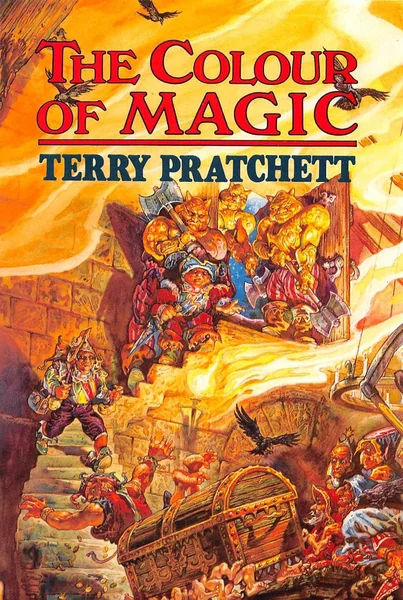
The Colour of Magic and The Light Fantastic by Terry Pratchett by Terry Pratchett - book cover
The Colour of Magic and The Light Fantastic by Terry Pratchett

by Terry Pratchett

3.2/5

Here's the honest truth about starting at the very beginning: The Colour of Magic and The Light Fantastic are not the best Discworld novels. They're rough, episodic, and lean heavily on parody of fantasy tropes that may not land if you haven't read the genre they're sending up. Rincewind the incompetent wizard and Twoflower the oblivious tourist stumble through adventures that feel more like connected sketches than a novel — because, largely, they are. What these books offer is the pleasure of watching a singular imagination warm up, the Discworld still half-formed, Death appearing only briefly, Ankh-Morpork barely sketched. For readers who want to understand where Pratchett came from before seeing where he arrived, there's genuine charm here. But if you bounced off these and gave up on Discworld, go back — try Guards! Guards! or Small Gods first, and return here later when you're already in love with the Disc.
"An uneven but necessary starting point — charming in its ambition, rough in its execution."
N/A
Level: N/A
Final Thoughts

There's no single "correct" way to enter Terry Pratchett's Discworld, and that's part of what makes his work so extraordinary. Whether you begin with the rough-edged early adventures of The Colour of Magic, the razor-sharp comedy of Making Money, or the bustling momentum of Raising Steam, you're stepping into one of the most imaginative literary universes ever created.

The honest truth is that any starting point will eventually lead you to the same place: hopelessly devoted, rereading your favourites and hunting down the ones you missed. Pick the book that sounds most like you, start there, and trust the turtle. Discworld will do the rest.

Frequently Asked Questions

It genuinely depends on your reading style. The Colour of Magic is the chronological beginning but represents Pratchett still finding his voice. Many fans recommend starting with a standalone-friendly novel like Making Money, which introduces the charming Moist von Lipwig and requires no prior Discworld knowledge to enjoy.
No — and this is one of Pratchett's greatest gifts to readers. Each Discworld novel can be read as a standalone, though some characters and storylines do continue across multiple books. Making Money, for example, is a sequel to Going Postal, but reads perfectly well on its own.
It's the chronological starting point, but not necessarily the best entry point for modern readers. The Colour of Magic is more episodic and experimental than Pratchett's later work, and some new readers bounce off it before discovering how brilliant the series becomes. Go in with adjusted expectations and you'll find plenty to enjoy.
Pratchett's comedy blends sharp satirical observation with absurdist wordplay and genuine warmth. He skewers institutions — banking in Making Money, industrialisation in Raising Steam — while always keeping his characters deeply human. It's wit with heart, which is rarer than it sounds.
Absolutely. While some fans feel the very late novels like Raising Steam show the effects of Pratchett's illness (he was diagnosed with early-onset Alzheimer's in 2007), they still contain remarkable ideas and social commentary that reward patient readers. They're different in texture, but far from worthless.
With 41 novels in the main series, most dedicated readers take anywhere from one to several years, depending on pace. The good news is there's no urgency — each book is its own reward. Starting with this list of three will give you a clear sense of whether Discworld is the literary universe you want to commit to long-term.
Best Terry Pratchett Books: Where to Start on Discworld | LuvemBooks