BOOKS
Published

Read Time

8 min read

Reader rating

4.4

· 20,070 Amazon ratings
reader ratings, not a LuvemBooks score
Curated & edited by

LuvemBooks Editorial

How we create our reviews →
Share This Review

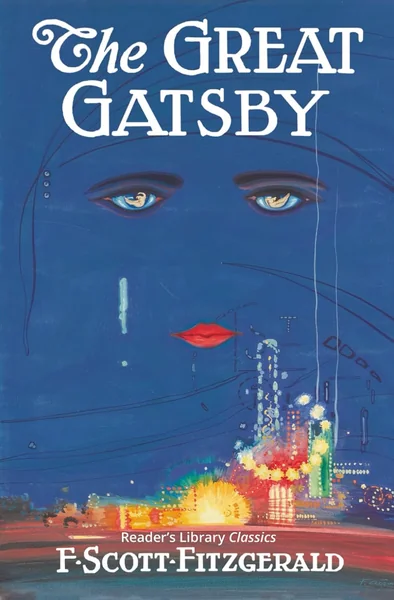
The Great Gatsby – Reader's Library Classic by F. Scott Fitzgerald Review: An Essential Jazz Age Novel in Affordable Form

This Reader's Library Classics paperback edition of F. Scott Fitzgerald's The Great Gatsby brings one of American literature's most examined novels into the public-domain era in an accessible, compact format — making the text widely available to new readers and returning students alike, though shoppers should be aware of the broader landscape of post-2021 reprints flooding the market.
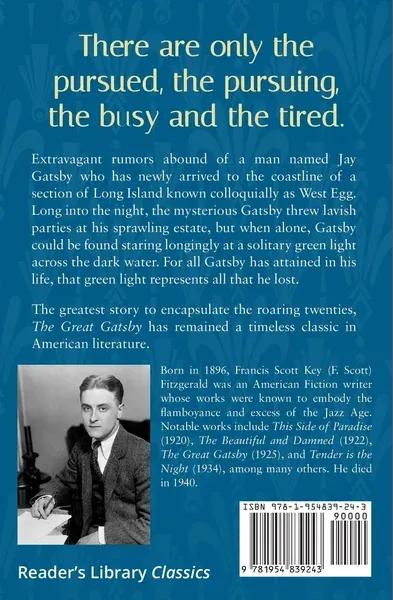
Back cover with synopsis, author biography, portrait photograph, and barcode.Tap to enlarge

LuvemBooks Verdict

Best for

Students, first-time readers, and anyone building an affordable personal library of canonical American fiction who wants a compact, physical copy of Fitzgerald's Jazz Age masterpiece without spending much.

Worth it if

You want an accessible, low-cost entry point to one of the most enduringly debated novels in American literary history — particularly if you're drawn to Jazz Age cultural history, the hollowness of the American Dream, or Fitzgerald's lyrical modernist prose.

Skip if

Readers seeking extended narrative scope or subplot complexity may find the novel's deliberately concentrated, compressed form less satisfying — and anyone buying a public-domain reprint should first verify the edition contains the complete, unaltered text, given Wikipedia's warning that numerous altered and incomplete reprints have flooded the market since 2021.

Critical engagement with The Great Gatsby has deepened across a century: BBC Culture documents that the novel was widely misunderstood on first publication in 1925, with early reviewers reading it as crime fiction and Fitzgerald himself lamenting that "not one had the slightest idea what the book was about," while bookmarks.reviews records that even the most enthusiastic early notices left readers in "a mood of chastened wonder" without fully grasping its significance — a belated recognition that only hardened into canonical status through school curricula and later scholarship.

An anonymous early reviewer described it as a novel requiring only 'a deadened intellect' and producing 'an aftermath of wonder that such things are produced.'

The Guardian
Sources: BBC Culture, Bookmarks Reviews, The Guardian, The Good Novel, Culture Honey, Bookish Insights, ThoughtCo
4.4from 20,070 Amazon ratings— reader ratings, not a LuvemBooks score

Age & Reading Level

Recommended age

Adult

Reading level

Adult

Content to know about

alcohol and prohibition-era excess
moral corruption and infidelity
class contempt and racism of the period

Skip if you're looking for a long, plot-driven narrative with complex subplots and extended character arcs

Trending Now
Trending

The Great Gatsby by F. Scott Fitzgerald is Trending

Updated Sep 12, 2026
In This Review
  • What Works & What Doesn't
  • What the Novel Is — and What It Argues
  • The Novel's Place in the Literary Canon
  • A Novel That Was Not Always Celebrated
  • The Public Domain Context — and Why Edition Choice Matters
  • Who This Edition Is For

What Works & What Doesn't

What Works
  • Fitzgerald's critique of the American Dream through Jay Gatsby's obsessive pursuit of Daisy Buchanan remains one of the most incisive in American literary fiction
  • The novel carries enormous canonical weight, examined and praised across decades of scholarship and cited by the American Library Association as among the most discussed classics in U.S. Literature
  • The 2021 entry into the public domain makes this Reader's Library Classics paperback an affordable, accessible physical edition of the complete text
  • Fitzgerald's Jazz Age setting — the parties, the class divides, the Long Island geography — gives the novel a vivid historical and cultural specificity that doubles as social criticism
What Doesn't
  • Wikipedia explicitly notes that the post-2021 public-domain moment has produced 'numerous altered and incomplete reprints,' making careful edition verification essential before purchase
  • The novel's relatively brief scope means readers seeking extended narrative depth or subplot complexity may find the story more concentrated and compressed than expected
This Reader's Library Classics edition of The Great Gatsby is a solid, affordable entry point to a novel that has never stopped generating critical conversation — though this review covers the text's content and its documented reception from published sources, not hands-on use of the edition itself.

What the Novel Is — and What It Argues

Set on the prosperous Long Island of 1922, The Great Gatsby centers on the narrator Nick Carraway's encounters with the enigmatic Jay Gatsby, a man of newly acquired wealth who throws lavish parties at his sprawling West Egg estate while fixating, from a distance, on a solitary green light across the dark water. That green light belongs to the dock of Daisy Buchanan — the socialite and lost love whose real-life inspiration, according to Wikipedia's reception history, was Ginevra King, a Chicago debutante whose influence shaped the character deeply. Fitzgerald, one of the leading voices of the post–World War I "Lost Generation," uses Gatsby's obsession to mount a sustained critique of the American Dream: the novel argues that the pursuit of wealth and status leads not to fulfillment but to emptiness, and that the glittering surface of Jazz Age prosperity conceals profound moral rot. The Barnes & Noble synopsis captures the novel's central tension plainly — for all Gatsby has attained, the green light represents everything he has lost.
numerous altered and incomplete reprints have flooded the market

The Novel's Place in the Literary Canon

The Great Gatsby, first published in 1925, has long occupied a central position in American literary culture. F. Scott Fitzgerald — author also of This Side of Paradise, The Beautiful and the Damned, and Tender Is the Night — is widely credited with giving the Jazz Age its defining portrait, and Wikipedia notes that Fitzgerald himself claimed to have coined the very term "Jazz Age." Critical engagement with the novel has only deepened over the decades, with later scholarship focusing especially on Fitzgerald's disillusionment with American idealism. The American Library Association has listed the book among the most challenged classics in U.S. Literature, a distinction that underscores how seriously its themes continue to provoke. As critics has noted, Gatsby "has been thoroughly inspected and crawled over, lifted up and shaken out for every last detail it can surrender to its fascinated readers, but this remarkable novel has some surprises left" — a testament to its sustained critical vitality.

A Novel That Was Not Always Celebrated

It is worth noting that the novel's reputation was not always secure. Critical coverage records that an anonymous early reviewer described it in terms that spoke for many of its first readers — as one of countless modern novels requiring little more than a "deadened intellect" and producing only "an aftermath of wonder that such things are produced." The book sold modestly in Fitzgerald's lifetime, and it was only through the tireless promotional efforts of literary champions, and eventually its adoption into school and university curricula, that The Great Gatsby* ascended to canonical status. This history of belated recognition is itself part of what makes the novel such a rich object of study — and part of why public-domain editions like this one matter, extending access to a text that now belongs to everyone.
Back cover with synopsis, author biography, portrait photograph, and barcode.

The Public Domain Context — and Why Edition Choice Matters

The novel's U.S. Copyright expired on January 1, 2021, when all literature of 1925 entered the public domain. This Reader's Library Classics paperback, published February 25, 2021, is among the earliest wave of reprints made possible by that transition. Wikipedia explicitly flags that since the copyright lapsed, "numerous altered and incomplete reprints have flooded the market" — a caution that applies across the category, not as a specific verdict on this edition, but as essential context for any buyer. Readers selecting a public-domain reprint should confirm the edition contains the complete, unaltered text before purchasing, regardless of publisher.

Who This Edition Is For

As a compact paperback, this Reader's Library Classics edition is designed to serve readers who want the novel in a physical, affordable format — students, first-time readers, and those building a personal library of canonical American fiction. The themes Fitzgerald wove into the narrative — the hollowness of material success, the impossibility of recapturing the past, and the seductive cruelty of class in America — remain urgently relevant. Readers drawn to American literary modernism, to the cultural history of the Prohibition era, or simply to the enduring question of what the American Dream actually costs will find The Great Gatsby as penetrating now as scholars have long argued it to be. The value of this particular edition lies in its accessibility; the value of the novel itself is, by any measure of its critical legacy, beyond serious dispute.

Sources & Further Reading

The key facts and claims in this review are grounded in the retrieved, verified sources listed below.

  1. Cited in this review
  2. 1
  3. 2
  4. Further reading
  5. 3
  6. 4
  7. 5
  8. 6
  9. 7
  10. 8
  11. 9
  12. 10
  13. 11
  14. 12
  15. 13
  16. 14