8 min read
4.6
· 25,112 Amazon ratingsShare This Review

Our review
The Grapes of Wrath
The Grapes of Wrath: 75th Anniversary Edition by John Steinbeck Review: A Landmark Novel in a Commemorative Package
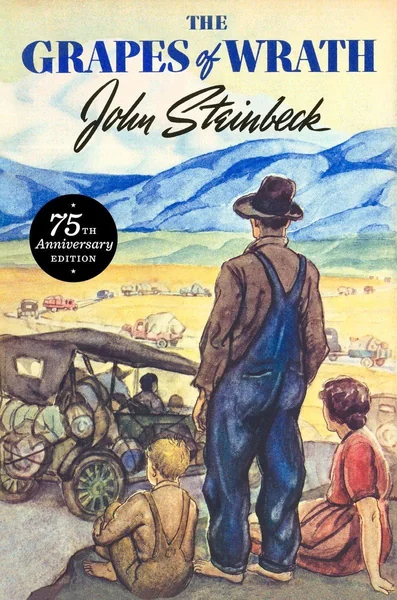
This 75th Anniversary Edition of John Steinbeck's Pulitzer Prize– and National Book Award–winning novel presents the enduring story of the Joad family's forced migration from Oklahoma to California during the Great Depression, in a hardcover volume modeled on the original 1939 first edition and featuring cover illustration by Elmer Hader and specially designed endpapers by Michael Schwab. This review is based on the book's documented contents and published reception, not hands-on use of the physical edition.
LuvemBooks Verdict
Best for
Readers who want to own a presentation-quality hardcover of one of the most decorated novels in American literature — particularly those drawn to the commemorative design of Elmer Hader's original cover art and Michael Schwab's endpapers — as well as first-time readers approaching the Joads' story of Dust Bowl dispossession for the first time.
Worth it if
The text's towering literary reputation and the edition's deliberate tribute to the 1939 first edition — its original cover illustration and specially designed endpapers — are what you're paying for, and you're content to assess the physical production quality yourself before committing.
Skip if
Academic readers needing scholarly apparatus — an introduction, critical essays, or contextual notes — should look elsewhere, as this edition does not appear to include any, and collectors unable to inspect the physical volume firsthand should be aware that paper, binding, and reproduction fidelity cannot be confirmed from published sources alone.
What readers & critics say
Kirkus Reviews called it a work of "deep and disciplined passion" with "flash after flash of unforgettable pictures," singling Steinbeck out from all his contemporaries. Bloomsbury's critical survey notes that while the novel instantly became a bestseller upon its 1939 publication, it has "elicited a wide range of critical responses," with some earlier reviewers faulting Steinbeck for apparent sentimentality and others disturbed by his portrait of heartless, greedy Americans — a contested but enduring legacy that Steinbeck in the Schools summarises as the novel having "come to be celebrated as a shining achievement… in the entire American literary canon," even as it retains detractors to this day.
“There is anger here, but it is a deep and disciplined passion… not a book for casual reading.”
— Kirkus ReviewsAsk LuvemBooks
Was this helpful?
- Is it worth reading?
- For readers drawn to American literary realism, The Grapes of Wrath represents one of the most decorated and critically sustained novels ever published in the United States — honored with the Pulitzer Prize, the National Book Award, and a direct citation at Steinbeck's Nobel Prize in Literature in 1962. Don DeLillo, as quoted by the publisher, argues that Steinbeck 'shaped a geography of conscience' and that 'there is something at stake in every sentence,' a view that reflects the novel's remarkable consistency of critical regard across generations. Its themes of economic injustice, migrant labor, and human dignity have lost none of their relevance since 1939. Readers seeking a beautifully produced commemorative object will find the 75th Anniversary Edition's design intent clearly articulated; those needing scholarly apparatus should supplement it with additional resources.
- Similar books
- Readers who respond to The Grapes of Wrath's moral urgency and social realism will find natural companions in the titles curated below. The Great Gatsby and Other Works by F. Scott Fitzgerald shares the era and its preoccupation with the American Dream's costs and contradictions, while Crime and Punishment by Fyodor Dostoevsky offers comparably high moral stakes and a protagonist — Raskolnikov — whose conscience is tested under extreme social pressure, much as Tom Joad's is. Among the other curated titles, Upton Sinclair's The Jungle is perhaps the closest thematic parallel, exposing the brutal exploitation of the working poor with the same reforming fury Steinbeck brings to the plight of Dust Bowl migrants. Zora Neale Hurston's Their Eyes Were Watching God and Cormac McCarthy's The Road round out the selection with their own accounts of survival, displacement, and the search for dignity under harsh conditions.
- Who should read this?
- This edition is most naturally suited to two groups: readers encountering The Grapes of Wrath for the first time who want the full, unaltered text of one of American literature's most consequential novels, and longtime admirers of Steinbeck seeking a presentation edition that honors the novel's original visual identity through Elmer Hader's cover art and Michael Schwab's endpapers. It also makes a compelling gift for anyone who values significant American literature as both a reading experience and a collectible artifact. Academic readers, however, should note the absence of a new introduction or critical essays and will want to supplement this edition accordingly.
- About John Steinbeck
- John Ernst Steinbeck was an American writer and novelist.
- What are the major themes?
- The Grapes of Wrath engages several interlocking themes that have kept it continuously relevant since 1939: economic injustice and the exploitation of migrant labor, the gap between the promise and the reality of the American Dream, and the resilience of human dignity under extreme dispossession. The novel also carries a strong current of Christian symbolism — Jim Casy is widely interpreted as a Christ-like figure through his ministry and death, while Tom Joad's arc traces an evolving moral conscience moving from self-interest toward collective responsibility. The intercalary chapters broaden these themes beyond the Joad family to indict the systemic forces driving the Dust Bowl migration as a whole.
- How does this compare to Travels with Charley?
- The two Steinbeck works LuvemBooks has reviewed occupy very different registers. The Grapes of Wrath is a work of social-realist fiction at full force — a novel of dispossession, suffering, and moral outrage structured around the Joad family's Dust Bowl migration, and among the most decorated novels in American literary history. Travels with Charley in Search of America, by contrast, is a non-fiction road narrative in which Steinbeck himself travels across the United States, offering a more reflective and personal engagement with the American landscape and character. Both share Steinbeck's abiding interest in ordinary American lives, but the two books differ sharply in genre, tone, and ambition.
- Tell me about this specific edition
- This Viking hardcover was published in April 2014 to commemorate the novel's 75th anniversary and is explicitly modeled on the 1939 first edition. Its most distinctive features, as stated by the publisher, are the inclusion of the original cover illustration by Elmer Hader — the artist who designed the iconic first-edition cover — and specially designed endpapers by Michael Schwab, giving the volume clear commemorative distinction beyond a standard reprint. The edition does not appear to include a new introduction, critical essays, or scholarly apparatus. Whether the reproduction and production quality fulfill the commemorative design intent is something that cannot be determined without firsthand inspection of the physical volume.
Summarize this book
Follow up
Synthesized from verified book data & published reviews · How we review
What would you like to know about The Grapes of Wrath?
Answers come from our editorial notes on this book. If we haven't covered something, we'll say so.
Readers often ask
Our Review
What the Novel Is and What It Tells
Place in American Literary History
The Commemorative Edition's Design and Stated Contents
Critical and Literary Reception
Who This Edition Is For
Sources & Further Reading
The key facts and claims in this review are grounded in the retrieved, verified sources listed below.
- Cited in this review
- 1
- 2
- 3
- Further reading
- 4
John Steinbeck, Wikipedia
- 5
en.wikipedia.org
- 6
- 7
- 8
- 9
sunriverbooks.com
- 10
- 11
steinbeckintheschools.com
- 12
penguinrandomhouse.com
- 13
barnesandnoble.com
Age & Reading Level
Recommended age
Ages 14+
Reading level
Adult
4 content notes · who it suits
Content to know about
Best for: Adults / mature 14+ — unflinching depictions of poverty, labor exploitation, death, and social injustice require a reader comfortable with serious, morally weighty literary fiction.
Skip if you're looking for hopeful or redemptive fiction with an optimistic resolution.
Reader reviews
Be one of the first readers to answer.
Read it? Was it right for you?
Books like The Grapes of Wrath
Curated picks for readers who enjoyed The Grapes of Wrath, with our reasoning for each match.
More by John Steinbeck
If you liked The Grapes of Wrath