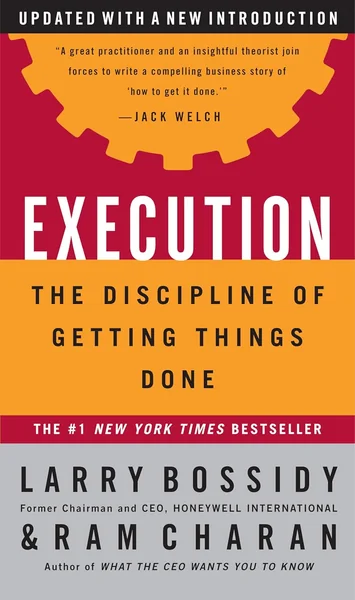
Execution: The Discipline of Getting Things Done
by Larry Bossidy, Ram Charan, Charles Burck
At a glance
About the Author
Larry Bossidy, Ram Charan, Charles Burck1 book reviewed
Execution
The Discipline of Getting Things Done
by Larry Bossidy, Ram Charan, Charles Burck
LuvemBooks Verdict
Best for: Senior leaders, newly appointed managers, and business professionals who want a practitioner-grounded framework for closing the gap between strategy and results in large, hierarchically structured organisations.
Worth it? Skip it? Read the full verdict →Ask LuvemBooks
Was this helpful?
- Is it worth reading?
- For senior leaders and managers in large or mid-sized organizations, Execution remains one of the most widely cited business books of the past two decades and a standard reference on the business shelf — Wharton professor Michael Useem described it as offering 'a compelling leadership prescription' that 'comes down to realism, discipline, and above all, great execution.' Critics called it 'a must-read for anyone who cares about business,' and its sustained readership of more than two million copies across two decades reflects broad, ongoing relevance. The key caveat is that its framework is built from the vantage point of large, hierarchically complex organizations, so entrepreneurs and nonprofit leaders will need to translate the concepts considerably before applying them.
- Who should read this?
- The book is expressly designed for anyone moving into a first management role or taking on the responsibility of running a unit, division, or entire company — and it is particularly well suited to readers who favor frameworks grounded in real executive experience rather than academic theory. Senior and top-level leaders at large, hierarchically complex organizations will find the most direct applicability. Readers who want named examples rather than hypothetical scenarios — such as the contrasting cases of Jamie Dimon at JPMorgan Chase and Charles Prince at Citigroup — will find this approach notably different from most management titles.
- Similar books
- Readers who respond to Execution's emphasis on organizational discipline and leadership accountability will find strong companions in the curated shelf below. Jim Collins' Good to Great examines why some companies make the leap to sustained superior performance — a natural complement to Bossidy and Charan's focus on follow-through over strategy alone. Patrick Lencioni's The Five Dysfunctions of a Team and The Advantage both address the organizational health and leadership cohesion that execution depends on. For readers interested in innovation under competitive pressure, Clayton Christensen's The Innovator's Dilemma is a foundational pairing, and Kim Scott's Radical Candor offers a more granular, manager-level lens on the people process that Execution covers from the top down.
- What makes it stand out?
- Two features distinguish Execution from most management titles. First, its co-authors bring an unusually credible combination: Larry Bossidy led real organizational turnarounds at AlliedSignal and Honeywell, while Ram Charan has taught at Harvard Business School and the Kellogg School of Northwestern University — giving the argument both boardroom authenticity and conceptual rigor. Second, the book names real executives and draws explicit lessons from their decisions, most notably the contrasting paths of Jamie Dimon at JPMorgan Chase and Charles Prince at Citigroup, rather than retreating to abstracted or fictionalized parables.
- What are its limitations?
- The book's most significant limitation is its organizational scope: the framework and case examples are drawn primarily from large, hierarchically complex organizations — the kind Bossidy ran and Charan advised — making direct application harder for small-business owners, entrepreneurs, or leaders in the public and nonprofit sectors. The perspective is also weighted toward the top of the org chart; managers seeking detailed guidance on mid-level or front-line execution will find the book less granular at those layers. These are natural constraints of the book's strengths rather than failures of execution (so to speak), but readers should enter with a clear sense of the context the authors are addressing.
- Is it good for new managers?
- The book is explicitly designed to reorient thinking for anyone moving into a first management role or taking on the responsibility of running a unit, division, or entire company — making it a well-suited early read for new managers who are encountering the gap between strategic planning and actual results for the first time. It is most directly useful for those entering roles in larger organizations with defined structures and reporting layers. New managers in startups or flat teams will find the principles valuable but the specific processes less immediately applicable without adaptation.
Summarize this book
Follow up
Synthesized from verified book data & published reviews · How we review
Press Enter to ask. Answers come from our editorial Q&A — start typing to see related questions.
Age & Reading Level
Recommended age
Adult
Reading level
Adult
who it suits
Skip if you're looking for ground-level, tactical execution guidance for small teams, startups, or nonprofit organizations rather than a large-organization leadership framework.
Editorial Review
Published in 2002 by Crown Currency and a #1 New York Times bestseller with more than two million copies in print, Execution: The Discipline of Getting Things Done by Larry Bossidy, Ram Charan, and Charles Burck makes a forceful case that bridging the gap between strategy and results — not vision-setting alone — is the true work of leadership, and it remains one of the most widely cited business books of the past two decades.
Read the Full ReviewBooks like Execution
Curated picks for readers who enjoyed Execution, with our reasoning for each match.
If you liked Execution