

8 min read
4.4
· 1,651 Amazon ratingsShare This Review
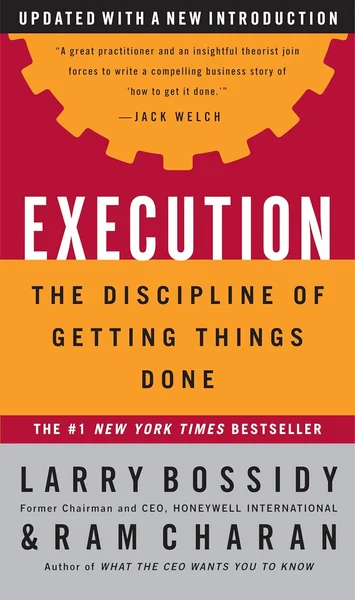
Execution: The Discipline of Getting Things Done by Larry Bossidy, Ram Charan & Charles Burck Review: A Landmark Business Classic on Results
Published in 2002 by Crown Currency and a #1 New York Times bestseller with more than two million copies in print, Execution: The Discipline of Getting Things Done by Larry Bossidy, Ram Charan, and Charles Burck makes a forceful case that bridging the gap between strategy and results — not vision-setting alone — is the true work of leadership, and it remains one of the most widely cited business books of the past two decades.
LuvemBooks Verdict
Best for
Senior leaders, newly appointed managers, and business professionals who want a practitioner-grounded framework for closing the gap between strategy and results in large, hierarchically structured organisations.
Worth it if
You lead or are about to lead a team, unit, or company and want a clear, experience-backed framework — built around real named executives and companies — for making execution the centre of your leadership practice rather than an afterthought to strategy.
Skip if
You run a small business, a startup, or a flat non-corporate organisation, or you are seeking granular tactical guidance for mid-level or front-line execution challenges — the book's framework and case examples are built for large, hierarchically complex organisations and weighted toward the top of the leadership layer.
What readers & critics say
Manager-Tools rates the book five stars, noting that execution is "often left by the side of the road" in a business landscape crowded with strategy and big-picture titles, positioning this as a rare corrective. The Cosy Dragon highlights the book's central argument that linking people, strategy, and operations is "the real job of running a business, not formulating a 'vision' and leaving the work of carrying it out to others."
Sources: Manager Tools, The Cosy DragonAge & Reading Level
Recommended age
Adult
Reading level
Adult
who it suits
Skip if you're looking for ground-level, tactical execution guidance for small teams, startups, or nonprofit organizations rather than a large-organization leadership framework.
In This Review
- What Works & What Doesn't
- What the Book Is and What It Argues
- Credentials and Context Behind the Argument
- Strengths: Real-World Cases and Intellectual Honesty
- Limitations and Who May Find It Less Useful
- Relevance and Who It Is For
What Works & What Doesn't
What Works
- #1 New York Times bestseller with more than two million copies in print, reflecting sustained, broad readership across two decades
- Grounded in named, real-world case studies — including Jamie Dimon at JPMorgan Chase and Charles Prince at Citigroup — rather than abstracted examples
- Co-authored by a practitioner (Bossidy, a turnaround executive at AlliedSignal and Honeywell) and an academic adviser (Charan, Harvard and Kellogg), giving the argument both boardroom credibility and conceptual rigor
- Offers a clear, three-process framework — people, strategy, and operations — that organizes the execution challenge in a structured and actionable way
- Praised by critical coverage as 'a must-read for anyone who cares about business' and endorsed by senior practitioners and management academics alike
What Doesn't
- The framework and case examples are drawn primarily from large, hierarchically complex organizations, making direct application harder for small-business owners, entrepreneurs, or nonprofit leaders
- The perspective is weighted toward top-level and senior leadership; managers seeking detailed guidance on mid-level or front-line execution will find the book less granular at those layers
What the Book Is and What It Argues
Credentials and Context Behind the Argument
Strengths: Real-World Cases and Intellectual Honesty
Limitations and Who May Find It Less Useful
Relevance and Who It Is For
Frequently Asked Questions
Sources & Further Reading
The key facts and claims in this review are grounded in the retrieved, verified sources listed below.
- Cited in this review
- 1
- 2
- Further reading
- 3
- 4
thecosydragon.com
- 5
- 6
- 7
manager-tools.com
- 8
- 9
Related Reviews
Reviews of books we picked for readers who enjoyed Execution.



Reader Comments
No comments yet
Be the first to share your thoughts!