BOOKS
Published

Read Time

3 min read

Curated & edited by

LuvemBooks Editorial

How we create our reviews →
Share This Review

More Happy Than Not by Adam Silvera Review: A Gut-Punch Debut About Identity and Memory

Adam Silvera's debut novel More Happy Than Not is a New York Times bestseller and a TIME Magazine pick for the 100 Best YA Books of All Time — a gritty, emotionally charged young adult novel set in the Bronx that weaves together grief, sexual identity, and a near-future technology that promises to erase the memories making you who you are.

LuvemBooks Verdict

Best for

Readers who want YA fiction that confronts suicide, homophobic violence, grief, and self-suppression with full seriousness — particularly those drawn to narratives where a clever structural twist recontextualizes everything they thought they understood about a character.

Worth it if

You want a propulsive, emotionally unsparing YA novel whose near-future premise carries real sociopolitical weight, and you're prepared for a plot architecture designed to implicate you in a character's self-erasure before you fully realise what has been erased.

Skip if

You're seeking a gentle or lightly paced coming-of-age story — the novel's unflinching depictions of suicide, homophobic violence, and grief make it a genuinely demanding read, and the speculative memory-erasure conceit may sit uneasily with readers who prefer a fully grounded realistic tone.

What readers & critics say

Kirkus Reviews called it "a brilliantly conceived page-turner," and the book earned starred reviews from five major outlets on publication. The New York Times selected it as an Editors' Choice and called it "mandatory reading," with critics at nytimes.com praising Silvera's "delicate knitting of class politics through an ambitious narrative about sexual identity and connection that considers the heavy weight and constructive value of traumatic memory."

A brilliantly conceived page-turner.

Kirkus Reviews

Silvera manages a delicate knitting of class politics through an ambitious narrative about sexual identity and connection that considers the heavy weight and constructive value of traumatic memory.

nytimes.com

Gripping, thought-provoking tale of memory and sexual identity — Aaron slowly begins to question his own identity in a near future where memories can be suppressed.

Common Sense Media
Sources: Kirkus Reviews, The New York Times
4.6from 915 Amazon ratings— reader ratings, not a LuvemBooks score
In This Review
  • What Works & What Doesn't
  • What the Novel Is and What It Sets in Motion
  • A Narrative Built on Revelation
  • Reception and Cultural Standing
  • The Weight of Specific Setting and Stakes
  • Who the Novel Is For, and Where It Demands the Most

What Works & What Doesn't

What Works
  • A New York Times bestseller that earned starred reviews from five major outlets, including Kirkus Reviews, Publishers Weekly, and Booklist — one of the most critically decorated YA debuts of 2015.
  • The novel's structural twist — revealing that Aaron has already undergone the Leteo memory-erasure procedure before the story begins — recontextualizes the entire narrative in a way that rewards close reading.
  • Silvera roots Aaron's impossible choices in the concrete social pressures of working-class Bronx life, giving the near-future science-fiction premise real emotional and sociopolitical grounding.
  • Named to TIME Magazine's 100 Best YA Books of All Time list and Paste Magazine's Best Young Adult Novel of All Time list, cementing its place as a genuine landmark in the genre.
  • Critics called it 'mandatory reading,' recognizing its layered treatment of sexual identity, class politics, and traumatic memory.
What Doesn't
  • The novel's unflinching depictions of suicide, homophobic violence, and grief make it a demanding read — not suited to readers seeking lighter YA fare or a gently paced coming-of-age story.
  • The near-future memory-erasure premise, while emotionally resonant, requires readers to accept a speculative conceit that some may find an uneasy fit with the novel's otherwise grounded, realistic tone.
Adam Silvera's debut novel is one of the most decorated YA novels of the last decade, and its premise earns every commendation.

What the Novel Is and What It Sets in Motion

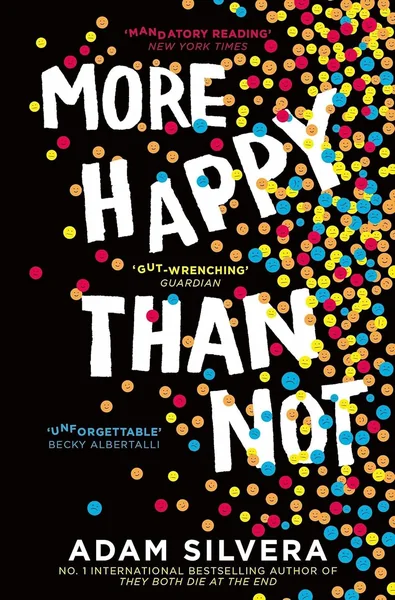
More Happy Than Not by Adam Silvera front cover
More Happy Than Not centers on sixteen-year-old Aaron Soto, a teenager living in the Bronx whose father died by suicide three months before the story begins. Aaron, who carries his own attempt's scar — a smile-shaped mark on his wrist — is trying to claw his way back to happiness, leaning on his girlfriend Genevieve and his neighborhood crew. When Genevieve leaves for an artist's retreat, Aaron falls into an increasingly close friendship with Thomas, a newcomer with an idealist, carefree personality. As those feelings deepen into something Aaron cannot dismiss, he confronts the possibility of turning to the Leteo Institute — a near-future organization that performs neurosurgery to erase traumatic memories — to suppress his sexuality and reclaim the life he had before. The publisher's synopsis frames the novel's central moral question starkly: why does happiness have to be so hard, and how much of yourself are you willing to erase to find it?

A Narrative Built on Revelation

What distinguishes the novel structurally is the way Silvera constructs Aaron's story around layered disclosure. As Soho Press noted in its own promotional material, "the true beauty of this book is the way Silvera subtly reveals the plot — readers find Aaron coming out to them in a gradual way." The twist that Aaron has already used the Leteo Institute before — that repressed memories of a secret relationship with a classmate named Collin and a violent rejection by his father are not new history but recovered history — recontextualizes everything that came before it. The plot's architecture is designed to implicate the reader in Aaron's self-erasure before they fully realize what has been erased.

Reception and Cultural Standing

The novel's critical footprint is substantial and well-documented. It earned starred reviews from Kirkus Reviews, Publishers Weekly, School Library Journal, Booklist, and Shelf Awareness, and critical coverage both named it an Editors' Choice and called it "mandatory reading." Critics praised how Silvera "manages a delicate knitting of class politics through an ambitious narrative about sexual identity and connection that considers the heavy weight and constructive value of traumatic memory, as well." Beyond the Times, the book landed on TIME Magazine's 100 Best YA Books of All Time list, Paste Magazine's Best Young Adult Novel of All Time list, and was a Junior Library Guild selection, among dozens of other year-end honors. It was also shortlisted for the Lambda Literary Award for Children's and Young Adult Literature. This is not a novel that slipped through quietly — it announced Silvera as a significant voice in the genre from its first outing.

The Weight of Specific Setting and Stakes

Silvera, who was born and raised in the Bronx, grounds the novel in a working-class urban landscape that shapes Aaron's choices as concretely as his internal life does. The threat of violence from Aaron's own friend group — who assault both Thomas and eventually Aaron himself upon discovering his sexuality — is not abstract. The Leteo Institute's appeal reads as a direct product of that environment: when the cost of being openly gay is physical danger and social exile in a place you cannot simply leave, the fantasy of a surgical solution to identity carries genuine weight. The novel is set in a near-future version of this world, but the social dynamics it depicts are rooted in specific, recognizable pressures of class and neighborhood belonging.

Who the Novel Is For, and Where It Demands the Most

More Happy Than Not does not soften its subject matter. It engages directly with suicide, homophobic violence, grief, and the psychological cost of self-suppression. Readers looking for a light entry point into LGBTQ+ YA fiction will find this is not that book — it is designed, in Silvera's own structural choices, to sit with difficulty rather than resolve it tidily. For readers who want YA fiction that treats adolescent pain with full seriousness, the novel's combination of propulsive plot mechanics and emotional honesty has made it a reliable recommendation for nearly a decade. Those who prefer a more measured narrative pace may find the novel's twists arrive with considerable force; that intensity is precisely what its most devoted readers cite as its defining quality.

Sources & Further Reading

The key facts and claims in this review are grounded in the retrieved, verified sources listed below.

  1. Cited in this review
  2. 1
  3. 2
  4. 3
  5. Further reading
  6. 4
    Adam Silvera — author profileHigh-authority source

    Adam Silvera, Wikipedia

  7. 5
  8. 6
  9. 7
  10. 8