BOOKS
Published

Read Time

4 min read

Reader rating

4.6

· 11,079 Amazon ratings
reader ratings, not a LuvemBooks score
Curated & edited by

LuvemBooks Editorial

How we create our reviews →
Share This Review

Speak by Laurie Halse Anderson Review: A Landmark YA Novel on Trauma and Voice

First published in 1999, Laurie Halse Anderson's Speak is a National Book Award Finalist and Michael L. Printz Honor Book that has sold more than 3.5 million copies and been translated into 35 languages — a genuine modern classic of young adult literature, and one of the most decorated and widely taught novels in its genre.

LuvemBooks Verdict

Best for

Young readers aged 12 and up — particularly those in grades 7–9 — navigating questions of consent, identity, and self-expression, as well as adults who want to understand why this novel has held such a singular place in YA literature for over two decades.

Worth it if

You value literary craft alongside emotional honesty and want a novel that takes both its protagonist and its subject — rape, survivor guilt, and the slow reclamation of identity — with complete seriousness and zero sentimentality.

Skip if

Readers or parents seeking a gentler introduction to themes of adolescent trauma should be aware that the novel's unflinching portrayal of sexual assault, depression, and social ostracism is genuinely demanding, and its fragmented, nonlinear diary structure will frustrate those who prefer a conventional narrative arc.

Kirkus Reviews calls it "a frightening and sobering look at the cruelty and viciousness that pervade much of contemporary high school life, as real as today's headlines," praising its gripping plot and powerfully drawn characters. Common Sense Media describes it as "one of the most devastatingly true and painful portrayals of high school to come along in a long time," highlighting Melinda's realistic and compelling healing process.

A frightening and sobering look at the cruelty and viciousness that pervade much of contemporary high school life, as real as today's headlines.

kirkusreviews.com

One of the most devastatingly true and painful portrayals of high school to come along in a long time.

commonsensemedia.org
Sources: Kirkus Reviews, Common Sense Media
4.6from 11,079 Amazon ratings— reader ratings, not a LuvemBooks score

Look inside the book

Preview the actual pages, via Google Books
In This Review
  • What Works & What Doesn't
  • What the Novel Is and What It Portrays
  • Craft and Narrative Structure
  • Significance and Recognition
  • Genuine Limitations and Reader Considerations
  • Who This Novel Is For

What Works & What Doesn't

What Works
  • National Book Award Finalist and Michael L. Printz Honor Book, with an exceptional awards record across multiple major literary recognitions
  • Structurally inventive diary format mirrors Melinda's trauma, giving the narrative a psychological authenticity grounded in craft
  • Tackles rape, survivor guilt, and identity with directness that has made it a landmark in the YA genre for over 25 years
  • More than 3.5 million copies sold and translated into 35 languages, reflecting sustained, broad resonance across generations of readers
  • Expands into a rich multimedia universe — a 2004 film adaptation, a graphic novel with Eisner Award–winner E.M. Carroll, and a 20th anniversary edition with additional content
What Doesn't
  • Its unflinching portrayal of sexual assault, depression, and social ostracism has made it one of the most challenged books in U.S. Schools — the subject matter is demanding and not suited to all young readers at all stages
  • The fragmented, nonlinear diary structure, while artistically purposeful, may frustrate readers who prefer a more conventional narrative arc
A cornerstone of young adult literature, Speak endures because it refuses easy comfort — a novel that places a survivor's silence, guilt, and slow reclamation of identity at the center of the story with uncompromising honesty.

What the Novel Is and What It Portrays

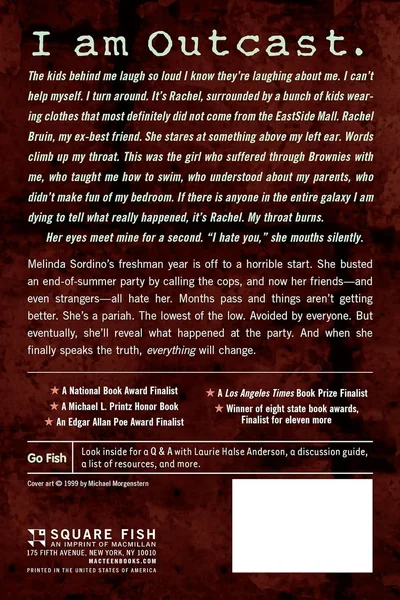
Back cover with synopsis, review quotes, and publisher information for a National Book Award finalist novel.
Speak follows Melinda Sordino through her freshman year at Merryweather High School in the aftermath of a traumatic event. The previous summer, Melinda was raped by senior Andy Evans at an end-of-summer party. In shock, she called 9-1-1; when the police arrived and broke up the party, several partygoers were arrested. No one knew why she had called, and Melinda — unable to verbalize what happened to her — became an outcast, abandoned by her friends and silenced by her own trauma. The novel traces her year of near-total withdrawal from speech and social connection, and her gradual, painful movement toward acknowledging what Andy Evans did and confronting him again when he poses a continued threat to others at her school. As Macmillan's description notes, Melinda's healing process is still underway when a second violent encounter forces her to fight back and refuse silence.
Anderson structures the narrative as a diary, told across four school marking periods, with a nonlinear and fragmented quality that, as Wikipedia's summary of the novel notes, mirrors the disorientation of trauma itself. It is classified as a problem novel — or trauma novel — and it earns that designation without sensationalism.

Craft and Narrative Structure

The diary format is central to how Speak operates as a work of fiction. Anderson uses it to render Melinda's interiority directly — her dark humor, her self-blame, and the way she edits her own experience even in private. The novel also incorporates intertextual symbolism throughout: fairy-tale imagery, Hawthorne's The Scarlet Letter, and references to Maya Angelou all work, according to Wikipedia's scholarly summary, to layer Melinda's trauma within broader cultural and literary frameworks around women, silence, and shame. The art classroom — and Melinda's relationship with her teacher Mr. Freeman — functions as the one channel through which she can express what she cannot say aloud; the gradual development of an art project becomes the novel's structural spine for her recovery.
Scholar Barbara Tannert-Smith, whose work is documented in Wikipedia's reception summary, has argued that the novel's commercial success is rooted in its ability to speak the reader's language — a quality that distinguishes Speak from more distanced treatments of similar subject matter.

Significance and Recognition

Few YA novels of the past three decades carry the weight of accolades that Speak does. Macmillan's record of the book's recognition includes: a National Book Award Finalist for Young People's Literature, a Michael L. Printz Honor Book, a New York Times Bestseller, an Edgar Allan Poe Award Finalist, a Los Angeles Times Book Prize Finalist, a Golden Kite Award Winner, and recognition by TIME Magazine as one of the best YA books of all time. It has been translated into 35 languages, adapted into a 2004 film directed by Jessica Sharrar and starring Kristen Stewart as Melinda, and adapted into a graphic novel — Speak: The Graphic Novel, with artwork by Eisner Award–winner E.M. Carroll, published in 2018.
Originally published in 1999, the novel has appeared in multiple editions, including a 20th anniversary version released in 2019 alongside Anderson's memoir Shout. The Square Fish paperback edition is the widely circulated reprint that has brought the novel to successive generations of classroom readers.

Genuine Limitations and Reader Considerations

The very qualities that make Speak powerful — its unflinching subject matter, its portrayal of rape, social ostracism, and depression — have also made it one of the most challenged books in American schools. Wikipedia's documentation of the novel's censorship history records that it was challenged in Missouri schools and listed in the Newsletter of Intellectual Freedom's "Books Challenged or Banned" bibliography. Anderson has publicly and repeatedly spoken out against these challenges. The novel does not soften or deflect from its subject matter, and readers or parents seeking a gentler introduction to themes of adolescent trauma will find the content demanding. That same directness is, for many, precisely the point — but it is worth naming as a genuine threshold.

Who This Novel Is For

Speak is designed for readers aged 12 and up, and is commonly taught in grades 7 through 9. It is a strong choice for young readers navigating questions of consent, identity, and self-expression, and for adults who want to understand why this particular novel has occupied such a singular place in YA literature for over two decades. Readers who value literary craft alongside emotional honesty — who want a novel that takes both its protagonist and its subject seriously — will find Speak as relevant now as when it first appeared. Its 3.5 million copies sold and translation into 35 languages are not merely publishing statistics; they reflect a readership that has, for a quarter century, recognized something true and necessary in Melinda Sordino's story.

Sources & Further Reading

The key facts and claims in this review are grounded in the retrieved, verified sources listed below.

  1. Cited in this review
  2. 1
  3. 2

    us.macmillan.com

  4. 3
  5. Further reading
  6. 4

    Laurie Halse Anderson, Wikipedia

  7. 5
  8. 6
  9. 7
  10. 8