
7 min read
4.8
· 1,506 Amazon ratingsShare This Review
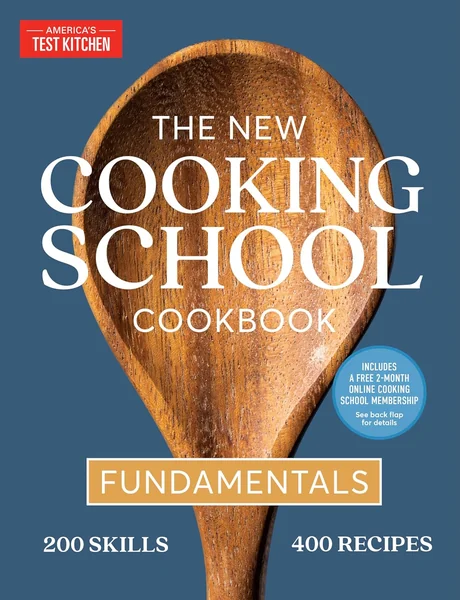
The New Cooking School Cookbook: Fundamentals by America's Test Kitchen Review: A Rigorous, Course-Structured Kitchen Education
America's Test Kitchen's The New Cooking School Cookbook: Fundamentals is a comprehensive culinary reference designed to teach foundational cooking skills through 80 themed courses, 400 recipes, and more than 200 kitchen tips and techniques — structured explicitly as an in-home cooking school for cooks at any level.
LuvemBooks Verdict
Best for
Home cooks at any level who want to build genuine, lasting culinary competence through a structured, curriculum-driven approach rather than simply collecting recipes to reproduce.
Worth it if
You want a single, authoritative reference that takes you from foundational skills through a broad range of techniques — and you're willing to engage with its school-style sequencing to get the most from it.
Skip if
You're looking for a concise, quick-reference weeknight cookbook — at 680 pages with a course-by-course curriculum, the book's depth and structure will feel disproportionate to that goal.
What readers & critics say
Lee Valley describes the book as "a comprehensive, well-organized guide… aimed to provide home cooks of any skill level with the foundational knowledge needed for successful cooking," noting its thematic chapter structure and practical coverage of kitchen basics. The dokumen.pub snippet records that a prior ATK cooking school title earned a James Beard Award and Publishers Weekly bestseller status, reflecting the broader critical standing of ATK's cooking-school series.
Sources: Lee Valley, dokumen.pubAge & Reading Level
Recommended age
Adult
Reading level
Adult
who it suits
Skip if you want a lean, quick-reference cookbook for fast weeknight meals rather than a structured culinary education.
In This Review
- What Works & What Doesn't
- What the Book Actually Is
- The Course-Driven Structure and Its Design Intent
- Scope, Scale, and ATK's Institutional Authority
- Genuine Strengths: Breadth and Accessibility by Design
- Who May Find Limitations Here
What Works & What Doesn't
What Works
- 80 themed courses and 400 recipes provide exceptional breadth for a single-volume cooking reference
- Progressive course structure is designed to build skills systematically, mirroring a real culinary curriculum
- More than 200 kitchen tips and hacks embedded throughout offer practical, actionable guidance beyond the recipes themselves
- Each course includes culinary history, giving readers context for the techniques and dishes they're learning
- Explicitly designed for both beginners and experienced cooks looking to fill foundational gaps
What Doesn't
- At 680 pages, the volume's scale makes it a poor fit for readers seeking a concise, quick-reference cookbook
- The sequenced course structure assumes an engaged, learner-oriented reader — those who want to dip in and out without the surrounding curriculum may find the format overly prescriptive
What the Book Actually Is
The Course-Driven Structure and Its Design Intent
Scope, Scale, and ATK's Institutional Authority
Genuine Strengths: Breadth and Accessibility by Design
Who May Find Limitations Here
Frequently Asked Questions
Sources & Further Reading
The key facts and claims in this review are grounded in the retrieved, verified sources listed below.
- Cited in this review
- 1
- 2
shop.americastestkitchen.com
- 3
- Further reading
- 4
- 5
Related Reviews
Reviews of books we picked for readers who enjoyed The New Cooking School Cookbook.
Reader Comments
No comments yet
Be the first to share your thoughts!