
8 min read
4.9
· 11,003 Amazon ratingsShare This Review
The Food Lab: Better Home Cooking Through Science by J. Kenji López-Alt Review: A Landmark Culinary Science Reference
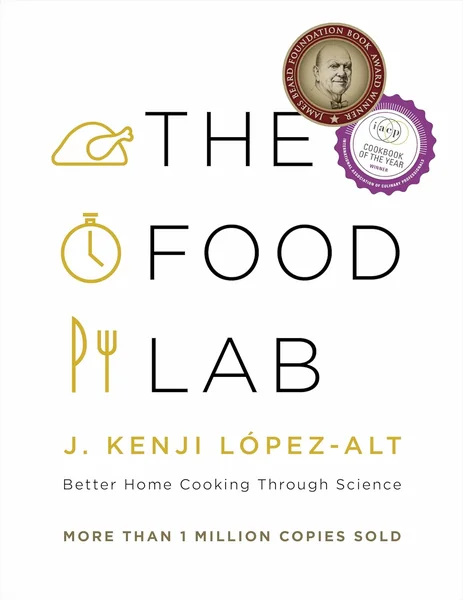
J. Kenji López-Alt's The Food Lab is a James Beard Award-winning cookbook and New York Times bestseller that applies the scientific method to nearly 300 savory American recipes, explaining the underlying chemistry and physics of cooking so that home cooks understand not just what to do, but why it works. This review assesses the book's content, organisation, and published critical reception — not a kitchen test.
LuvemBooks Verdict
Best for
Curious home cooks who want to understand the mechanics of why cooking techniques work — not just follow recipes — and are willing to invest time in a dense, encyclopedic reference built around everyday American dishes.
Worth it if
You want a single, authoritative volume that replaces cooking intuition with scientific understanding, covering everything from emulsification to the Leidenfrost effect as it applies to familiar dishes like steak, mac and cheese, and roast turkey.
Skip if
You need a quick, prescriptive weeknight guide or are looking for coverage beyond savory American cuisine — the 958-page depth and technique-first organisation will feel like far more than you need.
What readers & critics say
According to Wikipedia, The Food Lab charted on the New York Times Best Seller list and won both the 2016 James Beard Foundation Award for General Cooking and the 2016 IACP Cookbook of the Year and Best American Cookbook awards. Smart Bitches Trashy Books described it as "a nerd's dream" — "hopelessly intimidating yet utterly fascinating" — praising López-Alt as "a geek in the best and truest sense: he is full of enthusiasm."
“Kenji shows that conventional methods often don't work that well, and home cooks can achieve far better results using new — but simple — techniques.”
— TantorAge & Reading Level
Recommended age
Adult
Reading level
Adult
who it suits
Skip if you want a concise, quick-reference cookbook or guidance on global cuisines, baking, or pastry.
In This Review
- What Works & What Doesn't
- What the Book Actually Is
- Its Place in the Genre and Its Critical Standing
- Strengths: Technique, Depth, and Everyday Ambition
- What the Structure Delivers
- Who It Serves Best — and Where It May Test Patience
What Works & What Doesn't
What Works
- Winner of the 2016 James Beard Foundation Award for General Cooking and both the IACP Cookbook of the Year and Best American Cookbook awards — an extraordinary sweep of top culinary honors
- Applies the scientific method to nearly 300 accessible, everyday American recipes, with recipes arranged by technique to build cumulative cooking knowledge
- Praised by published reviews, the Chicago Tribune, critical coverage, and the Globe and Mail for the depth and sophistication of its approach
- Includes charts and embedded experiments that explain the underlying science — temperature, energy, emulsification, and more — in practical terms
- Designed to function as a lasting reference encyclopedic enough for experienced home cooks, not just beginners
What Doesn't
- At 958 pages, the book's depth and explanatory density make it a substantial commitment — not suited to readers seeking a concise, quick-reference guide
- Focused exclusively on savory American cuisine, which limits its scope for cooks seeking guidance on global cuisines, baking, or pastry
- Critics noted that López-Alt's continuously updated Serious Eats column may feel more current and responsive than a fixed print edition can
- The technique-first organisation, while educational, requires more navigational effort than conventional chapter-by-ingredient or chapter-by-course cookbooks
What the Book Actually Is
Its Place in the Genre and Its Critical Standing
Strengths: Technique, Depth, and Everyday Ambition
What the Structure Delivers
Who It Serves Best — and Where It May Test Patience
Frequently Asked Questions
Sources & Further Reading
The key facts and claims in this review are grounded in the retrieved, verified sources listed below.
- Cited in this review
- 1
- 2
smartbitchestrashybooks.com
- Further reading
- 3
en.wikipedia.org
- 4
booklarder.com
- 5
- 6
- 7
seriouseats.com
- 8
tantor.com
Related Reviews
Reviews of books we picked for readers who enjoyed The Food Lab.
Reader Comments
No comments yet
Be the first to share your thoughts!