BOOKS
Published

Read Time

4 min read

Curated & edited by

LuvemBooks Editorial

How we create our reviews →
Share This Review

Salt, Fat, Acid, Heat by Samin Nosrat Review: A Visionary Technique-First Cookbook

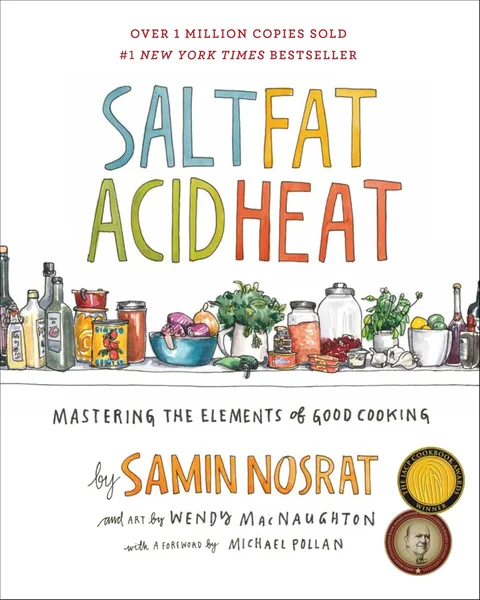
Samin Nosrat's Salt, Fat, Acid, Heat is a technique-driven cookbook that reframes how cooks at every level understand flavor and texture, building its entire curriculum around four foundational elements — salt, fat, acid, and heat — illustrated throughout by Wendy MacNaughton's watercolors, infographics, and hand-lettering. Publishers Weekly called it an "exceptional debut" certain to inspire greater confidence in the kitchen, and the book has reached millions of readers since its release from Simon & Schuster.

LuvemBooks Verdict

Best for

Home cooks and culinary students who want to understand *why* cooking works — not just follow instructions — and are willing to engage with explanatory text and diagrams as much as recipes.

Worth it if

You want a transferable, principle-first framework that makes you a more intuitive cook across any dish, not just the roughly 100 recipes the book contains.

Skip if

You primarily want a large, ready-to-execute recipe collection and have little patience for the substantial explanatory sections, diagrams, and conceptual teaching that occupy a meaningful portion of the book's length.

What readers & critics say

Publishers Weekly awarded it an enthusiastic review on publication, calling it an "excellent, accessible cookbook" and an "exceptional debut" that is "sure to inspire greater confidence in readers," highlighting Nosrat's clear explanations of how salt crystals affect flavor, how fat drives crispness, and how to balance all four elements. Bookmarks Reviews praised Nosrat's wisdom in covering food science without getting lost in chemistry, describing the four-element framework as "a valuable user's manual for recipes" that lets even the greenest cooks understand how a dish's parts fit together.

An excellent, accessible cookbook — an exceptional debut that is sure to inspire greater confidence in readers.

Publishers Weekly
Sources: Publishers Weekly, Bookmarks Reviews
4.8from 24,155 Amazon ratings— reader ratings, not a LuvemBooks score

Look inside the book

Preview the actual pages, via Google Books
In This Review
  • What Works & What Doesn't
  • What the Book Actually Is and Does
  • Origins and the Seven-Year Making of the Book
  • Significance: Where It Sits in the Cookbook Landscape
  • Strengths: Reception and Critical Assessment
  • Who It Is For — and Where It Has Limits

What Works & What Doesn't

What Works
  • Publishers Weekly called it an 'exceptional debut' and praised its accessible, confidence-building approach to teaching cooking fundamentals
  • Structured around a transferable four-element framework — salt, fat, acid, and heat — designed to make any dish improvable, not just the recipes printed in the book
  • Seven years in development, with the core curriculum tested through live teaching before being committed to the page
  • Wendy MacNaughton's watercolor illustrations, infographics, and hand-lettering replace photography throughout, a deliberate design choice Saveur described as a 'refreshing break' from standard cookbook conventions
  • Endorsed by Alice Waters, Bon Appétit, and NPR, and inspired a four-part Netflix documentary series — reflecting unusually broad cultural reach for a debut cookbook
What Doesn't
  • With roughly 100 recipes, the volume is lighter on ready-to-execute dishes than many cookbooks of comparable length — a meaningful portion of the book is devoted to explanatory text, diagrams, and conceptual frameworks
  • The principle-first, course-of-study structure rewards readers who engage with the teaching material; those seeking a straightforward recipe reference may need to reorient their expectations
This review assesses Salt, Fat, Acid, Heat based on its content, structure, and reception from published sources — not a kitchen test.

What the Book Actually Is and Does

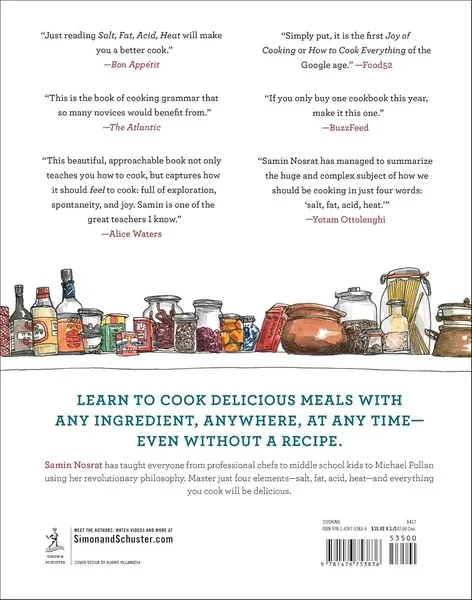
Back cover with review quotes and illustrated kitchen ingredients along bottom border.
Salt, Fat, Acid, Heat is a cookbook by American chef Samin Nosrat, illustrated by Wendy MacNaughton and designed by Alvaro Villanueva, published by Simon & Schuster. It is structured as a reference book and teaching tool, organized around the four elements its title names: salt, which enhances flavor; fat, which delivers flavor and generates texture; acid, which balances flavor; and heat, which determines a food's final texture. Nosrat positions these four factors as what she calls the "cardinal directions" of cooking — the underlying variables that determine whether any dish succeeds or fails. The book's stated goal is not merely to provide recipes but to teach readers to cook intuitively, so that mastering the elements becomes transferable to any dish, not just those printed on its pages.
Nosrat anchors the teaching in roughly 100 recipes, ranging from foundational techniques — breaking down a chicken, boiling an egg to a precise doneness, constructing a Caesar salad — to full dishes such as Vietnamese cucumber salad and pasta al ragù. These recipes are designed to function as demonstrations of the principles at work, not simply as standalone instructions. As the publisher describes it, the book is intended for everyone "from professional chefs to middle school kids," positioning it as a genuinely broad-audience volume rather than one pitched at a single skill level.

Origins and the Seven-Year Making of the Book

The book's backstory is notable and directly shaped its pedagogical structure. Nosrat began developing her four-element framework around 2009–10, when author Michael Pollan — then a cooking student of hers — encountered her system and urged her to write a book around it. She spent years building out a formal curriculum, teaching classes to test and refine the material, and identifying which concepts communicated most powerfully through visual diagrams. Those diagrams, mapping sources of acid or salt across many ingredients and traditions, became a structural backbone of the finished volume. The book took seven years in total: three years to write, a further year developing the illustrations with MacNaughton, and considerable time before that developing the underlying curriculum through live teaching.
That pedagogical origin matters because it means the content was tested in classrooms before it was committed to the page. The framework did not begin as a book concept; it began as a teaching system — which explains why the volume reads as a structured course rather than a curated collection of recipes.

Significance: Where It Sits in the Cookbook Landscape

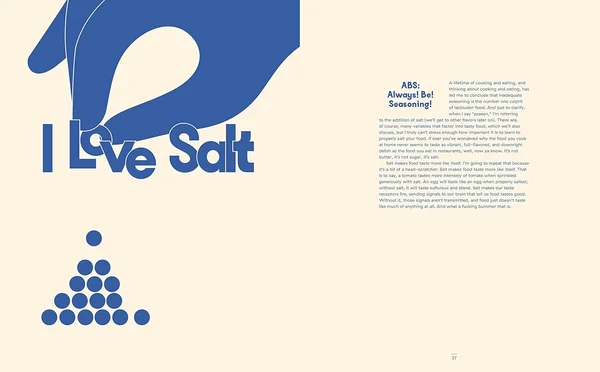
The book's departure from standard cookbook conventions was a deliberate choice. Nosrat insisted on MacNaughton's watercolor illustrations rather than photography specifically so that readers would not feel there is only one "correct" outcome when cooking a recipe. The American food magazine Saveur described this as a "refreshing break from this contemporary formula" of a "cleanly laid-out recipe facing an artful image of salad or toast." The entire book — all of MacNaughton's watercolors, infographics, and hand-lettering — contains no photographs at all, a structural commitment to the idea that cooking is a process, not a plated result.
The book also inspired a 2018 four-part Netflix documentary series of the same name, starring Nosrat herself, which extended the reach of its core ideas to a broader audience and reinforced its status as a cultural touchstone in food writing, not merely a kitchen reference.

Strengths: Reception and Critical Assessment

Publishers Weekly awarded the book an enthusiastic review on publication, calling it an "excellent, accessible cookbook" and an "exceptional debut" that is "sure to inspire greater confidence in readers." The review highlighted Nosrat's clear, measured explanations — noting, for instance, her attention to how even the shape of salt crystals affects a dish's overall flavor, and how fat drives crispness, caramelization, and texture. Bon Appétit is quoted by the publisher as stating plainly, "Salt, Fat, Acid, Heat will make you a better cook." Alice Waters, the chef who first gave Nosrat a job at Chez Panisse, has called her "America's next great cooking teacher," and critical coverage has described her as "the next Julia Child." These are not casual endorsements — they reflect the degree to which the food world received this book as something genuinely instructive rather than merely appealing.

Who It Is For — and Where It Has Limits

The book is designed for the widest possible cooking audience, and that ambition is both its greatest strength and a genuine point of friction for some readers. Cooks who come to a cookbook primarily seeking a large volume of ready-to-execute recipes may find the emphasis on principle-first teaching a different experience than expected. The recipe count — around 100 — is modest relative to the book's length and scope, because a substantial portion of the volume is devoted to explanatory text, diagrams, and conceptual frameworks rather than recipe pages. Readers who want to flip to a dish and start cooking may need to reorient their expectations: the book is structured as a course of study as much as a kitchen reference, and it rewards engagement with the explanatory material rather than skipping to the back matter. That is a design choice with a clear rationale, but it is worth knowing before purchase.

Sources & Further Reading

The key facts and claims in this review are grounded in the retrieved, verified sources listed below.

  1. Cited in this review
  2. 1
  3. 2
  4. 3
  5. Further reading
  6. 4
    Samin Nosrat — author profileHigh-authority source

    Samin Nosrat, Wikipedia

  7. 5
  8. 6
  9. 7
  10. 8
  11. 9
  12. 10