
8 min read
4.6
· 6,311 Amazon ratingsShare This Review
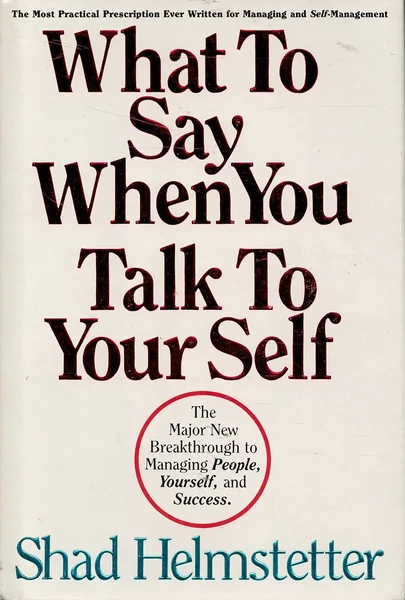
What to Say When You Talk to Your Self by Shad Helmstetter Review: A Foundational Self-Talk Classic
Shad Helmstetter's What to Say When You Talk to Your Self is a self-help guide built around the premise that internal programming — the habitual self-talk running through the mind — shapes behavior, success, and wellbeing, and that deliberately reprogramming it can produce lasting change. Originally published in 1986 and considered by many readers a landmark in personal-growth literature, the book remains widely read decades later. This review is based on the book's content, structure, and published reader and source commentary — not hands-on application.
 Tap to enlarge
LuvemBooks Verdict
Best for
Readers open to the self-help tradition who want a concrete, repeatable daily practice for replacing negative internal conditioning — particularly those who have found conventional motivational approaches unsustainable and prefer a structured, independent system over abstract theory or external coaching.
Worth it if
You're looking for a systematized, granular take on affirmation-based self-improvement that can be embedded into everyday routine without a coach or program, and you're willing to commit to the ongoing repetition the method requires.
Skip if
You need peer-reviewed clinical or neuroscientific grounding for any behavioral-change method you adopt, or you're looking for a one-time motivational read rather than a long-term, discipline-dependent daily practice.
What readers & critics say
Everand describes it as a title "considered by many to be one of the most important and helpful personal growth books ever written," noting readers find it provides clear methods for developing the right frame of mind for success. A reviewer on Storygraph cautions that the book can come across as "tasteless, bootstrap-pulling rambling" if approached without a specific goal in mind, though they note a reader needn't subscribe wholesale to Helmstetter's framework to absorb something positive from it.
Sources: Everand, The StoryGraph, Confident GermanAsk LuvemBooks
Was this helpful?
- Is it worth reading?
- For readers open to the self-help tradition and seeking a concrete, repeatable daily practice, What to Say When You Talk to Your Self has demonstrated remarkable staying power — nearly four decades of readership and a 2018 revised edition attest to that durability. Its structured framework addresses a specific gap in self-development: the need for internally motivated, word-for-word reprogramming rather than surface-level encouragement. The main caveat is that the framework rests on Helmstetter's own model rather than peer-reviewed clinical research, and the method demands consistent long-term repetition that the book itself cannot enforce. Readers seeking a single-read motivation boost or clinical validation for behavioral-change techniques will likely find it a less ideal match.
- Similar books
- Readers drawn to What to Say When You Talk to Your Self will find strong thematic overlap with several classics and contemporary titles. Joseph Murphy's The Power of Your Subconscious Mind similarly explores how internal mental patterns shape external outcomes, while Napoleon Hill's Think and Grow Rich is an earlier landmark in programming the mind for success. For a more research-anchored take on daily behavioral change, James Clear's Atomic Habits offers a system-based approach grounded in habit science. Don Miguel Ruiz's The Four Agreements and Brianna Wiest's The Mountain Is You both explore internal belief structures and self-limiting patterns, and Jen Sincero's You Are a Badass® shares Helmstetter's positive, practical orientation toward self-directed transformation.
- Who should read this?
- What to Say When You Talk to Your Self is best suited to readers who are open to the self-help tradition and want a concrete, repeatable daily practice rather than abstract motivational theory. It is particularly well matched to those who have found conventional motivational approaches unsustainable and are looking for a system they can apply independently, without a coach or external program. Readers already familiar with affirmation-based approaches will find Helmstetter's version more systematized and granular than most. Those who require clinical or neuroscientific validation for behavioral-change methods, or who want a single-read motivation boost without a commitment to ongoing practice, will likely find the method less well matched to their needs.
- Is there science behind it?
- The Self-Talk framework in What to Say When You Talk to Your Self rests on Helmstetter's own model of mental programming and self-talk levels rather than peer-reviewed clinical research. Helmstetter does argue that self-talk engages the brain's physiological processes — framing the method as more than surface-level motivation — but this claim is presented within his own system rather than drawn from independently verified neuroscience. Readers who require empirical grounding for behavioral-change methods may find the scientific underpinnings less rigorous than they'd prefer, and the book is best approached as a practitioner's framework rather than a clinical protocol.
- How do you actually use it?
- Helmstetter's system is designed to be embedded in daily routine rather than applied as a separate, effortful program. Readers script and repeat Self-Talk statements — phrased in the present tense as though change is already underway, such as "I no longer watch TV" or "I never drink coffee" — with enough regularity to overwrite older, unhelpful mental patterns. The book organizes these statements across distinct levels of Self-Talk, from reactive or resigned language up to affirmative declarations of identity and decision. The method requires consistent, long-term repetition; the book provides the framework and examples, but the discipline of daily application is left entirely to the reader.
- Why has this book lasted so long?
- Originally published in 1986, What to Say When You Talk to Your Self has remained widely read for nearly four decades — a span that places it among the longer-lasting titles in personal-growth literature. Everand describes it as "considered by many to be one of the most important and helpful personal growth books ever written," and a 2018 revised and updated eBook edition confirms continued commercial demand. Reader commentary consistently points to the book's reframing of self-improvement as a daily practice embedded in ordinary life, and its premise that the tools for self-motivation were already present internally — rather than dependent on external coaching or programs — as the core of its enduring appeal.
Summarize this book
Follow up
Synthesized from verified book data & published reviews · How we review
Press Enter to ask. Answers come from our editorial Q&A — start typing to see related questions.
Age & Reading Level
Recommended age
Adult
Reading level
Adult
who it suits
Skip if you need clinically validated, peer-reviewed methods for behavioral change or want a one-time motivational read without a commitment to ongoing daily practice.
Our Review
What the Book Actually Argues
Structure and Method: The Five Levels
Reception and Cultural Standing
What Readers Praise — and Where It Has Limits
Who This Book Is For
Sources & Further Reading
The key facts and claims in this review are grounded in the retrieved, verified sources listed below.
- Cited in this review
- 1
- 2
- Further reading
- 3
- 4
Related reading
Adjacent titles worth exploring. We haven't reviewed these yet, so they link out to Amazon.