7 min read
4.5
· 15,425 Amazon ratingsShare This Review
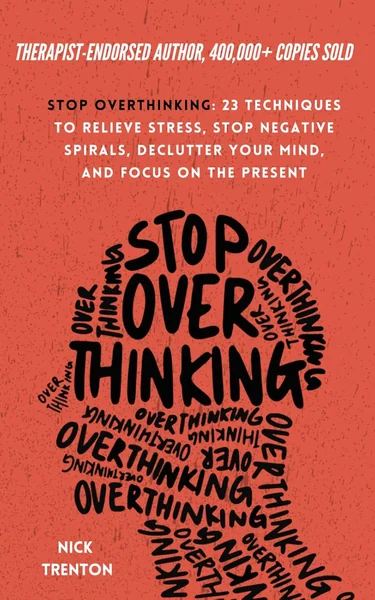
Stop Overthinking by Nick Trenton Review: A Structured Self-Help Guide to Mental Clarity
Nick Trenton's Stop Overthinking: 23 Techniques to Relieve Stress, Stop Negative Spirals, Declutter Your Mind, and Focus on the Present is a self-help guide designed to help readers break anxiety-driven thought cycles through behavioral psychology and mindfulness techniques — a practical, accessible entry point for anyone trapped in chronic rumination, though readers seeking deep clinical depth may want to supplement it.
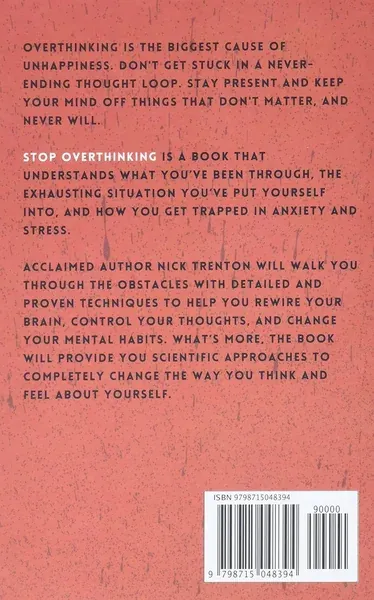 Tap to enlarge
LuvemBooks Verdict
Best for
Readers at the beginning or middle of their anxiety-management journey who recognise themselves in chronic mental loops and want a structured, numbered toolkit of actionable techniques rather than a philosophical or clinical text.
Worth it if
You want concrete, step-by-step strategies — drawn from behavioral psychology and the 4 A's stress management framework — that you can navigate directly to and apply without wading through dense theory.
Skip if
You already have solid grounding in CBT or mainstream mindfulness literature, or you're looking for research-heavy, clinically detailed coverage of each technique rather than an accessible introductory overview.
What readers & critics say
Aggregator and summary sites describe the book as a practical, structured resource: befreed.ai highlights its use of the 4 A's stress management system and mindfulness techniques to "break anxiety's grip," while summarybook.net characterises it as "a valuable resource for anyone seeking to regain control of their mental well-being," praising its practical strategies. Selfpublishingtitans.com notes that its 23 techniques are "meticulously crafted to address specific aspects of overthinking," offering readers a comprehensive approach to tackling mental clutter.
Sources: befreed.ai, summarybook.net, selfpublishingtitans.comAsk LuvemBooks
Was this helpful?
- Is it worth reading?
- For readers who recognize themselves in the description of chronic overthinking and want a structured, approachable framework — rather than narrative storytelling or academic depth — Stop Overthinking delivers genuine value. Its 23-technique format, organized around the 4 A's stress management system and supplemented with breathwork and sensory grounding, gives it a concrete, body-and-mind dimension that aggregator commentary notes has made it a go-to resource for breaking negative thought cycles. The key caveat is audience fit: readers already well-versed in CBT or mainstream mindfulness literature will likely encounter familiar ground, and those seeking clinical or research-heavy coverage will find the individual techniques treated at an introductory level.
- Who should read this?
- Stop Overthinking is best suited to readers at the beginning or middle of their journey with anxiety and stress management — specifically those who recognize themselves in the description of exhausting, self-reinforcing mental loops and want a structured, step-by-step framework for change. The 23-technique format makes it particularly appealing to readers who prefer concrete, actionable tools over abstract theory or narrative-driven self-help. It also serves as a natural starting point for anyone interested in exploring Trenton's wider The Path to Calm series. Readers already well-versed in CBT, mindfulness, or stress-management frameworks, or those seeking clinical-grade depth, are likely to find the coverage too introductory.
- Similar books
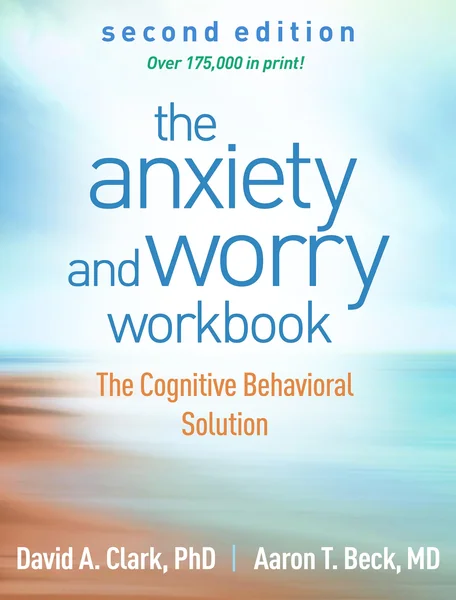
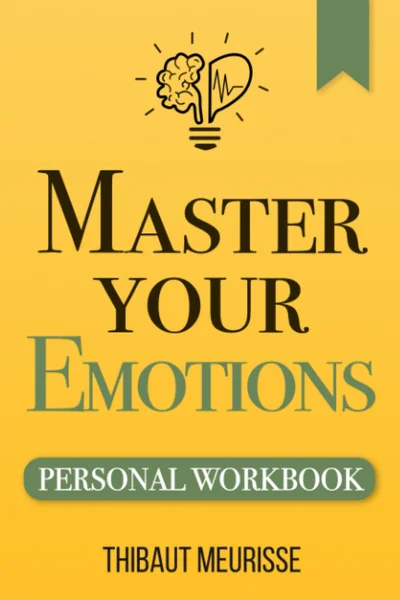
- Readers drawn to Stop Overthinking's focus on breaking negative thought cycles will find strong companions in the curated shelf below. Break Free From Overthinking by Karl Wiedermann covers adjacent territory with a similar accessible self-help approach, while The Magic of Mindful Self-Awareness by Matt Tenney brings a mindfulness-first lens to clearing mental clutter. For readers who want to go deeper on the cognitive side, The Anxiety and Worry Workbook: The Cognitive Behavioral Solution by David A. Clark and Aaron T. Beck offers a more clinically grounded, workbook-style treatment. Master Your Emotions by Thibaut Meurisse and Get Out of Your Head: Stopping the Spiral of Toxic Thoughts by Jennie Allen round out the shelf with practical, accessible takes on emotional regulation and thought-pattern interruption.
- About Nick Trenton
- Nick Trenton grew up in rural Illinois and describes himself as "a farm boy." He earned a BS in Economics before going on to become a prolific author focused on anxiety, self-regulation, and emotional well-being. He has authored over 30 books, emerging as a writer in the early 2020s, with Stop Overthinking among his most prominent titles.
- What are the main themes?
- The central theme of Stop Overthinking is the interruption of chronic rumination — the self-reinforcing anxiety cycles that Trenton argues are the single largest driver of unhappiness. Closely related themes include the distinction between productive analysis and unproductive overthinking, the identification of internal triggers that launch negative spirals, and the integration of both cognitive restructuring (via the 4 A's stress management framework) and body-based practices such as breathwork and sensory grounding. Mindfulness — particularly the return of attention to the present moment — runs throughout as an organizing principle.
- Where does this fit in the series?
- Stop Overthinking is the first title in Nick Trenton's The Path to Calm series, making it the natural entry point into his methodology. The series has since grown to more than two dozen books, all centering on themes of anxiety, self-regulation, and emotional well-being. Readers who respond to the structured, technique-driven approach in this volume have a deep catalog to continue with.
Summarize this book
Follow up
Synthesized from verified book data & published reviews · How we review
Press Enter to ask. Answers come from our editorial Q&A — start typing to see related questions.
Age & Reading Level
Recommended age
Adult
Reading level
Adult
who it suits
Skip if you want clinical depth, research-heavy coverage of the neuroscience, or are already well-versed in CBT and mainstream mindfulness literature.
Our Review
What the Book Actually Is and Does
Scope and Place in the Self-Help Genre
Strengths: Structure, Specificity, and Accessibility
Genuine Limitations and Who May Be Frustrated
Who This Book Is For
Sources & Further Reading
The key facts and claims in this review are grounded in the retrieved, verified sources listed below.
- Cited in this review
- 1
- 2
- 3
- Further reading
- 4
- 5
- 6
newbookrecommendation.com
- 7
Books like Stop Overthinking
Curated picks for readers who enjoyed Stop Overthinking, with our reasoning for each match.
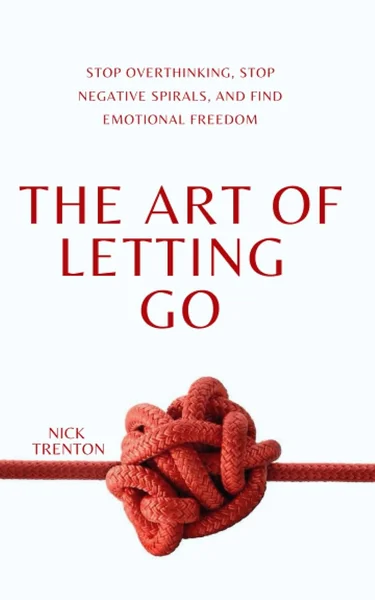
If you liked Stop Overthinking