At a glance

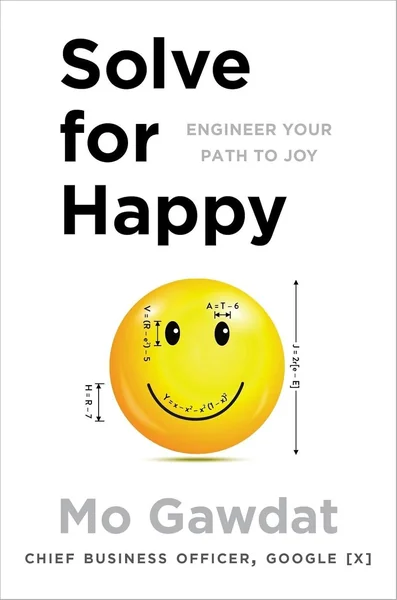
Solve for Happy
by Mo Gawdat
LuvemBooks Verdict
Best for: Readers who want a self-help book that earns its optimism — specifically those who have experienced serious loss or persistent low-level unhappiness and respond best to a structured, logic-driven framework rather than motivational anecdote.
Worth it? Skip it? Read the full verdict →Ask LuvemBooks
Was this helpful?
- Is it worth reading?
- For readers drawn to systematic frameworks and emotionally grounded non-fiction, Solve for Happy stands among the more substantive offerings in the self-help category. Its dual structure — fusing a deeply personal grief memoir with a rigorous engineer's logical model — gives it both emotional weight and intellectual substance that purely theoretical happiness writing cannot match. The key caveat is that the logic-first approach demands genuine active engagement rather than passive absorption, which is a meaningful commitment across 368 pages; those expecting a lighter read should approach with that in mind.
- Similar books
- Readers who connect with Solve for Happy's blend of personal adversity and philosophical framework will find much to engage with in the curated selection below. Viktor E. Frankl's Man's Search for Meaning shares the experience of meaning-making forged through devastating loss. The Art of Happiness by the Dalai Lama similarly bridges personal narrative and systematic thinking about contentment. The Courage to Be Disliked by Ichiro Kishimi and Fumitake Koga offers another logic-structured approach to psychological freedom. For those drawn to the cognitive-defects dimension of Gawdat's model, Don't Believe Everything You Think by Thomas E. Kida is a natural companion, and A Simpler Life by The School of Life offers a more distilled, accessible take on building a calmer, more intentional existence.
- Who should read this?
- Solve for Happy is best suited to analytically minded adult readers who want a structured, intellectually rigorous approach to understanding and improving their own happiness — not a gentle pep talk but a systematic model with named, testable components. It also speaks powerfully to readers processing grief or serious adversity, since Gawdat's own framework was stress-tested against the loss of his son Ali and is explicitly designed for real, serious hardship rather than mild dissatisfaction. The book has genuine cross-genre appeal: it works for readers drawn to neuroscience and positive psychology as much as for those seeking a personal narrative of resilience.
- About Mo Gawdat
- Mohammad Gawdat is an Egyptian author and former technology executive.
- What are the main themes?
- The book's central themes are the nature of happiness as a default human state, the cognitive distortions that block it, and the possibility of constructing a logical, learnable discipline for reclaiming it. Running through the analytical framework is a deeply personal exploration of grief, loss, and meaning — anchored in Gawdat's experience of losing his son Ali. Additional themes include the relationship between identity and the inner monologue (Gawdat argues the voice in one's head is not 'you' but the brain communicating to you), the illusions of control and time, and the role of unconditional love as one of the five ultimate truths.
- What is the reading experience like?
- Reading Solve for Happy requires active intellectual engagement: Gawdat delivers his framework through thought experiments designed to help readers question foundational assumptions about their own existence, and the systematic categorisation of illusions, defects, and truths means the book covers considerable ground across its 368 pages. The autobiographical through-line — from Gawdat's childhood in Egypt through his years of depression, his decade of research, and ultimately the death of his son Ali — prevents the book from reading as a dry engineering manual. The result is a text that alternates between analytical rigour and moments of genuine emotional weight.
Summarize this book
Follow up
Synthesized from verified book data & published reviews · How we review
Press Enter to ask. Answers come from our editorial Q&A — start typing to see related questions.
Age & Reading Level
Recommended age
Adult
Reading level
Adult
2 content notes · who it suits
Content to know about
Skip if you're looking for a light, anecdote-driven motivational read rather than a rigorous, logic-structured framework.
Editorial Review
Solve for Happy is a self-help non-fiction book in which Mo Gawdat, former Chief Business Officer of Google X, draws on engineering logic, neuroscience, and positive psychology — and on the shattering loss of his 21-year-old son Ali — to construct a practical framework for lasting happiness. The book argues that happiness is a default human state, blocked by six illusions, seven cognitive defects, and curable by five ultimate truths, all examined through a series of thought experiments.…
Read the Full ReviewBooks like Solve for Happy
Curated picks for readers who enjoyed Solve for Happy, with our reasoning for each match.
If you liked Solve for Happy