

9 min read
4.5
· 43 Amazon ratingsShare This Review
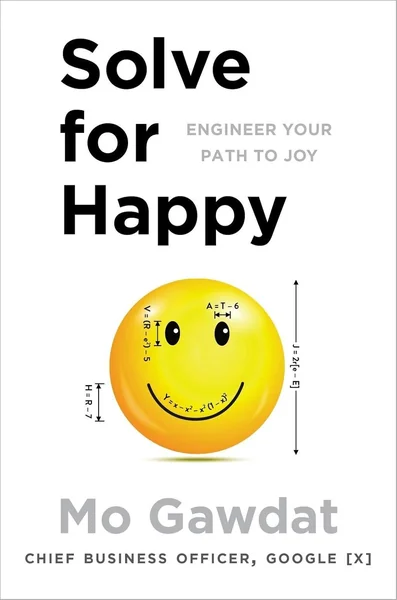
Solve for Happy by Mo Gawdat Review: A Grief-Born Engineer's Formula for Joy
Solve for Happy is a self-help non-fiction book in which Mo Gawdat, former Chief Business Officer of Google X, draws on engineering logic, neuroscience, and positive psychology — and on the shattering loss of his 21-year-old son Ali — to construct a practical framework for lasting happiness. The book argues that happiness is a default human state, blocked by six illusions, seven cognitive defects, and curable by five ultimate truths, all examined through a series of thought experiments. Sergey Brin, co-founder of Google, called it "a powerful personal story woven with a rich analysis of what we all seek in a way we can act upon."
LuvemBooks Verdict
Best for
Readers who want a self-help book that earns its optimism — specifically those who have experienced serious loss or persistent low-level unhappiness and respond best to a structured, logic-driven framework rather than motivational anecdote.
Worth it if
Worth it if you're drawn to systematic, named frameworks for self-examination — the six illusions, seven cognitive defects, five ultimate truths — and want a happiness book whose credibility is tested against genuine, devastating grief rather than mild dissatisfaction.
Skip if
Skip it if you're looking for a light, anecdote-driven pick-me-up: the engineering-style analytical scaffolding demands real intellectual engagement across 368 pages, and readers expecting passive, feel-good absorption are likely to find it a heavier commitment than anticipated.
What readers & critics say
The Guardian's profile contextualises the book as Gawdat's attempt to apply his engineer's equation for happiness to the real-world test of his son Ali's death during routine surgery, noting how the framework underpins his life after that loss. Matthewbartolo.com describes it as "more than just another self-help book" — a "thoughtful, honest guide to living through the messiness of reality" with tools that are "easy to grasp and powerful."
“Gawdat turned to the equation, which they had worked on together, in an attempt to come to terms with his tragic loss.”
— The GuardianAge & Reading Level
Recommended age
Adult
Reading level
Adult
2 content notes · who it suits
Content to know about
Skip if you're looking for a light, anecdote-driven motivational read rather than a rigorous, logic-structured framework.
In This Review
- What Works & What Doesn't
- What the Book Actually Is
- The Personal Engine at the Heart of the Argument
- Reception and Significance
- Genuine Strengths
- Who It Serves and Where It Challenges
What Works & What Doesn't
What Works
- Rare dual structure — fuses a deeply personal grief memoir with a rigorous, engineer's logical framework, giving the book both emotional weight and intellectual substance
- Concrete, named framework (six illusions, seven cognitive defects, five ultimate truths) gives readers a repeatable vocabulary for self-examination rather than vague encouragement
- Gawdat's own extraordinary test case — applying the happiness equation to the loss of his son Ali — lends the book a credibility that purely theoretical happiness writing cannot match
- Endorsed by Google co-founder Sergey Brin and marketed by Pan Macmillan as an international bestseller, reflecting broad, cross-audience appeal
- Blends neuroscience and positive psychology within an accessible narrative, giving it cross-genre utility for both analytically and emotionally motivated readers
What Doesn't
- The logic-first, engineering-style structure demands active intellectual engagement across 368 pages — readers expecting a lighter, anecdote-driven self-help read may find the analytical depth a significant commitment
- The framework's ambition — tackling illusions, cognitive defects, and ultimate truths simultaneously — means the book covers considerable ground, which may make some sections feel dense relative to others
What the Book Actually Is
The Personal Engine at the Heart of the Argument
Reception and Significance
Genuine Strengths
Who It Serves and Where It Challenges
Frequently Asked Questions
Sources & Further Reading
The key facts and claims in this review are grounded in the retrieved, verified sources listed below.
- Cited in this review
- 1
panmacmillan.com
- 2
- Further reading
- 3
Mo Gawdat, Wikipedia
- 4
marloyonocruz.com
- 5
lifeclub.org
- 6
- 7
boldwinner.com
- 8
linkedin.com
- 9
allencheng.com
- 10
simonandschuster.com
Related Reviews
Reviews of books we picked for readers who enjoyed Solve for Happy.

Reader Comments
No comments yet
Be the first to share your thoughts!