BOOKS
Published

Read Time

3 min read

Curated & edited by

LuvemBooks Editorial

How we create our reviews →
Share This Review

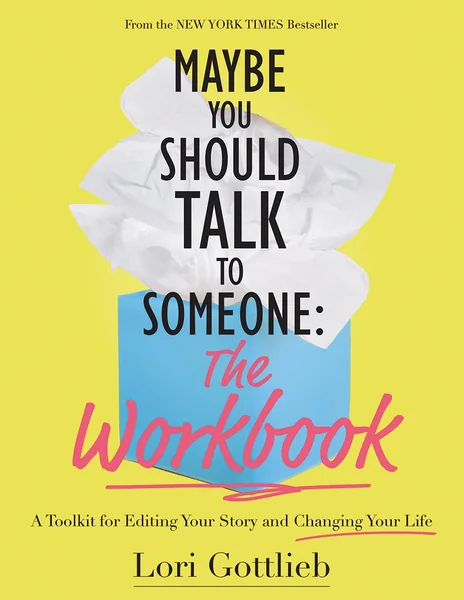
Maybe You Should Talk to Someone: The Workbook by Lori Gottlieb Review: A Structured Companion for Self-Examination

Published by PESI Publishing in November 2021, Maybe You Should Talk to Someone: The Workbook is Lori Gottlieb's structured companion to her New York Times bestselling memoir, designed to guide readers through the therapeutic concept of examining and revising their personal narratives — drawing directly on the patients and frameworks from the original book to offer exercises, writing prompts, and self-reflection tools.

LuvemBooks Verdict

Best for

Readers who found the original Maybe You Should Talk to Someone memoir deeply resonant and want a structured, self-directed way to apply its therapeutic frameworks and patient case studies to their own lives.

Worth it if

You've read the memoir, connected with the stories of John, Julie, Charlotte, and Rita, and are looking for a concrete, actionable toolkit — combining writing prompts, exercises, and reflective concepts — to turn those insights into personal self-examination.

Skip if

You haven't read the original memoir, since the workbook's patient-based examples will carry less emotional weight without that narrative context, or if you're seeking a clinical resource or a substitute for professional mental health support.

What readers & critics say

Critical reception centres on the source memoir rather than the workbook itself: Kirkus Reviews gave the memoir a starred review and called it "irresistibly addictive," praising Gottlieb's "great empathy and compassion" and her "smooth, conversational tone and frank honesty." According to Wikipedia, the memoir was also reviewed by Publishers Weekly, USA Today, Time, New Statesman, and Slate, indicating broad mainstream critical attention for the work on which this companion is built.

With great empathy and compassion, Gottlieb chronicles the many problems facing [her patients].

Kirkus Reviews

The process of psychotherapy has rarely been so thoroughly deconstructed. Gottlieb tells these stories with honesty and wit.

Stanford Magazine

Maybe You Should Talk to Someone was one of my best books of 2021. It made such an impact on me.

The Wordy Habitat

Gottlieb does a fine job of pulling back the curtain and letting readers see the inner workings of psychotherapy and the psychotherapist's mind.

Dr. Natalie Christine
Sources: Kirkus Reviews, Wikipedia, Stanford Magazine, The Wordy Habitat, Dr. Natalie Christine
4.6from 641 Amazon ratings— reader ratings, not a LuvemBooks score

Look inside the book

Preview the actual pages, via Google Books
In This Review
  • What Works & What Doesn't
  • What This Workbook Is and What It Contains
  • The Source Material That Grounds It
  • The Workbook's Design Intent and Strengths
  • Scope and Honest Limitations
  • Who This Workbook Is For

What Works & What Doesn't

What Works
  • Directly rooted in the rich patient cases and therapeutic frameworks of a New York Times bestselling memoir, giving the exercises specific, human grounding
  • Combines multiple formats — writing prompts, exercises, and reflective concepts — into a single self-directed toolkit
  • Responds directly to documented reader demand for a deeper, more actionable companion to the original memoir
  • Published by PESI Publishing, a specialist in mental health and professional education resources, lending credibility to its therapeutic framing
What Doesn't
  • Best experienced as a companion to the memoir rather than a standalone text — readers unfamiliar with John, Julie, Charlotte, and Rita may find the patient-based examples less immediately meaningful
  • As a self-directed workbook, its practical effectiveness depends entirely on the individual reader's engagement and cannot be assessed from the content description alone
Maybe You Should Talk to Someone: The Workbook is a purposeful, structured companion to Lori Gottlieb's acclaimed memoir, designed not to be read passively but worked through actively as a personal guide to self-examination.

What This Workbook Is and What It Contains

Maybe You Should Talk to Someone: The Workbook is a companion workbook to Gottlieb's memoir, Maybe You Should Talk to Someone: A Therapist, Her Therapist, and Our Lives Revealed, published by PESI Publishing in November 2021. Rather than repackaging the memoir itself, the workbook is built around a central therapeutic premise: that readers can become "editors" of their own life narratives, identifying the stories that hold them back and revising them toward more constructive ends. According to Gottlieb's own description on her website, the workbook combines eye-opening concepts, thought-provoking exercises, compelling writing prompts, and real examples drawn directly from the patients featured in the original memoir. It is explicitly framed as "an experience, a meditation, and a practical toolkit combined into one."

The Source Material That Grounds It

The memoir at the heart of this workbook was, at the time of its release, an instant New York Times bestseller that became what Gottlieb's site describes as an "international phenomenon." Kirkus Reviews named it one of the Best Books of 2019, calling it "irresistibly addictive" and "a vivacious portrait of a therapist from both sides of the couch." The memoir itself drew on Gottlieb's dual position — as a practicing psychotherapist navigating patients including John, a self-assured producer convinced everyone around him is the problem; Julie, a newly married young woman facing a cancer diagnosis; Charlotte, a twenty-something caught in cycles of unhealthy relationships and excessive drinking; and Rita, a retired teacher contemplating whether life is worth continuing — while simultaneously undergoing her own therapy with a therapist named Wendell following a painful and unexpected breakup. Kirkus praised the memoir's "smooth, conversational tone and frank honesty," as well as its capacity to let readers "eavesdrop" on genuine human crises with both humor and compassion. The workbook is rooted in that same cast of real cases and the therapeutic insights they generated.

The Workbook's Design Intent and Strengths

The workbook's central organizing idea — that people carry internal narratives that shape their behavior and wellbeing, and that those narratives can be examined and changed — is drawn directly from the therapeutic framework Gottlieb illustrates in the memoir. According to the publisher's description, the guide is structured to take readers through a journey of self-reflection using the same patient stories and concepts that resonated with the memoir's millions of readers. Gottlieb's website notes that as readers of the memoir "highlighted and underlined page after page," they asked for a guide as transformative as the book itself — and the workbook was created in direct response to that demand. Its design intent is to translate the insights of professional therapy into a self-directed, accessible format for a general audience.

Scope and Honest Limitations

Because this is a functional, self-directed workbook, its real value lies in how well its exercises work in practice for individual users — something that can only be assessed through hands-on use, not through editorial description alone. This review reflects the workbook's content and design as described by published sources, not a tested application of its methods. What can be said with confidence is that the workbook is explicitly positioned as a companion to the memoir rather than a standalone text: readers who have not read Maybe You Should Talk to Someone the memoir may find the references to John, Julie, Charlotte, and Rita less immediately resonant, since the workbook draws on those patient narratives as illustrative anchors. Readers approaching the workbook cold, without the emotional and narrative context the memoir provides, may get less from those grounding examples.

Who This Workbook Is For

The workbook is squarely aimed at readers who connected deeply with the memoir and want a structured way to apply its lessons to their own lives. It is designed for general readers interested in self-reflection and personal growth, not as a clinical tool for therapists or a replacement for professional mental health support. Given that its source memoir earned broad praise for its accessibility — Kirkus highlighted Gottlieb's ability to make readers "identify with the author as both a mid-40s single mother and a perceptive, often humorous psychotherapist" — the workbook is positioned to reach the same wide audience of people drawn to the intersection of storytelling and psychological insight. For those who found the original memoir transformative and wanted more, this companion offers a concrete next step.

Sources & Further Reading

The key facts and claims in this review are grounded in the retrieved, verified sources listed below.

  1. 1

    Lori Gottlieb, Wikipedia

  2. 2
  3. 3
  4. 4
  5. 5
  6. 6
  7. 7
  8. 8
  9. 9